906-second window · 3 observations · Measured Oct 6, 2026, 12:56 PM UTC · Provider: go_recent_snapshot_v2
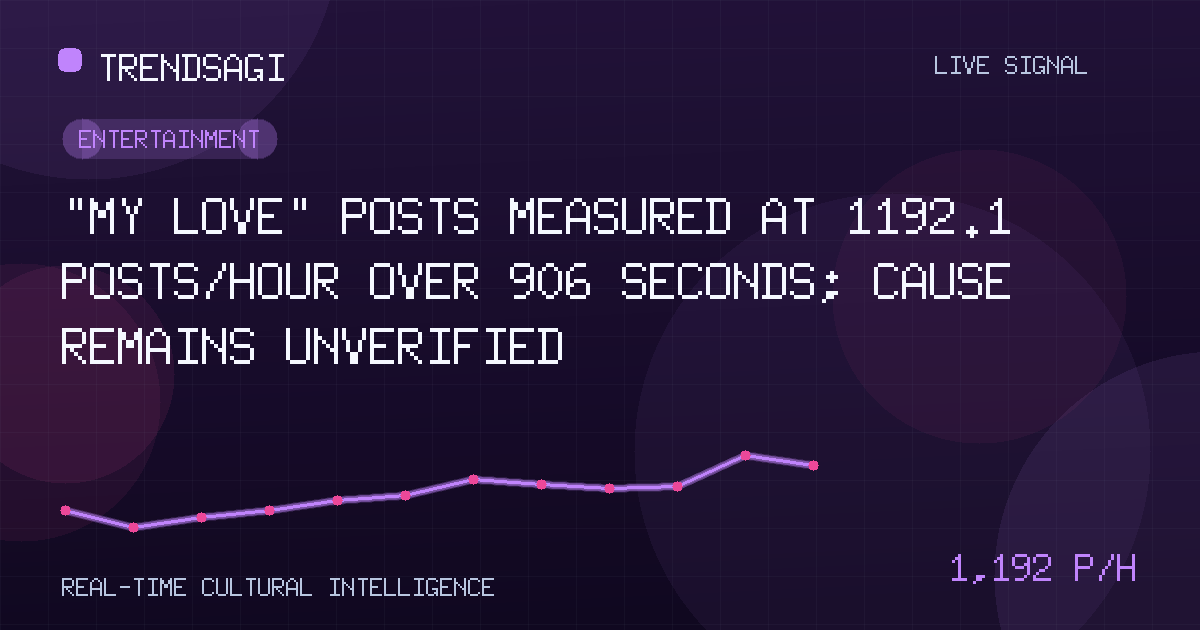
"My Love" posts measured at 1192.1 posts/hour over 906 seconds; cause remains unverified
The latest "My Love" snapshot has 4800 posts and a measured 1192.1 posts/hour rate; readers should not infer reach or an unverified cause.
Automated briefing. Generated from stored signal measurements and source-backed research; it is not manually reviewed. Read the methodology and limitations.
Metrics in this briefing are a snapshot associated with its publication date and may not reflect current conditions.
What changed
The clearest conclusion is that posts labeled "My Love" were moving rapidly during a narrow observed window, but their trigger is not established. The latest snapshot contains 4800 posts, a count of collected posts rather than unique authors, reactions, reach, or people.
At 2026-10-06T12:56:32Z, the recorded measured change was 1192.1 posts/hour over an exact 906-second window using 3 stored observations. This is a measured snapshot rate, not a live or current rate, forecast, engagement total, or continuation estimate. It shows intensity within the observed window but does not identify a cause.
| Observation time | Measured snapshot rate | Snapshot volume |
|---|---|---|
| 2026-10-06T12:56:32Z | 1192.1 posts/hour | 4800 posts |
Why this topic may be moving
No verified public context accompanies this signal. The label carries no event description, and its Entertainment classification does not identify a particular work or event. "My Love" can be applied to different subjects, so the collection may combine conversations that readers would consider separate. A representative sample of the posts is needed before treating the label as one cultural event.
The rate establishes intensity within the monitored label, not its cause. Several explanations remain open and should be treated as hypotheses rather than findings:
- A release, episode, appearance, announcement, or controversy may have supplied a focal point, but no such trigger has been verified here.
- A highly active account or network may have repeated the same wording, making the label appear broader than its human audience.
- A change in the query or collection process may have increased visibility without an equivalent change in underlying conversation.
- Generic wording may have drawn several unrelated conversations into the same bucket.
Why it matters
For entertainment editors and communications teams, this is an entity-resolution problem before it is a story about a breakout. The first task is to determine whether the posts point to a specific title, person, incident, or several unrelated uses. A high short-window count can make an ambiguous phrase look like a single event and lead to a premature causal headline.
The signal can establish observed volume and short-term movement for the exact monitored label. It cannot, by itself, establish who posted, whether the accounts are independent, where the activity occurred, how many people were involved, or whether the activity was spontaneous. It also does not measure sentiment or authentic audience interest.
A measured spike is a prompt to investigate, not proof that a particular release, celebrity, controversy, or audience behavior caused it.
Audience researchers and trust analysts should care because account concentration, repeated wording, or unstable collection can change the interpretation of a trend. For ordinary readers, the defensible takeaway is limited: the label showed rapid measured activity in this snapshot, while its cultural meaning and cause remain unresolved.
What to watch next
Before assigning a cause or presenting the movement as a broad cultural shift, run these practical checks:
- Resolve the label. Review representative posts from across the exact observation window. Record what each post refers to and whether the phrase is a title, quotation, character name, campaign term, or ordinary expression.
- Reconstruct the sequence. Compare individual post timestamps with the timing of any proposed announcement or event. A verified event that follows the acceleration cannot by itself explain the earlier activity.
- Test distribution quality. Inspect repeated text, copied posts, account concentration, and timestamps that may indicate batch collection or automated behavior. None of these explanations should be assumed without evidence.
- Find durable public context. Look for a first-party announcement and independent coverage that identify the same subject. A credible explanation should connect the named trigger to the observed label rather than rely on the phrase alone.
- Compare adjacent windows and surfaces. Check whether the movement persists beyond the exact 906-second period and whether it appears across different platforms, accounts, and locations. A narrow spike is different from sustained cross-platform attention.
Concrete watch signals
Several observable outcomes would materially improve or weaken the current interpretation:
- Entity convergence: Sampled posts increasingly refer to the same identifiable work, person, or event rather than to the phrase in unrelated contexts.
- Trigger alignment: A verified announcement or publication appears before, or at the start of, the acceleration and explicitly concerns the same entity.
- Cross-surface spread: Similar activity becomes visible on multiple platforms and in separate geographic or language groups, supporting a broader audience phenomenon.
- Account distribution: Activity is distributed across independent accounts rather than dominated by repeated posts from a limited set.
- Persistence: The measured rate remains elevated after the original exact 906-second window, distinguishing a sustained movement from a brief burst.
- Collection stability: Raw post volume remains elevated without changes to the query, tracking method, or ingestion process.
Methodology and limitations
This briefing uses the latest snapshot of 4800 posts and the supplied measured change of 1192.1 posts/hour. That rate was measured at 2026-10-06T12:56:32Z over an exact 906-second window using 3 stored observations. The two figures answer different questions: snapshot volume describes the size of the observed collection, while posts per hour describes its measured short-window rate.
The short observation period and limited number of observations provide a narrow view of activity. Boundary effects, a concentrated publishing event, or a collection batch could influence the result, so the measurement should not be treated as a long-term baseline. The ambiguous label creates an additional risk: unrelated conversations may inflate the apparent scale of a single subject.
No verified external trigger is attached to the measurement, so a causal explanation would be speculative at this stage. The next update should preserve the exact observation time, separate volume from rate, disclose any collection changes, examine account-level composition, and add verified public context before explaining why the topic moved.
Track This Topic for New Signals
Set alerts for future velocity or sentiment changes around this topic.
Explore Tracking PlansAbout TrendsAGI research
TrendsAGI's automated research pipeline publishes dated signal snapshots, methodology notes, and practical workflows for teams evaluating cultural momentum. Read how signals are scoped, scored, and limited in our research methodology.