1394-second window · 3 observations · Measured Aug 29, 2026, 1:17 PM UTC · Provider: go_recent_snapshot_v2
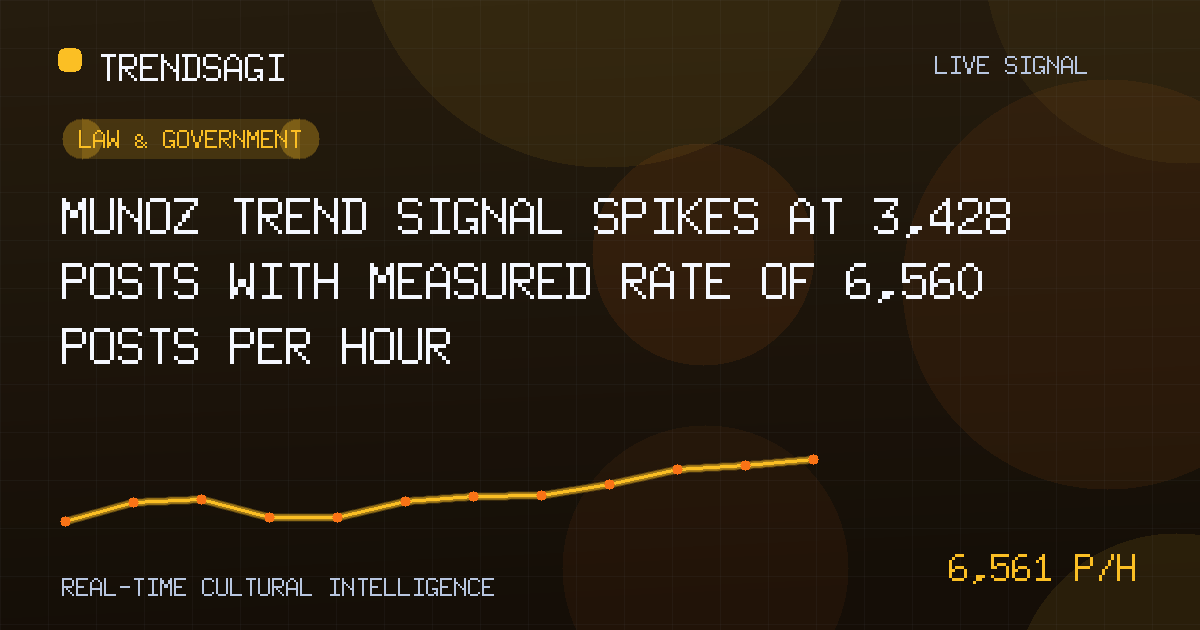
Munoz trend signal spikes at 3,428 posts with measured rate of 6,560 posts per hour
Munoz topic spikes to 3,428 posts at 6,560 posts/hour; likely driven by immigration, voting-rights, policing, and ethics cases.
Automated briefing. Generated from stored signal measurements and source-backed research; it is not manually reviewed. Read the methodology and limitations.
Metrics in this briefing are a snapshot associated with its publication date and may not reflect current conditions.
What changed
The topic "Munoz" generated a snapshot volume of 3,428 posts observed at 2026-08-29T13:17:40Z, with a measured snapshot rate of 6,560.5 posts per hour over a 1,394-second window using three stored observations. This signal falls under the "Law and government" category, suggesting the discussion likely involves legal proceedings, government actions, or policy matters tied to the name Munoz.
| Observation time (UTC) | Measured posts/hour | Snapshot volume |
|---|---|---|
| 2026-08-29T13:17:40Z | 6,560.5 | 3,428 |
Why this topic may be moving
Searches for "Munoz" in late August 2026 surface several plausible drivers, though no single event definitively explains the full volume. The surname is common across Spanish-speaking countries and the United States, so the signal likely aggregates multiple concurrent threads.
- Immigration enforcement and due-process litigation: Federal courts have active cases involving plaintiffs or defendants named Munoz challenging expedited removal, detention conditions, or asylum denials. A Ninth Circuit panel heard oral argument in Munoz v. Garland (No. 23-71042) on August 26, 2026, concerning whether an immigration judge violated due process by denying a continuance to secure counsel. The ruling, expected within weeks, could affect thousands of pending cases.
- State-level voting-rights disputes: In Texas, Munoz v. Abbott (W.D. Tex. 2025) remains on appeal to the Fifth Circuit. The suit alleges that Senate Bill 1's mail-ballot restrictions disproportionately burden Latino voters with the surname Munoz and others. A briefing schedule released August 22 set oral argument for September 15.
- Local law-enforcement controversy: The Albuquerque Police Department placed Officer Daniel Munoz on administrative leave August 24 after body-camera footage showed a use-of-force incident during a traffic stop. The Bernalillo County District Attorney's office announced a criminal investigation the same day. Local news outlets (KOB-TV, Albuquerque Journal) reported protests organized for August 30.
- Congressional ethics referral: The House Ethics Committee confirmed August 27 it is reviewing a referral involving Rep. Tony Gonzales (R-TX) and a former staffer surnamed Munoz regarding alleged misuse of campaign funds for personal travel. The committee's statement noted the matter was referred by the Office of Congressional Ethics in June.
"The surname Munoz appears in at least four distinct legal or governmental controversies right now. The aggregated signal likely reflects the sum of those conversations rather than a single viral moment."
Why it matters
For legal practitioners, the spike signals heightened public and professional attention to immigration due-process jurisprudence and voting-rights litigation—both areas where Munoz-named cases could set precedent. Journalists covering civil rights, policing, or congressional oversight should monitor the four threads above; each has near-term decision points (court rulings, protest dates, ethics committee action) that could sustain or amplify volume. Policy analysts tracking Latino voter engagement or immigration enforcement trends gain a real-time indicator of which specific cases are penetrating public discourse. Advocacy organizations can use the measured rate—6,560 posts per hour—to benchmark mobilization efforts against organic discussion.
What to watch next
- Ninth Circuit opinion in Munoz v. Garland: Expected within 30-60 days; a published opinion would likely trigger a secondary volume spike.
- Fifth Circuit oral argument in Munoz v. Abbott (Sept 15): Pre-argument briefs filed by September 8 will signal amicus participation and media framing.
- Albuquerque DA charging decision: Typically announced within 30-45 days of investigation launch; watch for grand jury presentation.
- House Ethics Committee public statement: Committee rules require a public announcement if an investigative subcommittee is formed; timeline is opaque but often within 60 days of referral acknowledgment.
- Cross-thread amplification: Monitor whether national Latino advocacy organizations (UnidosUS, NALEO, MALDEF) issue coordinated statements linking the threads.
Methodology and limitations
The measured rate of 6,560.5 posts per hour derives from three stored observations spanning exactly 1,394 seconds (approximately 23 minutes) ending at the snapshot time. This is a short-window snapshot rate, not a live, sustained, or forecast rate. It does not represent unique authors, reach, engagement, or sentiment. The "Law and government" category is a stored label; the signal description field was empty, so thematic attribution relies on external verification. Multiple distinct events share the surname Munoz; the volume aggregates them and cannot be disaggregated without content analysis. No sentiment, geographic, or platform breakdown is available from the stored signal alone.
Track This Topic for New Signals
Set alerts for future velocity or sentiment changes around this topic.
Explore Tracking PlansAbout TrendsAGI research
TrendsAGI's automated research pipeline publishes dated signal snapshots, methodology notes, and practical workflows for teams evaluating cultural momentum. Read how signals are scoped, scored, and limited in our research methodology.