15-minute window · 3 observations · Measured Oct 3, 2026, 11:36 PM UTC · Provider: go_recent_snapshot_v2
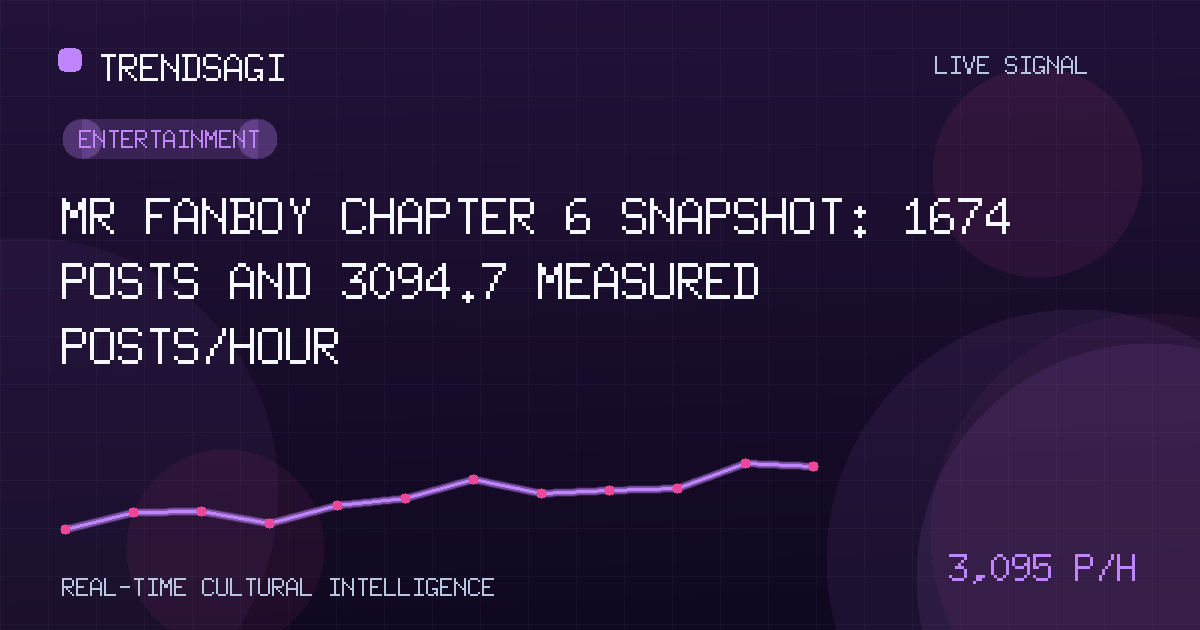
MR FANBOY CHAPTER 6 snapshot: 1674 posts and 3094.7 measured posts/hour
The stored signal records 3094.7 posts/hour and 1674 posts for “MR FANBOY CHAPTER 6”; why the activity surged remains unverified.
Automated briefing. Generated from stored signal measurements and source-backed research; it is not manually reviewed. Read the methodology and limitations.
Metrics in this briefing are a snapshot associated with its publication date and may not reflect current conditions.
What changed
The stored signal for “MR FANBOY CHAPTER 6” records a sharp increase in posts carrying that exact label, with the latest snapshot showing 1674 posts. The direct conclusion is that activity attached to the label surged during the measured window; it is not yet evidence that an official chapter release, controversy, or broader cultural event caused the increase. The stored description is empty, and no verified public catalyst accompanies the record, so why the topic is moving remains unclear.
The supplied change measurement is 3094.7 posts/hour over an exact 900-second window using 3 stored observations, timestamped 2026-10-03T23:36:46Z. That is a measured snapshot rate, not a live or current rate, forecast, reach, engagement figure, or unique-person count. It must also remain separate from the latest snapshot volume of 1674 posts.
| Observation time | 2026-10-03T23:36:46Z |
|---|---|
| Measured snapshot rate | 3094.7 posts/hour |
| Measurement window | Exact 900-second window using 3 stored observations |
| Latest snapshot volume | 1674 posts |
Why this topic may be moving
The label points to a chapter-related conversation, but the record does not identify the work, creator, publisher, platform, or event. Several ordinary mechanisms could produce this pattern: a new installment becoming available; a creator or account prompting reactions; a scene, character, or plot point prompting discussion; a controversy drawing attention; or a wave of reposts and templated comments. These are hypotheses for investigation, not verified explanations.
Exact-label measurement also creates ambiguity. “MR FANBOY” could be part of a title, a character or account reference, or wording used by a community. Without representative post text or verified links, the 1674-post snapshot cannot show which interpretation dominates. A coordinated duplicate, a quote post, a reaction image, or automated activity could contribute volume without representing broad independent interest.
No verified announcement, release page, episode listing, creator post, or news report is present in the available context. Accordingly, the cause should be reported as unresolved rather than attached to a speculative trigger.
What the signal can and cannot establish
The strongest supported finding is methodological: posts associated with the exact label changed at the supplied measured snapshot rate during the stated window. That is enough to flag the label for review and compare it with later observations. The category assignment, “Entertainment,” also indicates where the signal was filed, but does not verify the underlying story context.
A measured posting change can justify investigation without proving the identity, origin, organic character, or cultural importance of the conversation.
The signal cannot establish how many distinct authors posted, whether the posts were original or duplicated, how many people saw them, or whether reactions were positive, negative, or neutral. It does not supply sentiment, geography, audience demographics, source quality, or a normal historical baseline. Because the calculation uses 3 stored observations across an exact 900-second window, it can capture a concentrated burst without showing whether attention persisted afterward.
Nor does the latest snapshot volume establish that 1674 different people participated. It is a stored post count for the label at the observation time, not evidence of 1674 unique voices. Nor does the rate indicate that the same pace will continue after the snapshot.
Why it matters
For writers, creators, publishers, and fan communities, the signal may flag a conversation that deserves prompt contextual review. If the topic is tied to a new installment, the burst could help teams understand where fans are gathering and what language they are using. If it is not, the same volume could create publishing, moderation, or brand-safety workload without indicating meaningful audience demand.
Media and trend analysts should avoid presenting the measurement as proof of a mass event. Decision-makers should wait for a verified source and evidence that discussion is distributed beyond repeated copies. Fans looking for a chapter should treat the label as a lead, not confirmation that a new chapter is officially available; the primary release or creator record should be checked directly.
What to watch next
- Verified catalyst: Look for an official creator, publisher, chapter listing, or dated announcement that predates the earliest posts in the cluster. Confirm the title and installment before describing the activity as a release reaction.
- Earliest useful posts: Inspect the first qualifying posts rather than the most repeated ones. Determine what text, image, quotation, or link appears at the start of the chain and whether an identifiable source prompted it.
- Authorship and duplication: Compare representative posts for repeated wording, synchronized timing, recycled media, and profile overlap. This helps separate independent conversation from a repost cascade, coordinated promotion, or automated posting.
- Persistence: Check a later comparable observation. A falling rate would weaken a sustained-interest interpretation; continued activity at a similar measured snapshot rate would make persistence more plausible. Either outcome should be reported only for the relevant window.
- Topic drift: Track newly co-occurring names, places, plot terms, and questions. Terms tied to a specific story can clarify the subject, while unrelated or spam-like terms would point to label ambiguity or low-quality volume.
- Community health: Watch for accusation, harassment, misinformation, or calls to mobilize. A high-volume reaction may be notable for moderation even if it is not evidence of a broad positive trend.
Methodology and limitations
This briefing uses the canonical Entertainment-category snapshot observed at 2026-10-03T23:36:46Z. The latest snapshot volume is 1674 posts. The supplied measured snapshot rate is 3094.7 posts/hour, based on 3 stored observations across an exact 900-second window. No values have been recalculated or extrapolated.
The available record does not include raw posts, source links, account-level data, earlier comparison levels, or verified public context explaining the movement. As a result, the signal supports a conclusion about label-level posting change, but not a conclusion about an official release, public sentiment, unique participation, organic reach, or causation. The next editorial update should either attach a verified catalyst and describe how it connects to the earliest posts, or retain the explicit uncertainty.
Track This Topic for New Signals
Set alerts for future velocity or sentiment changes around this topic.
Explore Tracking PlansAbout TrendsAGI research
TrendsAGI's automated research pipeline publishes dated signal snapshots, methodology notes, and practical workflows for teams evaluating cultural momentum. Read how signals are scoped, scored, and limited in our research methodology.