895-second window · 2 observations · Measured Sep 26, 2026, 8:56 AM UTC · Provider: go_recent_snapshot_v2
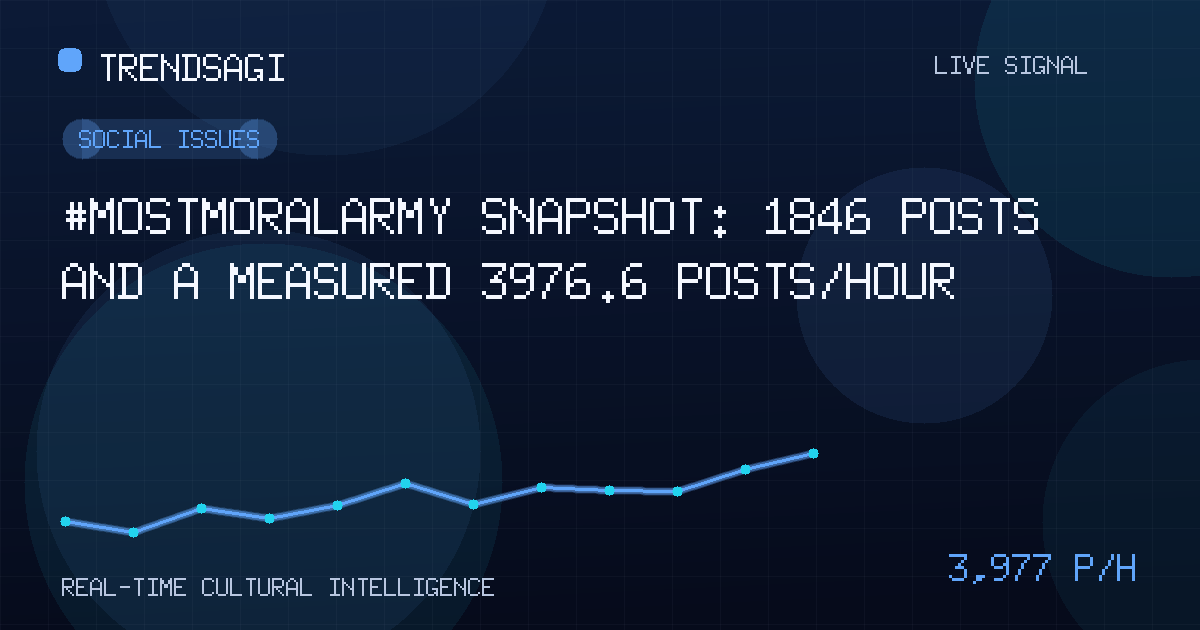
#MostMoralArmy snapshot: 1846 posts and a measured 3976.6 posts/hour
The stored #MostMoralArmy snapshot contains 1846 posts and a 3976.6 posts/hour measured rate; the cause remains unverified.
Automated briefing. Generated from stored signal measurements and source-backed research; it is not manually reviewed. Read the methodology and limitations.
Metrics in this briefing are a snapshot associated with its publication date and may not reflect current conditions.
What changed
The stored #MostMoralArmy signal shows a concentrated posting burst: the latest snapshot contains 1846 posts, and the measured snapshot rate is 3976.6 posts/hour. That rate was measured over an exact 895-second window using 2 stored observations, with the measurement recorded at 2026-09-26T08:56:10Z. It is a measured snapshot rate, not a live or current rate, forecast, reach, engagement, or unique-person count.
| Measure | Stored value |
|---|---|
| Snapshot observation time | 2026-09-26T08:56:10Z |
| Measured snapshot rate | 3976.6 posts/hour |
| Exact rate window | 895 seconds |
| Stored observations used | 2 |
| Latest snapshot volume | 1846 posts |
The direct read is that #MostMoralArmy was moving rapidly within the observed interval, but the cause is not established by the stored record. No specific news event, campaign, organization, or public figure is verified as the trigger. The available classification, Social Issues, identifies a broad editorial category rather than the subject of the conversation or the identity of participants.
Why this topic may be moving
No verified public context accompanies the signal, and the topic has no explanatory description in the stored record. The cause therefore remains unclear. It would be premature to attribute the burst to a news event, celebrity post, protest, advertising campaign, or platform intervention without attributable evidence.
Several mechanisms could produce the same observed pattern: an external trigger could prompt original posts; a challenge or movement could mobilize repeated participation; prominent accounts could amplify a phrase already in use; and duplicate, automated, or coordinated activity could contribute to the post count. These are hypotheses to test, not verified explanations. The snapshot cannot distinguish a temporary cascade from sustained interest, nor tell whether participants agree with the label.
Until representative posts are inspected, even the referent is unresolved. MostMoralArmy could name a campaign, community, role-play, or reused phrase; the label alone does not show which. A trend team should resolve that wording before drawing conclusions about public sentiment or institutional conduct.
Key distinction: The stored evidence can establish that posting accelerated within the measured window; it cannot establish why, who drove the acceleration, or whether the activity represented genuine public support.
Why it matters
This signal is useful mainly as a prompt for rapid verification. A high measured posting rate can matter even when its cause is unknown, but volume alone is vulnerable to being mistaken for popularity or consensus.
- Newsrooms and communications teams: Check whether the label refers to their organization, a person, or an issue before amplifying or responding.
- Researchers and analysts: Preserve the measurement definition and add observations; otherwise a short burst may be misread as a durable shift.
- Trust and safety teams: Review coordination, harassment, misinformation, or synthetic repetition if content sampling raises those concerns.
- Participants and audiences: Treat the snapshot as evidence of attention, not endorsement, truth, or a verified account of events.
That uncertainty changes the appropriate response. Verify the label and possible trigger before assessing content and coordination, then decide whether public communication, moderation, or further monitoring is warranted. Speed is a reason to check, not a reason to issue a conclusion.
What to watch next
- Durability: Collect subsequent snapshots with the same query and comparable windows. Determine whether elevated posting persists, recedes, or reappears; do not compare the 1846-post volume directly with a posts/hour rate.
- Trigger: Inspect the earliest available substantive posts and attributable posts from verified accounts around the measured window. Look for an announcement, news report, campaign prompt, or evidence that no identifiable trigger existed.
- Composition: Classify a representative sample as original posts, quotes, reposts, mentions, or duplicates. Check author-level counts if the underlying data permits, distinguishing broader participation from repeated publication.
- Coordination and authenticity: Look for repeated wording, synchronized bursts, reused media, account-age patterns, and unusual posting cadence. Treat these as indicators requiring review, not standalone proof of automation.
- Diffusion: Track co-occurring hashtags, phrase variants, languages, regions, and verified publishers. Changes in these dimensions may reveal the developing narrative or a shift in measurement coverage.
- Risk and response: Monitor for unsupported factual claims, harassment, doxxing, or an identifiable organization being targeted. Record platform labels, material corrections, and any authoritative response.
Methodology and limitations
The measured rate is reported as supplied and has not been recalculated. The latest snapshot volume is 1846 posts; the measured change is 3976.6 posts/hour over 895 seconds using 2 stored observations at 2026-09-26T08:56:10Z. These quantities are not interchangeable.
The record lacks a longer baseline, a definition of collection coverage, deduplication rules, geography, language mix, author counts, and content-level sampling. It therefore cannot establish normal activity, duration, peak status, sentiment, authenticity, organic reach, or conditions after the snapshot. With only 2 observations, there is also no basis for a smooth trend line or forecast.
The topic label is a retrieval key, not a verified description of the claims inside the posts. The Social Issues tag is a taxonomy assignment, not evidence of a particular ideology, incident, or campaign. Representative content review is therefore essential before interpretation. The defensible finding is narrow: #MostMoralArmy had a measured posting burst in the observed window, and its cause remains unverified.
Track This Topic for New Signals
Set alerts for future velocity or sentiment changes around this topic.
Explore Tracking PlansAbout TrendsAGI research
TrendsAGI's automated research pipeline publishes dated signal snapshots, methodology notes, and practical workflows for teams evaluating cultural momentum. Read how signals are scoped, scored, and limited in our research methodology.