1149-second window · 2 observations · Measured Aug 26, 2026, 12:45 AM UTC · Provider: go_recent_snapshot_v1
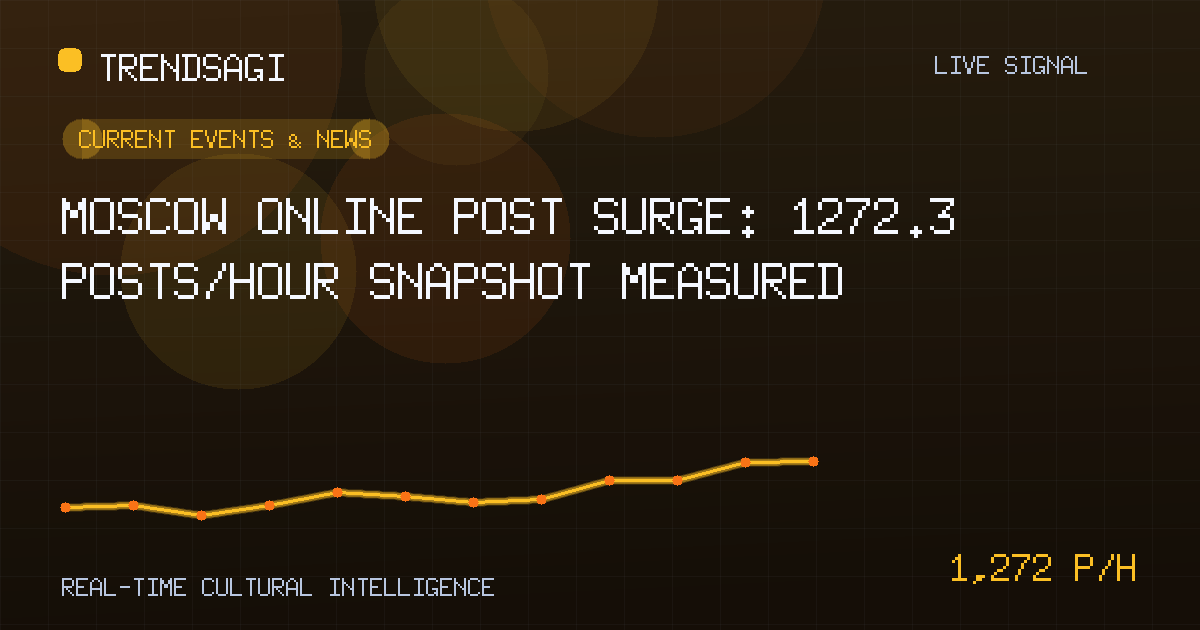
Moscow Online Post Surge: 1272.3 Posts/Hour Snapshot Measured
A measured spike in Moscow-related online posts at 1272.3 posts/hour suggests increased attention, useful for monitoring law and government trends, though
Automated briefing. Generated from stored signal measurements and source-backed research; it is not manually reviewed. Read the methodology and limitations.
Metrics in this briefing are a snapshot associated with its publication date and may not reflect current conditions.
What changed
A significant increase in online posts mentioning Moscow has been observed, with a measured snapshot rate of 1272.3 posts per hour as of August 26, 2026, at 00:45:32 UTC. This rate is derived from a 1149-second window using two stored observations, and the latest snapshot contained 406 posts. This surge indicates a rapid rise in discussions or reports centered on Moscow, falling under the category of law and government.
| Observation Time | Measured Posts/Hour | Snapshot Volume |
|---|---|---|
| 2026-08-26T00:45:32Z | 1272.3 | 406 posts |
Why this topic may be moving
The exact cause for this spike in posts about Moscow is unclear from the stored signal alone, as no verified public context is currently linked. However, given the category "Law and government," potential triggers could relate to recent legal or governmental events in Russia or internationally involving Moscow. For instance, it might coincide with:
- Major policy announcements or legislative changes in the Russian government.
- International diplomatic summits or negotiations where Moscow is a focal point.
- High-profile legal cases or court rulings that attracted media coverage.
- Public statements from officials or leaks that sparked online debate.
Without additional verification, these remain speculative. The surge could also stem from coordinated campaigns, automated posts, or viral content, but the signal does not specify. Historical patterns in Moscow-related trends often align with political cycles, sanctions discussions, or security incidents, but one must avoid assumptions.
Why it matters
This trend is significant for professionals monitoring law, government, and geopolitics, as online activity can foreshadow real-world developments or public sentiment shifts. For journalists and analysts, it serves as an early warning signal to investigate potential stories. Policymakers might use such data to gauge international attention on Russia-related issues. Additionally, businesses with interests in the region could assess reputational or operational risks.
The measured rate of 1272.3 posts/hour is a snapshot of activity at a specific time and does not necessarily represent sustained engagement, unique individuals, or reach—it is purely a volume-based metric from stored observations.
However, readers should note that online spikes do not always correlate with importance; they can be ephemeral or misleading. The value lies in using this as a starting point for deeper analysis rather than a definitive indicator.
What to watch next
To contextualize this trend, consider practical next steps:
- Monitor news sources: Check reputable outlets like Reuters, BBC, or TASS for any breaking news from Moscow around this date, focusing on legal or governmental actions.
- Analyze post content: If accessible, review the posts for recurring themes, such as mentions of specific laws, politicians, or events.
- Track temporal patterns: Observe if the rate stabilizes, increases, or drops in the hours following the snapshot, which could indicate a short-term flurry or a sustained trend.
- Cross-reference data: Look for corroborating signals from other topics or regions to see if this is part of a broader pattern.
- Check official channels: Review statements from the Russian government, international organizations, or embassies for clarifications.
These checks can help distinguish between noise and meaningful movement, ensuring decisions are based on verified context.
Methodology and limitations
This briefing is based on a canonical stored signal with untrusted data, and all values are treated as such. The measured change rate of 1272.3 posts/hour was calculated using two stored observations over a 1149-second window, providing a snapshot rate at the specified time. The snapshot volume of 406 posts is a count at that moment and should not be confused with a rate or engagement metric.
Key limitations include:
- No external verification has been conducted to determine the cause of the surge; public context is not yet linked.
- The data originates from a single source and may not represent the full scope of online activity about Moscow.
- The rate is a point-in-time measurement and can fluctuate rapidly; it is not a forecast or a measure of unique users.
- Stored signal descriptions are empty, limiting initial interpretive depth.
Readers are advised to use this as an initial signal and seek additional sources, such as news reports or expert analyses, for confirmation. Future updates should focus on integrating verified context to refine insights.
Track This Topic for New Signals
Set alerts for future velocity or sentiment changes around this topic.
Explore Tracking PlansAbout TrendsAGI research
TrendsAGI's automated research pipeline publishes dated signal snapshots, methodology notes, and practical workflows for teams evaluating cultural momentum. Read how signals are scoped, scored, and limited in our research methodology.