908-second window · 3 observations · Measured Oct 3, 2026, 5:41 AM UTC · Provider: go_recent_snapshot_v2
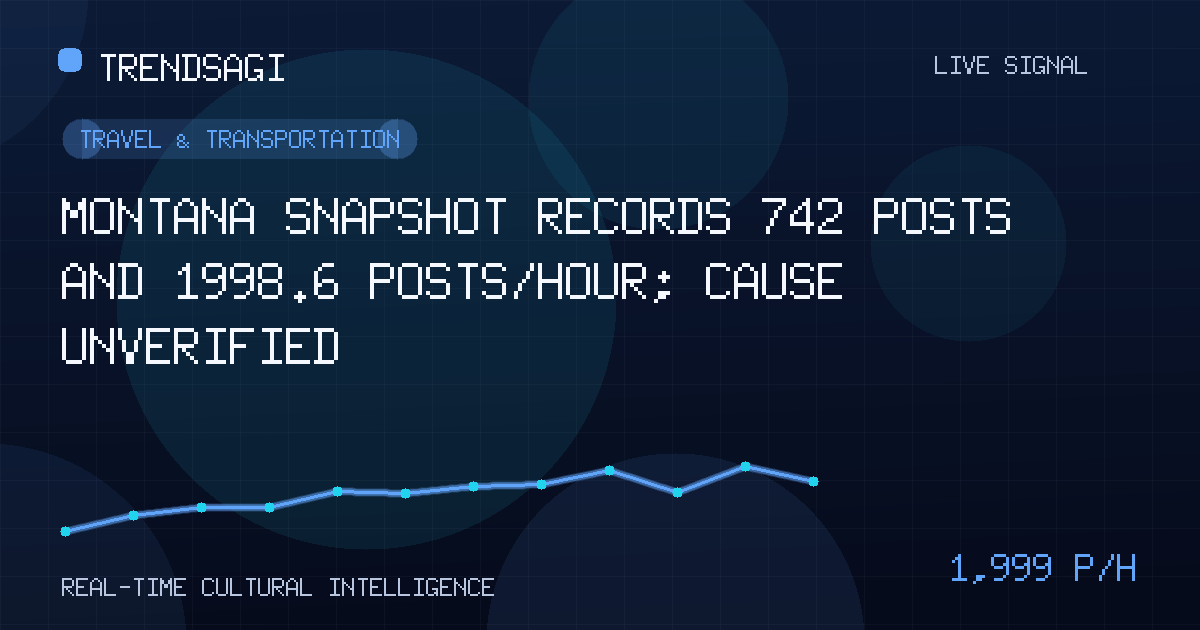
Montana snapshot records 742 posts and 1998.6 posts/hour; cause unverified
Montana's stored snapshot has 742 posts and a measured 1998.6 posts/hour rate; the cause is unverified, helping readers assess persistence and relevance.
Automated briefing. Generated from stored signal measurements and source-backed research; it is not manually reviewed. Read the methodology and limitations.
Metrics in this briefing are a snapshot associated with its publication date and may not reflect current conditions.
What changed
The latest stored signal records a measured snapshot rate of 1998.6 posts/hour around the broad label “Montana” in the Travel & Transportation category, but no verified catalyst is identified. The observation contains 742 posts. The direct conclusion is rapid posting activity in this monitored sample with an unexplained cause—not evidence that Montana is experiencing a live crisis, a tourism surge, or increased travel demand.
| Observation time | Measured snapshot rate | Snapshot volume |
|---|---|---|
| 2026-10-03T05:41:53Z | 1998.6 posts/hour | 742 posts |
The measured change rate covers an exact 908-second window using 3 stored observations, with the latest snapshot observed at 2026-10-03T05:41:53Z. It is a retrospective, sample-specific rate—not a live/current rate, forecast, reach, engagement metric, or count of unique people. The 742 figure is snapshot volume and must not be treated as a rate. Because the record provides no baseline, it also cannot establish whether 1998.6 posts/hour is unusual for this topic, normal for the observation period, or elevated because the platform’s overall activity increased.
Why this topic may be moving
Nothing in the stored record identifies a triggering public event, and no external event has been verified here. The cause therefore remains unclear. Several mechanisms could produce the same posting pattern, but none is established by the available evidence:
- A genuine news event could prompt many independent posts in a short window.
- A destination-marketing item, creator post, or scheduled promotional campaign could be copied widely.
- A recommendation-system shift, keyword-classification change, or collection issue could increase captured volume without a corresponding change in human attention.
- Quoted posts, duplicated stories, or automated reposting could inflate the corpus while representing fewer original discussions.
The topic label is also broad. Within a travel category, Montana could be a destination, an origin, a stop, or simply a word appearing in unrelated content. The category assignment does not prove geographic relevance, post-level subject, sentiment, or travel intent. Even a verified increase in posts would not, by itself, establish any of those things.
A posts-per-hour value is a reason to inspect the corpus, not a verified explanation. Until the posts cluster around one corroborated event, the responsible description remains unexplained activity around a broad topic label.
Why it matters
The signal is useful primarily as a monitoring trigger. If the activity persists and proves locally relevant, it could matter to destination operators, transportation providers, public-information teams, and editors preparing rapid responses. The current record does not justify operational action on its own, but it does justify checking whether a real-world issue is being amplified.
- Tourism businesses should distinguish general social attention from actionable evidence about booking interest, cancellations, staffing, or visitor questions.
- Air, rail, road, and local transit operators should look for a matching cluster of service, route, safety, or access-related posts before changing public communications.
- Montana public agencies and destination organizations should monitor for repeated questions or localized concerns rather than treating the aggregate label as evidence of an incident.
- Journalists and trend analysts should seek primary confirmation and avoid presenting an unexplained posting burst as a verified event.
What to watch next
The next useful step is a compact audit that tests whether the signal is persistent, relevant, concentrated, or externally explained.
- Validate the matching sample. Inspect the query or classifier that produced the label and review representative raw posts. Confirm that “Montana” is the intended proper name, that each item is genuinely relevant, and that formatting differences are not creating duplicates.
- Test persistence. Add subsequent snapshots using the same 908-second measurement method. Treat 1998.6 posts/hour as one observed benchmark, not a threshold or forecast. Repeated comparable readings would support sustained attention; a quick return to prior levels would be more consistent with a short burst.
- Normalize the signal. Compare Montana with total activity in the monitored corpus, the same category, and comparable geographic topics. A platform-wide increase should not be mislabeled as a Montana-specific trend.
- Locate concentration. Measure how much activity comes from the top accounts, domains, or original posts; separate original material from quotes and reposts; and determine whether posting is broadly distributed or driven by a small set of sources.
- Classify the subthemes. Code the actual post text for destination discussion, transport operations, weather, public safety, politics, and unrelated uses of the name. Add sentiment and geographic evidence only where the records support them.
- Verify a candidate catalyst. Search distinctive wording and claims, identify the public publisher, and seek confirmation from an official or primary source before assigning cause. If the posts do not converge on one corroborated event, retain the explanation “unclear.”
Concrete watch signals
- Persistence: multiple comparable windows remain near the observed rate.
- Concentration: a small set of original sources drives most activity.
- Local relevance: posts repeatedly identify Montana places, routes, services, or conditions.
- External confirmation: a dated public source explains the timing and subject of the cluster.
These signals are intentionally separate. Persistence does not prove local relevance, relevance does not prove a real-world event, and a real-world event does not necessarily explain every post carrying the label.
Methodology and limitations
This briefing uses the stored values exactly as supplied: an observation time of 2026-10-03T05:41:53Z, a measured change rate of 1998.6 posts/hour, a latest snapshot volume of 742 posts, and an exact 908-second measurement window based on 3 stored observations. The posts-per-hour value is a measured snapshot rate; it is not derived here from the 742-post volume. The 3 observations do not reveal the full distribution, variance, missing data, or collection latency. The signal also provides no baseline, raw post text, account-level data, engagement, sentiment, geographic verification, platform denominator, or confirmed external catalyst. Those gaps prevent a reliable claim about uniqueness, causation, impact, or current conditions. The supported conclusion is limited: at the stated observation time, the stored Montana topic sample was moving at the supplied measured rate, and its cause remains unverified.
Track This Topic for New Signals
Set alerts for future velocity or sentiment changes around this topic.
Explore Tracking PlansAbout TrendsAGI research
TrendsAGI's automated research pipeline publishes dated signal snapshots, methodology notes, and practical workflows for teams evaluating cultural momentum. Read how signals are scoped, scored, and limited in our research methodology.