910-second window · 3 observations · Measured Sep 23, 2026, 5:07 PM UTC · Provider: go_recent_snapshot_v2
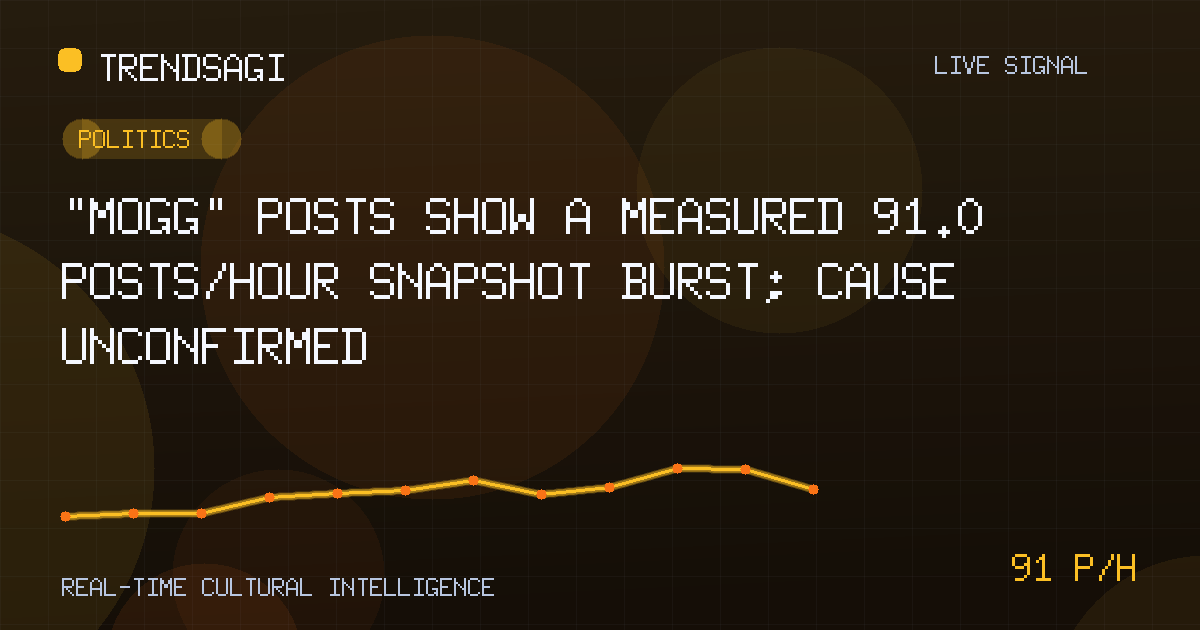
“Mogg” posts show a measured 91.0 posts/hour snapshot burst; cause unconfirmed
Mogg’s latest snapshot had 79 posts, with a measured 91.0 posts/hour over 910 seconds; here’s what the burst can—and cannot—establish.
Automated briefing. Generated from stored signal measurements and source-backed research; it is not manually reviewed. Read the methodology and limitations.
Metrics in this briefing are a snapshot associated with its publication date and may not reflect current conditions.
What changed
The stored signal labeled “Mogg” shows concentrated posting activity, but not a verified explanation for it. The latest snapshot contains 79 posts, observed at 2026-09-23T17:07:03Z.
The measured snapshot rate was 91.0 posts/hour over an exact 910-second window, using three stored observations. This describes collected activity in that historical window; it is not a live or current rate, forecast, reach, engagement, or unique-person count. It also does not establish how long the activity persisted.
| Observation time | Measured posts/hour | Latest snapshot volume |
|---|---|---|
| 2026-09-23 17:07:03 UTC | 91.0 posts/hour | 79 posts |
Why this topic may be moving
The available evidence does not verify a public trigger. The stored description is empty, and the label “Mogg” alone does not identify a person, organization, place, or event. It would be premature to attribute the burst to a specific statement, controversy, or news cycle without corroboration.
Several explanations are possible, but none is established by the aggregate figures. A relevant announcement, breaking-news development, or controversy could prompt a temporary rise in discussion. The signal is categorized as Politics, but that classification alone does not prove the posts are political or that they concern one identifiable subject.
- A specific event: reactions to an announcement, statement, or controversy may cluster around a news cycle. No such event is established here.
- Amplification: repeated claims, shared links, or coordinated reposting can increase volume without an equally broad increase in participation. This is a possibility to test, not a finding.
- Collection effects: monitoring changes or duplicate content may influence a snapshot, but the available figures do not reveal whether this occurred.
- Label ambiguity: different subjects sharing the term “Mogg” could be combined in one topic. The underlying posts are needed to determine whether the conversation is coherent.
More posts establish a measurement worth investigating, not an explanation worth repeating as fact. The responsible next step is to identify the subject and test a specific trigger against the timing and content of the posts.
Why it matters
News editors, public-affairs researchers, and communications teams can use this signal for triage, not as a ready-made explanation. It identifies a period worth inspecting, but it does not establish the topic’s importance, influence, or relationship to a broader development.
The signal also cannot show sentiment, agreement, authenticity, or policy impact. Posts may be repetitions, quotations, or reactions to older news. Alternatively, a smaller conversation could be sustained and consequential. Volume alone does not resolve those differences.
Those monitoring political conversation should first verify what “Mogg” names. An ambiguous label can combine unrelated subjects, and a category assignment cannot substitute for evidence in the posts. Readers should treat the burst as a verification prompt, not proof of a shift in public opinion.
What to watch next
The next useful work is verification rather than a stronger claim about momentum.
- Identify the subject in the original posts. Inspect content across the observed window and record what “Mogg” means in context. Note whether posts share a subject, event, or primary document, and whether competing meanings appear. This is the first check on whether the count represents one conversation or a merged label.
- Distinguish independent activity from duplication. Compare available wording, links, attachments, and account patterns. Different reactions that add information support broader discussion; near-identical copies may indicate amplification or collection duplication. The current total cannot distinguish these cases.
- Test a specific public explanation against the timing. If a primary statement, official announcement, or independent report can be verified, compare its publication time with the observed posts. Check whether the content actually refers to that event: timing similarity alone is not proof of causation.
- Collect comparable subsequent observations. A measured rate near 91.0 posts/hour in another window would support persistence, while a materially lower rate would support a shorter burst. Compare equivalent windows and retain observation counts rather than presenting a new snapshot volume as a rate.
- Look for substantive follow-up. Watch for verified reporting, new primary-source documentation, or continued posts that engage with the underlying issue rather than simply repeat it. These signals would help distinguish an isolated spike from a conversation developing a durable public footprint.
Methodology and limitations
The reported 91.0 posts/hour rate comes from three stored observations across an exact 910-second window ending at 2026-09-23T17:07:03Z. The separate latest-snapshot volume is 79 posts. These are different measures: snapshot volume is a count, while the measured rate characterizes activity across the specified interval.
Only aggregate information is available here. There are no underlying post texts, account identities, individual post timestamps, historical baseline, or verified contextual sources. Those limitations prevent a reliable assessment of cause, sentiment, authenticity, participation, or significance. The signal establishes activity within this collection; it does not establish that a wider public changed its views.
A single measured window cannot establish a new departure, a recurring pattern, or a continuation of earlier activity. The three observations provide the stated rate, but more comparable history is needed to characterize a durable trend. The 79-post figure describes the latest snapshot, not the topic’s complete posting history.
Track This Topic for New Signals
Set alerts for future velocity or sentiment changes around this topic.
Explore Tracking PlansAbout TrendsAGI research
TrendsAGI's automated research pipeline publishes dated signal snapshots, methodology notes, and practical workflows for teams evaluating cultural momentum. Read how signals are scoped, scored, and limited in our research methodology.


