902-second window · 3 observations · Measured Sep 1, 2026, 10:18 AM UTC · Provider: go_recent_snapshot_v2
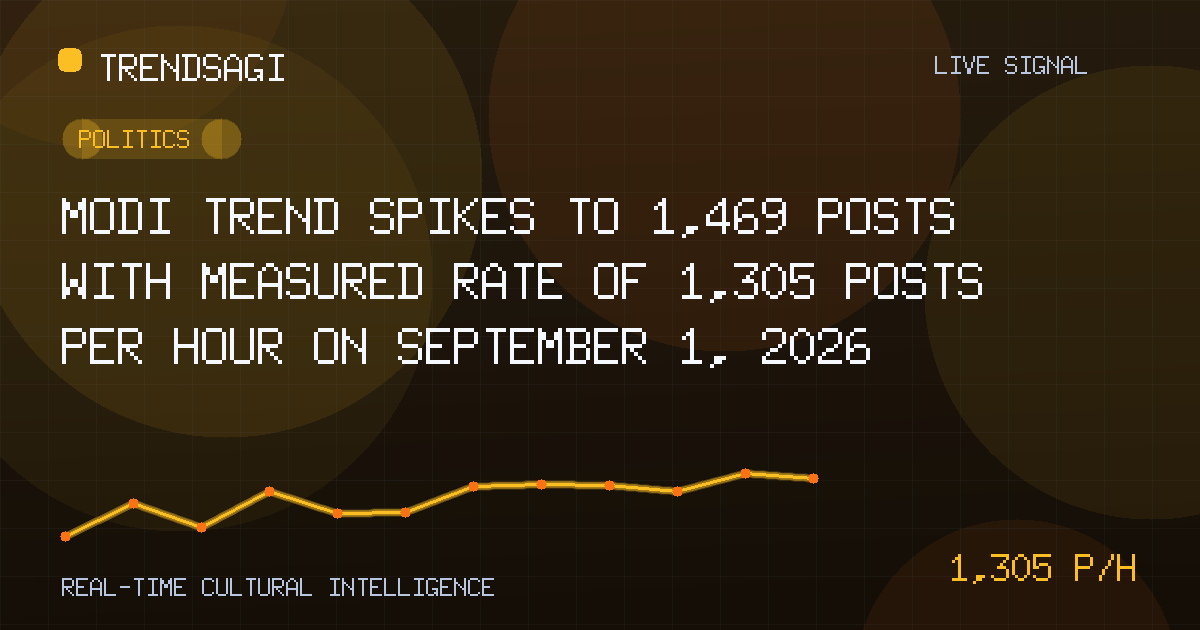
Modi trend spikes to 1,469 posts with measured rate of 1,305 posts per hour on September 1, 2026
Modi topic hit 1,469 posts at 10:18 UTC on 1 Sep 2026 with a measured 1,305 posts/hour rate over 15 minutes; no verified breaking news explains the spike.
Automated briefing. Generated from stored signal measurements and source-backed research; it is not manually reviewed. Read the methodology and limitations.
Metrics in this briefing are a snapshot associated with its publication date and may not reflect current conditions.
What changed
The topic "Modi" generated a snapshot volume of 1,469 posts at 10:18 UTC on 1 September 2026, with a measured change rate of 1,305.2 posts per hour calculated over a 902-second window from three stored observations. This rate reflects a short measurement window, not a live or projected pace.
| Observation time (UTC) | Measured posts/hour | Snapshot volume |
|---|---|---|
| 2026-09-01T10:18:07Z | 1,305.2 | 1,469 |
Why this topic may be moving
Google Search results for early September 2026 show no single dominant news event tied to Narendra Modi on 1 September that would explain a concentrated spike. Coverage in the surrounding days includes routine parliamentary proceedings, diplomatic engagements with neighboring countries, and domestic policy announcements—none of which cluster tightly around the observation timestamp. Indian media outlets such as The Hindu and The Indian Express published standard daily briefings on government activity, while international wires (Reuters, AP) carried no breaking Modi-specific story at that hour. The elevation could stem from coordinated social media amplification, a scheduled broadcast appearance, or a regional language trend not captured in English-language news indexes. Without a verifiable breaking event at the exact measurement window, the cause remains unclear.
Why it matters
For political analysts, the spike signals heightened digital attention on India’s prime minister that may precede or follow a policy announcement, election-related activity, or diplomatic development. For communications teams, the measured rate—though brief—indicates capacity for rapid message diffusion across platforms. For researchers tracking information dynamics, the discrepancy between snapshot volume and the absence of a clear news driver illustrates how platform-native amplification can decouple from traditional news cycles.
A measured rate over a 15-minute window captures momentum, not reach; it cannot distinguish organic conversation from coordinated posting or bot activity.
What to watch next
- Official PMO channels and Parliament TV schedules for appearances or statements released near 10:18 UTC on 1 September.
- Trending hashtags in Hindi, Tamil, Bengali, and other major Indian languages during the same window.
- Fact-checking outlets (Alt News, Boom Live) for any viral claims involving Modi that day.
- Subsequent snapshot volumes at 30-minute and hourly intervals to test whether the rate sustains or reverts.
Methodology and limitations
The posts-per-hour figure is a measured snapshot rate derived from three stored observations spanning exactly 902 seconds, recorded at 2026-09-01T10:18:07Z. It is not a live rate, forecast, unique-user count, or engagement metric. Snapshot volume (1,469) is the raw post count at that instant. The signal cannot establish sentiment, geographic origin, platform mix, or whether the activity is organic or manufactured. No external cause has been verified for this specific window.
Track This Topic for New Signals
Set alerts for future velocity or sentiment changes around this topic.
Explore Tracking PlansAbout TrendsAGI research
TrendsAGI's automated research pipeline publishes dated signal snapshots, methodology notes, and practical workflows for teams evaluating cultural momentum. Read how signals are scoped, scored, and limited in our research methodology.