1798-second window · 2 observations · Measured Sep 4, 2026, 6:33 AM UTC · Provider: go_recent_snapshot_v2
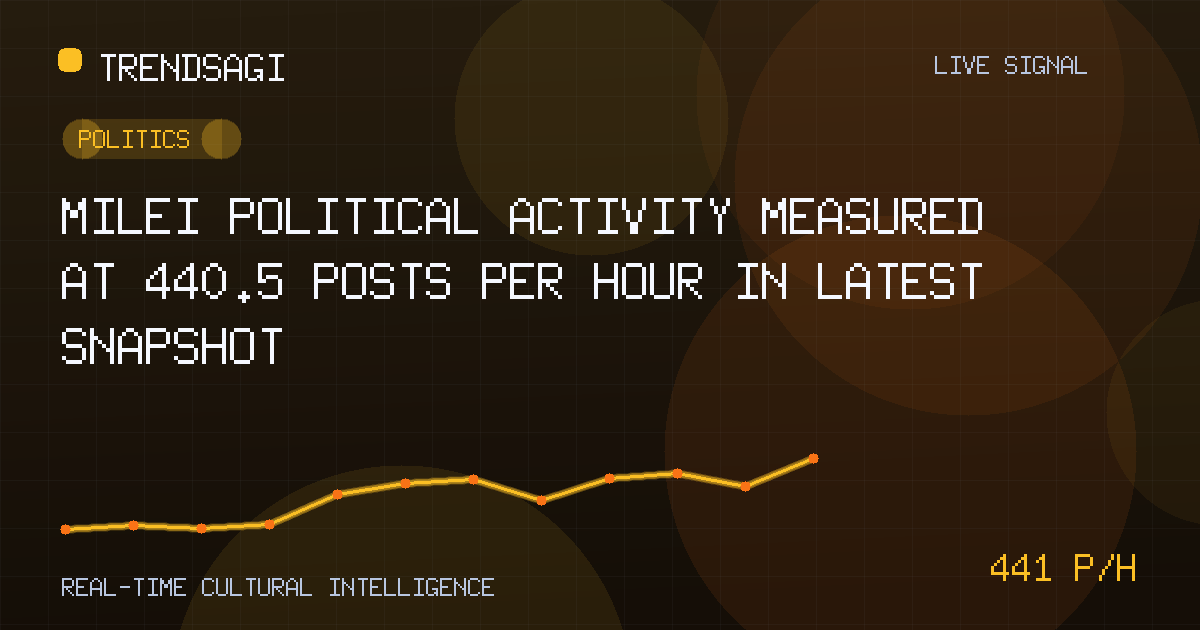
Milei Political Activity Measured at 440.5 Posts Per Hour in Latest Snapshot
Milei political discussions hit a measured snapshot rate of 440.5 posts per hour, totaling 734 posts. Learn what the data establishes and what to watch next.
Automated briefing. Generated from stored signal measurements and source-backed research; it is not manually reviewed. Read the methodology and limitations.
Metrics in this briefing are a snapshot associated with its publication date and may not reflect current conditions.
What changed
Political discussions surrounding Milei have reached a significant volume threshold. A measured snapshot rate of 440.5 posts per hour was recorded across a 1798-second observation window, culminating in a latest snapshot volume of 734 posts at 2026-09-04T06:33:23Z. This represents a substantial aggregation of digital attention within the politics category.
The velocity of this information sharing highlights an immediate spike in political engagement. Rather than a gradual accumulation of interest, the data captures a concentrated burst of activity, marking a distinct inflection point in the recent trajectory of online political discussions surrounding this figure.
| Observation Time | Measured Posts/Hour | Snapshot Volume |
|---|---|---|
| 2026-09-04T06:33:23Z | 440.5 | 734 |
Why this topic may be moving
Determining the precise external catalyst for this movement requires verification against independent public records. Based strictly on the provided canonical stored signal, the specific cause of the surge remains unverified. The signal description field is empty, offering no contextual metadata regarding whether this volume stems from a legislative vote, an economic policy shift, or a public address.
Without external attribution, we can only note that the measured snapshot rate indicates a high velocity of information sharing. It is crucial to rely on verified publishers for any narrative surrounding the cause, rather than assuming the driver based on the volume alone. If the cause is still unclear, we must acknowledge that gap in the data.
Why it matters
Understanding the mechanics of political discourse requires paying attention to volume metrics, especially in the politics category. The fact that 734 posts were aggregated in a specific window suggests that Milei remains a highly polarizing or impactful figure in public debate. For political analysts, journalists, and strategists, tracking these metrics provides a quantitative baseline for public interest.
Who should care about this data? Primarily, political communications teams, investigative journalists, and academic researchers studying political polarization. When a measured snapshot rate reaches 440.5 posts per hour, it signals that the subject is dominating the conversational bandwidth of a specific online ecosystem. This level of engagement often precedes or accompanies significant real-world policy actions or public reactions.
Furthermore, the concentration of this volume in the politics category suggests that the discourse is not merely celebrity gossip or entertainment, but likely involves substantive policy debates. The intensity of the conversation, as measured by the posts per hour metric, reflects the stakes that the public perceives in the topic.
What to watch next
Practical next checks for any researcher or analyst involve cross-referencing this volume with independent news cycles. To validate what the data cannot establish, one must look for corroborating reports from established news publishers. Specifically, checking whether major Argentine or international news outlets have published breaking stories at or around the 2026-09-04T06:33:23Z timestamp would provide necessary context.
Concrete watch signals should include monitoring for subsequent snapshots in the coming hours. If the volume sustains itself or grows, it indicates a sustained narrative rather than a fleeting moment of viral attention. Conversely, a rapid drop-off would suggest a transient spike, perhaps triggered by a single event that has already been digested by the audience.
Another practical check involves analyzing the sentiment and geographic distribution of the posts, if such metadata becomes available. A high volume of posts originating from a specific region could indicate localized political unrest or support, whereas a global distribution might suggest international implications of domestic policies. Until that data is verified, analysts must rely on the raw volume as their primary indicator.
Methodology and limitations
What the signal can establish is the sheer quantity of digital mentions within a constrained timeframe. The data objectively records that 734 posts existed at the observation time and that the aggregation occurred at a measured snapshot rate of 440.5 posts per hour over a 1798-second window. This provides a reliable, mathematically sound measurement of activity intensity.
However, what the signal cannot establish is the qualitative nature of those posts. It does not reveal whether the posts are positive, negative, or neutral. It cannot determine if the 734 posts represent 734 unique individuals or a smaller group of highly active users repeating the same messages. Furthermore, the signal cannot validate the truthfulness or accuracy of the claims being made within those posts.
Volume metrics are essential indicators of public attention, but they are inherently blind to the substance of the discourse. A high post rate confirms that a topic is resonating loudly, yet it remains entirely silent on whether that resonance is driven by genuine support, organized opposition, or misinformation.
The limitations of this dataset are significant for anyone attempting to draw broad conclusions about public opinion. Because the stored signal description is empty, the analyst is left with a numerical abstraction rather than a contextual narrative. This is why the measured snapshot rate must be treated as a piece of a larger puzzle, not a standalone proof of a trend.
Moving forward, the integrity of such trend briefings depends on the continuous verification of external context. Researchers must resist the temptation to fill narrative voids with speculation. Instead, they should strictly adhere to verified facts, attributing any external developments to their respective publishers and maintaining a clear distinction between observed data and inferred meaning.
Track This Topic for New Signals
Set alerts for future velocity or sentiment changes around this topic.
Explore Tracking PlansAbout TrendsAGI research
TrendsAGI's automated research pipeline publishes dated signal snapshots, methodology notes, and practical workflows for teams evaluating cultural momentum. Read how signals are scoped, scored, and limited in our research methodology.