860-second window · 3 observations · Measured Oct 9, 2026, 11:54 PM UTC · Provider: go_recent_snapshot_v2
Mike Ditka topic records 288.7 posts/hour in measured snapshot; trigger remains unverified
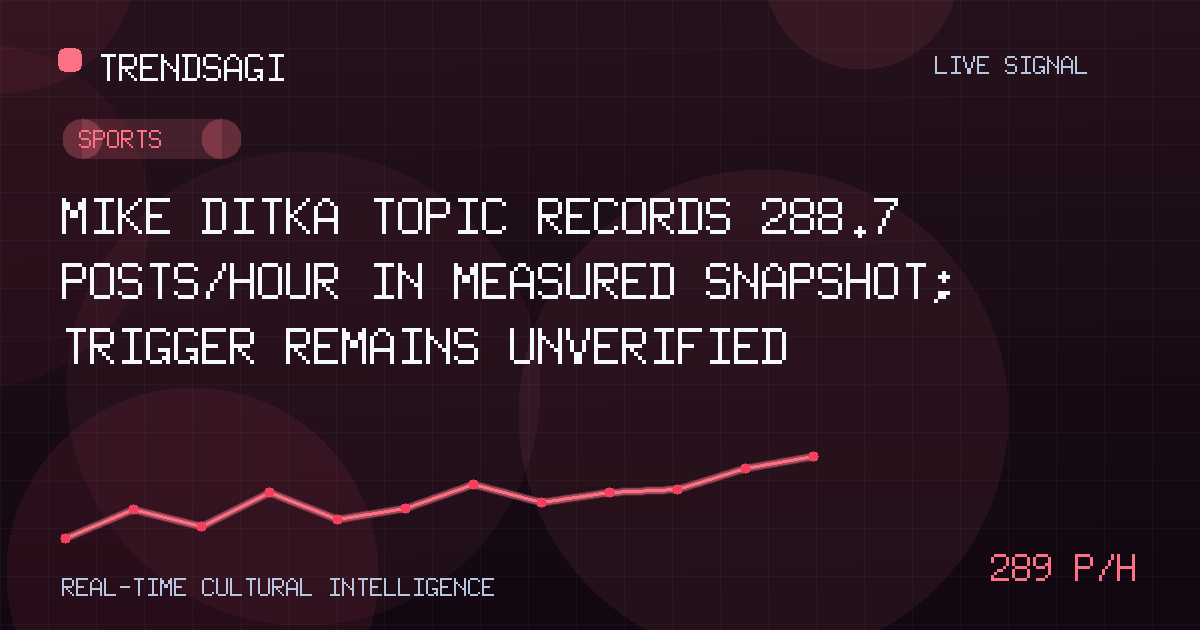
Mike Ditka posts recorded 288.7 posts/hour in the measured window; the 549-post snapshot shows volume, while the cause remains unverified.
Automated briefing. Generated from stored signal measurements and source-backed research; it is not manually reviewed. Read the methodology and limitations.
Metrics in this briefing are a snapshot associated with its publication date and may not reflect current conditions.
What changed
The topic labeled Mike Ditka recorded a measured snapshot rate of 288.7 posts/hour, but the reason for the movement has not been verified. The useful conclusion is narrow: labeled activity changed quickly enough to merit monitoring, not that a particular news event occurred.
The measured change rate was 288.7 posts/hour at the stored observation time of 2026-10-09T23:54:39Z. It was calculated from three stored observations across an exact 860-second window. The latest snapshot contained 549 posts, a separate volume measure rather than a rate. These figures describe a historical snapshot; they are not a live count, forecast, reach estimate, engagement measure, or count of unique people.
| Measure | Stored value |
|---|---|
| Observation time | 2026-10-09T23:54:39Z |
| Measured snapshot rate | 288.7 posts/hour |
| Latest snapshot volume | 549 posts |
Why this topic may be moving
No verified public trigger is established for this snapshot. The stored category is Sports, but that classification does not identify an event, and the absence of a signal description leaves the cause plainly unclear. A topic’s posting rate can rise because of a real development, but it can also reflect repeated content, label ambiguity, or a temporary gathering of accounts.
Several explanations should be tested rather than assumed:
- A new public item: A newly published interview, broadcast segment, documentary, milestone, appearance, or controversy could have prompted discussion. None of these possibilities is verified here.
- Secondary amplification: Multiple accounts may be reacting to or reposting the same underlying item, making the topic appear broader than the original event.
- Scheduled attention: A retrospective, media discussion, or recurring conversation could produce a temporary cluster without breaking news.
- Label or collection effects: The matching process may include ambiguous references, duplicated material, or changes in the observed post set. The signal alone cannot resolve those possibilities.
Editorial takeaway: A fast increase in labeled posts is a prompt to verify the event, not evidence of what happened.
What the signal can—and cannot—establish
The signal can establish that the monitored series contained 549 posts at the stated observation time and produced a measured snapshot rate of 288.7 posts/hour over the supplied window. That makes it a useful alert for further review, particularly when an editor needs to decide whether a developing conversation deserves verification.
It does not establish:
- Why the posts were published or whether one event caused the movement;
- Whether the discussion was positive, negative, neutral, or predominantly reactive;
- How many distinct authors or people were involved;
- How many people saw, clicked, shared, or otherwise engaged with the posts;
- Whether the topic persisted after the observation timestamp;
- Whether every post referred to the same public figure rather than an ambiguous name match;
- Whether activity was organic, coordinated, automated, or driven largely by duplicate content.
The 549-post snapshot and the 288.7 posts/hour rate answer different questions. Volume describes the stored post count at a point in the series. The measured rate describes how that count changed over the defined observation window. Neither should be presented as the size or importance of an audience.
Why it matters
- Sports editors need a way to identify fast conversation without assigning a cause before the underlying item is confirmed.
- Newsrooms and fact-checkers can use the alert to locate the earliest substantive posts, identify the item being repeated, and seek direct documentation.
- Community and audience teams should distinguish a meaningful publishing spike from a temporary burst of reposts or repeated material.
- Trend researchers can treat the observation as a candidate anomaly, then test persistence, entity accuracy, duplication, and cross-platform spread.
- Readers benefit from knowing that increased discussion and verified significance are not the same thing, especially when no public trigger has been established.
What to watch next
- Resolve the entity. Review a representative sample of matching posts and confirm that references point to the same Mike Ditka-related subject rather than a name collision or loosely associated conversation.
- Find the earliest substantive item. Separate original posts from copies, reactions, clips, and brief quotations. The first identifiable item may be more informative than the largest cluster.
- Seek primary confirmation. Look for a direct statement, published work, official record, or identifiable broadcast that can be dated and compared with the start of the measured movement.
- Check independent coverage. Determine whether reputable publishers are describing the same development and whether their reports add facts beyond the social conversation.
- Test persistence. Compare later fixed-length observation windows. A sustained sequence of elevated measured rates would support a continuing topic; a brief cluster would suggest a short-lived event.
- Measure content quality separately. Track original contributions, duplicate shares, distinct accounts, and substantive responses as separate indicators. None is supplied by the current snapshot.
Concrete confirmation would include a dated primary item preceding the cluster, multiple reputable reports converging on the same event, and subsequent activity that remains centered on that item rather than shifting to unrelated subjects. If none appears, the responsible description remains an unexplained increase in labeled discussion.
Methodology and limitations
This briefing uses the supplied stored observations rather than treating the posting rate as a live measurement. The rate of 288.7 posts/hour was measured from three observations over an exact 860-second window and recorded at 2026-10-09T23:54:39Z. The 549-post value is the latest stored snapshot volume.
The topic label and Sports classification provide context for monitoring but do not verify the content or establish causation. Because no external trigger could be confirmed, no specific news development is asserted here. The signal is sufficient to justify a verification pass, but insufficient to explain why the topic moved or to characterize the people producing and consuming the posts.
Track This Topic for New Signals
Set alerts for future velocity or sentiment changes around this topic.
Explore Tracking PlansAbout TrendsAGI research
TrendsAGI's automated research pipeline publishes dated signal snapshots, methodology notes, and practical workflows for teams evaluating cultural momentum. Read how signals are scoped, scored, and limited in our research methodology.


