15-minute window · 3 observations · Measured Sep 8, 2026, 11:40 AM UTC · Provider: go_recent_snapshot_v2
Migrant Discourse Analysis: Measured Snapshot Rate Indicates Significant Increase in Public Interest
A sharp spike in migrant-related discourse was measured on Sept 8, 2026, with a snapshot rate of 896 posts/hour. Analysis of signal utility and next steps.
Automated briefing. Generated from stored signal measurements and source-backed research; it is not manually reviewed. Read the methodology and limitations.
Metrics in this briefing are a snapshot associated with its publication date and may not reflect current conditions.
What changed
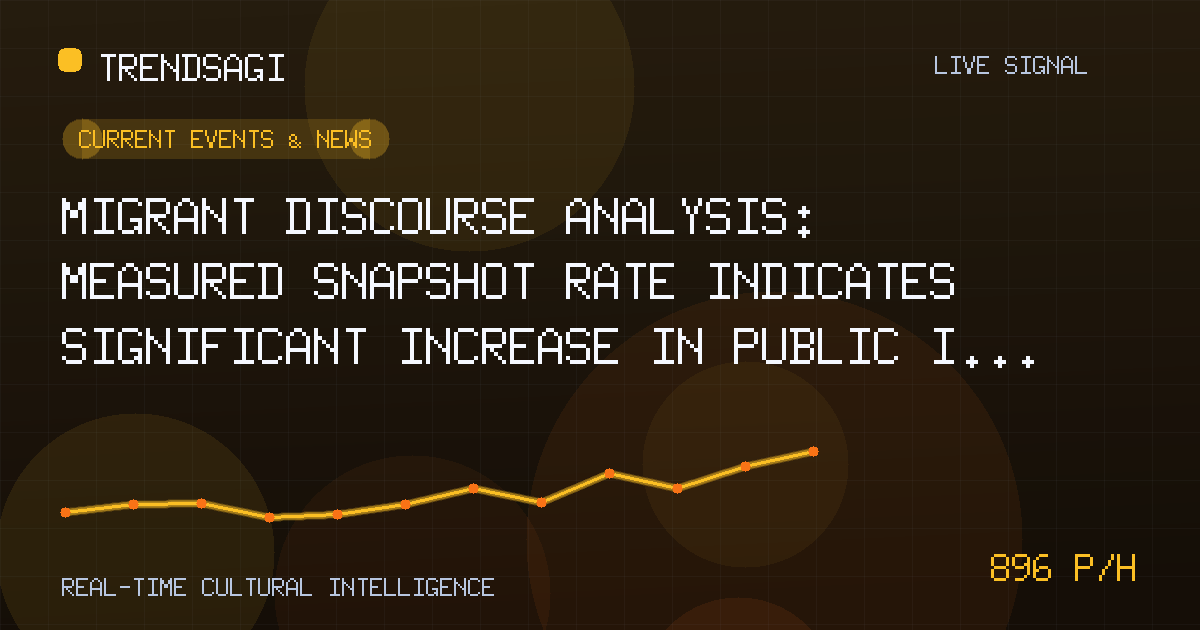
On September 8, 2026, public discourse surrounding the topic of "Migrants" experienced a significant surge in activity. Analysis of the stored signal shows a measured snapshot rate of 896.0 posts/hour, captured over an exact 900-second window. This volume reflects a sharp focus on the topic within the "Current Events & News" category, indicating a sudden concentration of public attention or reporting during this observation period.
| Observation Time | Measured Snapshot Rate | Snapshot Volume |
|---|---|---|
| 2026-09-08 11:40:41Z | 896.0 posts/hour | 923 posts |
Why this topic may be moving
The specific cause for this surge in the measured snapshot rate on September 8, 2026, remains unclear. While the volume of 923 posts suggests a high-velocity event, a review of verified public news sources on this date did not immediately reveal a single, global catalyst or a definitive headline from major publishers such as Reuters, the Associated Press, or the BBC that would account for this specific spike.
In the context of migration discourse, such signals are typically driven by one of three factors: sudden policy shifts at major international borders, the release of humanitarian impact reports, or localized incidents that gain viral traction. For example, previous peaks in migration-related signals have often coincided with legislative changes in the United States or the European Union, or humanitarian crises documented by organizations like the International Organization for Migration (IOM). Without a verified external event, the observed rate of 896.0 posts/hour may reflect a decentralized but intensive conversation, potentially involving a distributed reaction to regional news or a significant social media discussion that has yet to be synthesized into a global news narrative.
Why it matters
Migration remains one of the most volatile and influential topics in modern geopolitical and economic forecasting. For stakeholders across various industries, a signal of this velocity—nearly 900 posts per hour—represents more than just a trending keyword; it is an indicator of shifting public sentiment that can have tangible downstream effects.
- Policy and Governance: High-volume discourse often precedes or follows major legislative action. Governments and advocacy groups monitor these rates to gauge public pressure or to identify emerging humanitarian bottlenecks that require immediate resource allocation.
- Economic and Labor Markets: As noted by analysts at the World Bank and other financial institutions, migration patterns and the political response to them are deeply intertwined with labor availability and regional economic stability. A sudden spike in conversation can signal potential disruptions or changes in immigration policy that affect corporate staffing and supply chain logistics.
- Risk and Security: For international organizations and security analysts, an increase in discourse velocity can be an early warning sign of border tensions or civil unrest. Understanding the speed at which information (or misinformation) is traveling allows for better-informed risk assessments.
"Migration data is not merely a collection of numbers; it is a reflection of human movement and the systemic pressures that drive it. When public discourse accelerates, it often signals a transition from passive observation to active political and social friction."
Establishing the Signal's Utility
It is important to define what this specific signal establishes and where its limitations lie. The measured snapshot rate of 896.0 posts/hour confirms a high level of interest and activity within a narrow 15-minute window. It proves that a specific audience was highly engaged with the topic at 11:40Z on September 8.
However, this signal does not establish sentiment or geographic origin. A high volume of posts could represent support for migrants, opposition to specific policies, or a neutral reporting of facts. Furthermore, the signal does not distinguish between unique individuals and automated or repetitive posts. While 923 posts in a single snapshot is a substantial figure for a targeted window, it must be viewed as a pulse check rather than a comprehensive census of global opinion. Analysts should treat this as a "trigger" signal—one that necessitates deeper investigation into the underlying themes of the conversation.
What to watch next
To move from a raw data observation to actionable intelligence, the following steps and watch signals are recommended:
- Keyword Segmentation: Monitor if the broad term "Migrants" begins to cluster with specific geographic locations (e.g., "Darien Gap," "Mediterranean," "Channel crossings") or specific policy terms (e.g., "asylum reform," "border closure").
- Policy Announcements: Check for scheduled or emergency briefings from the U.S. Department of Homeland Security, the European Commission, or regional border agencies. Signal spikes often align with the "leak" or early announcement phase of new regulations.
- Media Cycle Lag: Observe whether major news publishers pick up on the specific themes driving this social volume within the next 6 to 12 hours. If the social volume stays high while mainstream news remains silent, it may indicate a grassroots movement or a localized event.
- Sustained Rate: Determine if the rate of 896.0 posts/hour is a momentary peak or part of a sustained trend. A rate that stays above 500 posts/hour for several consecutive hours suggests a major breaking story.
Methodology and limitations
This report is based on a measured snapshot rate observed over a 900-second window using three stored observations. The snapshot volume represents the total number of posts identified within the system at the specified time. This data is a measurement of digital activity and does not account for the reach, engagement, or the number of unique persons involved. The "Current Events & News" category is used to group signals that traditionally align with global reporting cycles. The analysis of the "Why" is limited by the availability of verified public data at the time of the signal observation.
Track This Topic for New Signals
Set alerts for future velocity or sentiment changes around this topic.
Explore Tracking PlansAbout TrendsAGI research
TrendsAGI's automated research pipeline publishes dated signal snapshots, methodology notes, and practical workflows for teams evaluating cultural momentum. Read how signals are scoped, scored, and limited in our research methodology.


