893-second window · 2 observations · Measured Sep 23, 2026, 11:41 PM UTC · Provider: go_recent_snapshot_v2
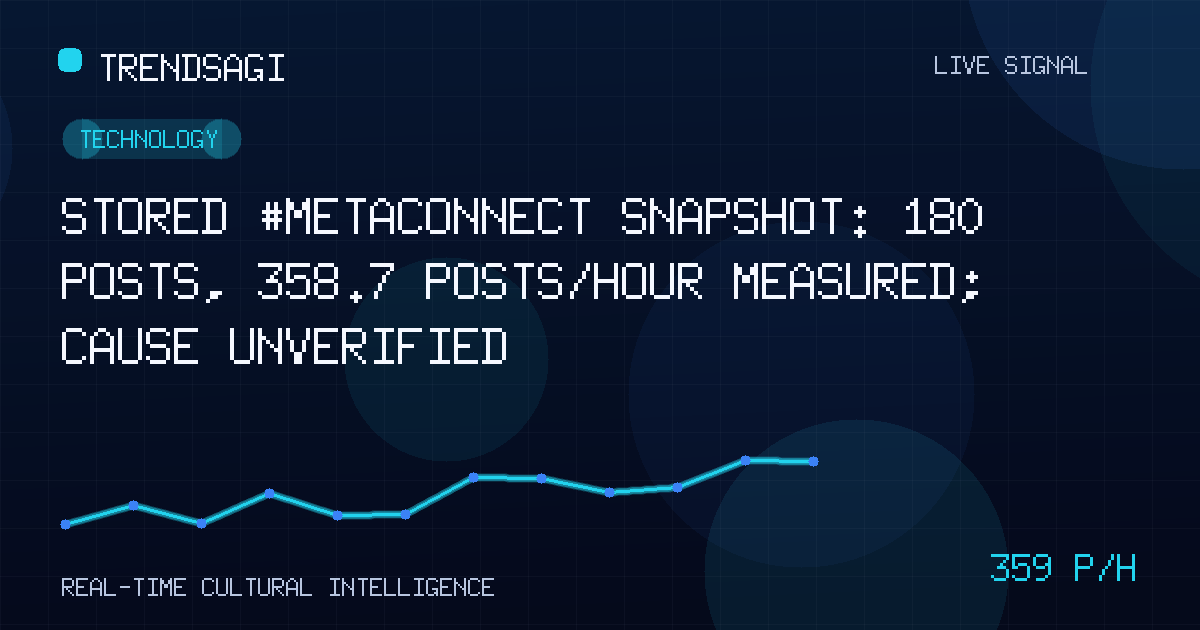
Stored #MetaConnect snapshot: 180 posts, 358.7 posts/hour measured; cause unverified
A stored #MetaConnect snapshot has 180 posts and a measured snapshot rate of 358.7 posts/hour, plus checks for verifying the cause.
Automated briefing. Generated from stored signal measurements and source-backed research; it is not manually reviewed. Read the methodology and limitations.
Metrics in this briefing are a snapshot associated with its publication date and may not reflect current conditions.
What changed
The Technology-category signal labeled #MetaConnect recorded 180 posts in the latest supplied snapshot, alongside a measured snapshot rate of 358.7 posts/hour. The cause is unclear: the stored record does not identify a specific public event, actor, or campaign behind the activity.
The rate was measured at 2026-09-23T23:41:06Z across an exact 893-second window using 2 stored observations. It is not a live rate, forecast, reach estimate, or unique-person count. No verified public explanation is established here, so attributing the movement to a launch, announcement, or incident would go beyond the evidence.
| Observation time | 2026-09-23T23:41:06Z |
|---|---|
| Latest snapshot volume | 180 posts |
| Measured snapshot rate | 358.7 posts/hour |
| Measurement window | Exact 893-second window |
| Stored observations | 2 |
Why this topic may be moving
The stored material does not verify a public cause. Several explanations are possible, but none is established by the count alone:
- Event-driven attention: a scheduled announcement or breaking development could concentrate discussion. Neither is confirmed for this signal.
- Community activity: recurring discussions, tutorials, or peer questions can raise posting without a news event. The snapshot does not show whether those formats are present.
- Promotion or reposting: repeated content or coordinated distribution could increase captured posts without representing independent reactions. Neither is demonstrated here.
- Measurement effects: a collection change, duplicate-handling issue, or temporary scheduling pattern could affect the count. The record does not indicate whether collection conditions changed.
These explanations cannot be ranked from the supplied totals. The Technology classification describes the stored category; it does not confirm an official connection, product news, or a shift in public opinion.
What the signal can—and cannot—establish
The snapshot establishes that 180 posts were captured under the tracked label at the stated time. The 2 observations support the reported measured snapshot rate for that short window. Together, they justify a descriptive alert: the activity merits inspection.
They do not establish how long the pattern has existed, whether it continues, or what the posts say. The totals also cannot show sentiment, importance, organic reach, or the number of people involved. Many small contributions and repeated content can produce the same volume.
Editorial takeaway: A measured posting rate can prioritize verification, but it cannot explain itself. Content inspection and corroboration are the next steps, not a larger claim about the topic.
Why it matters
For communications and product teams, a change in posting activity can prompt a check for substantive discussion, promotion, or inaccurate claims. That makes the label useful for triage, but not for an announcement or crisis conclusion. Community operators may want to distinguish participant conversation from repetitive forwarding, while analysts and journalists need corroboration before treating the label as evidence of a real-world development.
Researchers should preserve the distinction between observation and interpretation. The measured snapshot rate can prioritize a review queue; it cannot estimate audience size, adoption, business impact, or public sentiment. Teams should compare the same label, collection method, and observation intervals before calling the change sustained.
What to watch next
A useful follow-up would test the burst rather than narrate it:
- Inspect the snapshot. Review the captured posts for original text, timestamps, linked destinations, source types, and repeated wording. Separate replies and re-posts from original contributions, and record the classification method.
- Build a comparable series. Collect additional fixed-interval snapshots using the same query and collection rules. Retain exact timestamps, observation counts, and window lengths so rates with different methods are not presented as equivalent.
- Check provenance. Look for a first-party publication, named announcement, incident report, or other verifiable record that aligns with the activity window. Attribute any supporting explanation to its publisher; timing alone is not corroboration.
- Audit collection integrity. Confirm that duplicate suppression, language settings, indexing delays, and source changes did not create or amplify the pattern. A measurement change requires a different explanation from a change in discussion.
Concrete watch signals
Several signals would help distinguish a short-lived burst from a durable shift:
- Persistence: additional measured snapshot rates remain elevated against a documented baseline, with each rate’s window and observation count disclosed.
- Breadth: activity comes from multiple independent sources rather than repeated content from a small set.
- Originality: distinct contributions replace duplicated or forwarded material.
- Corroboration: a verified public development aligns with both the timing and the content being posted.
- Measurement stability: collection rules remain consistent, with no evidence of a coverage or duplicate-handling change.
Methodology and limitations
This briefing uses only the supplied Technology-category observation for #MetaConnect. Latest snapshot volume is 180 posts, not a rate. The 358.7 posts/hour figure is a measured snapshot rate over an exact 893-second window from 2 stored observations, measured at 2026-09-23T23:41:06Z. It is not a live rate, projection, reach estimate, engagement measure, or unique-person count.
The 2 observations and short measurement window do not establish a baseline, duration, turning point, or cause. The hashtag identifies the tracked label, not the content or affiliation of those posting. No external fact is used to explain the movement because no verified public explanation is established for this briefing. The supported conclusion is narrow: a measured burst is present in the stored signal, and its driver remains unverified.
Track This Topic for New Signals
Set alerts for future velocity or sentiment changes around this topic.
Explore Tracking PlansAbout TrendsAGI research
TrendsAGI's automated research pipeline publishes dated signal snapshots, methodology notes, and practical workflows for teams evaluating cultural momentum. Read how signals are scoped, scored, and limited in our research methodology.


