906-second window · 3 observations · Measured Sep 26, 2026, 10:56 PM UTC · Provider: go_recent_snapshot_v2
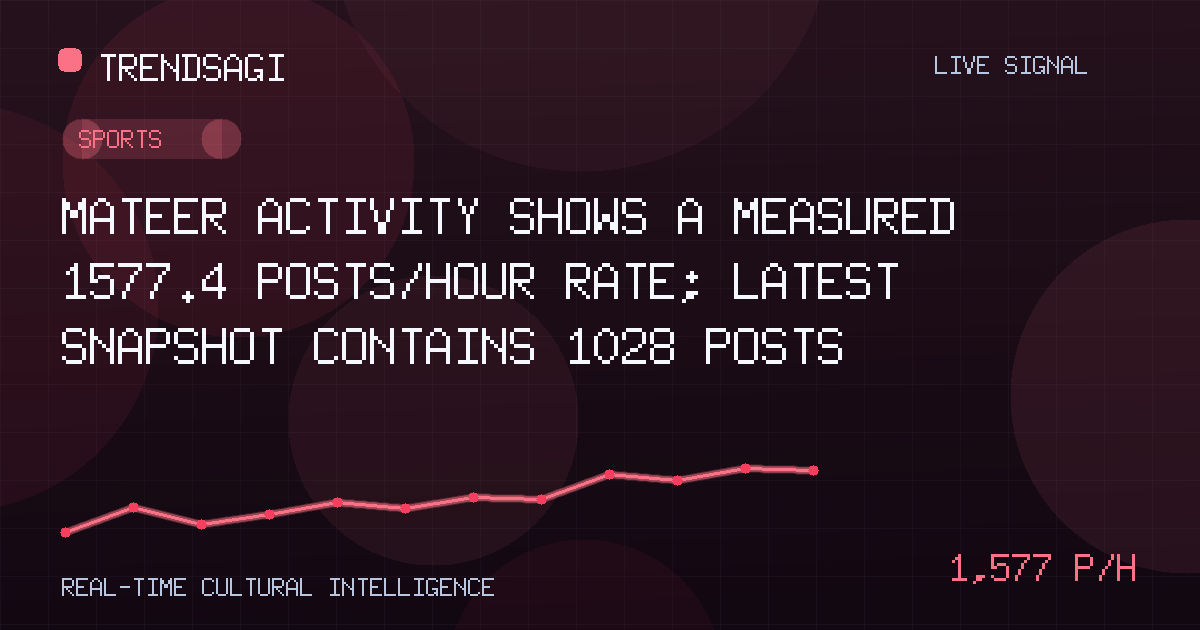
Mateer activity shows a measured 1577.4 posts/hour rate; latest snapshot contains 1028 posts
Mateer’s latest snapshot has 1028 posts and a measured 1577.4 posts/hour rate; here is what is known and what to verify next.
Automated briefing. Generated from stored signal measurements and source-backed research; it is not manually reviewed. Read the methodology and limitations.
Metrics in this briefing are a snapshot associated with its publication date and may not reflect current conditions.
What changed
The Mateer label shows a concentrated burst in posting: the latest stored snapshot, timestamped 2026-09-26T22:56:24Z, contains 1028 posts. That makes the name worth monitoring, but it does not establish the cause. The record is categorized as Sports, has no description, and does not identify which person, team context, spelling, or event the posts concern.
The measured snapshot rate—the available change measure—is 1577.4 posts/hour over an exact 906-second window using 3 stored observations. It describes pace in that historical window, not a live or current rate, forecast, reach estimate, engagement measure, or unique-person count. The 1028 figure is snapshot volume; it is a different measure and should not be substituted for the rate.
| Metric | Value |
|---|---|
| Observation time | 2026-09-26T22:56:24Z |
| Latest snapshot volume | 1028 posts |
| Measured snapshot rate | 1577.4 posts/hour |
| Measurement basis | Exact 906-second window; 3 stored observations |
Why this topic may be moving
The reason for the movement remains unclear. No verified public context ties the burst to a specific occurrence. The stored category and name alone cannot establish the trigger, which would remain speculation until supported by attributable reporting or a clearly matched primary source.
Identity is the first unresolved issue. If Mateer maps to more than a single person or is an incorrectly indexed term, the current record cannot distinguish those cases. The Sports classification narrows the subject area but not the entity. This should therefore be treated as an activity alert, not confirmation of a particular story.
- Event chronology: Check whether posts cluster around a timestamped public occurrence.
- Entity resolution: Identify the exact Mateer being discussed and exclude unrelated namesakes.
- Source concentration: Determine whether a single account, outlet, or thread dominates the feed.
- Text duplication: Separate repeated claims or quotations from independently authored reactions.
What the signal can and cannot establish
The signal establishes what the collection observed, when it observed it, and the short-window pace encoded by the stored calculation. It does not establish sentiment, factual accuracy, organic participation, geography, platform mix, or influence. Because the underlying observation values and a longer baseline are not provided, the rate cannot be independently reproduced here or used to claim a sustained trend.
- Volume is not reach: 1028 posts do not show how many people saw or joined the discussion.
- Pace is not persistence: a rate across 906 seconds does not show that activity continued.
- Activity is not causation: a posting burst does not reveal what caused it.
- Posts are not people: repeated or automated posting may inflate apparent activity.
A large post count establishes activity inside the monitored collection, but only identity, chronology, and independent corroboration establish what that activity is about.
The appropriate response is verification, not amplification based on volume alone.
Why it matters
A short-window activity alert can create time pressure for sports desks, community teams, and communications staff, especially when a surname is ambiguous. The main downside is misidentification: publishing or responding to the wrong Mateer could spread confusion. The signal is most useful as a prompt to inspect underlying posts, source mix, and chronology before assigning a narrative.
- Journalists can use it as a verification queue, prioritizing identity and primary evidence.
- Communications teams can watch for a confirmed event or response involving the resolved person.
- Community managers can distinguish a substantive issue from repetitive or low-information posts.
- Analysts should retain the collection method when comparing future observations.
What to watch next
The next checks should be concrete and ordered:
- Sample the full window: Review representative posts from the beginning, middle, and end rather than relying only on highly ranked items.
- Resolve the entity: Use post text, account context, and named participants to identify the exact Mateer while excluding unrelated matches.
- Inspect the sequence: Examine the 3 underlying observations to see whether activity builds, peaks, or recedes within the measured window.
- Test authenticity: Look for original wording, coordinated timing, repeated text, and public account histories; do not assume either organic interest or automation.
- Corroborate externally: Check whether attributable reporting or a clearly relevant primary source establishes the same event and identity.
Concrete escalation signals are a rapid measured snapshot rate in subsequent comparable windows, broader distribution across distinct original posts, and credible sources converging on the same explanation. De-escalation signals are a rate returning toward the collection baseline, a feed dominated by duplicates, unresolved identity, or a failure to find external corroboration. Either pattern should be recorded with the same counting method used here.
Methodology and limitations
All reported figures come directly from the stored signal. The observation time is 2026-09-26T22:56:24Z; latest snapshot volume is 1028; the measured snapshot rate is 1577.4 posts/hour over an exact 906-second window using 3 stored observations. No external causal claim is included because no attributable trigger could be confirmed from the available public context.
- Collection coverage is unspecified, so the signal may not represent all platforms or audiences.
- No geography, language, author-level deduplication, or engagement data is supplied.
- No longer comparison series establishes whether the pace is normal for this collection.
- No post sample establishes topic relevance, sentiment, or source independence.
Bottom line: Mateer has a documented short-window activity burst that warrants checking, but not a verified explanation. The next useful finding is not another volume count; it is a resolved identity tied to a corroborated event.
Track This Topic for New Signals
Set alerts for future velocity or sentiment changes around this topic.
Explore Tracking PlansAbout TrendsAGI research
TrendsAGI's automated research pipeline publishes dated signal snapshots, methodology notes, and practical workflows for teams evaluating cultural momentum. Read how signals are scoped, scored, and limited in our research methodology.