891-second window · 3 observations · Measured Sep 23, 2026, 5:41 PM UTC · Provider: go_recent_snapshot_v2
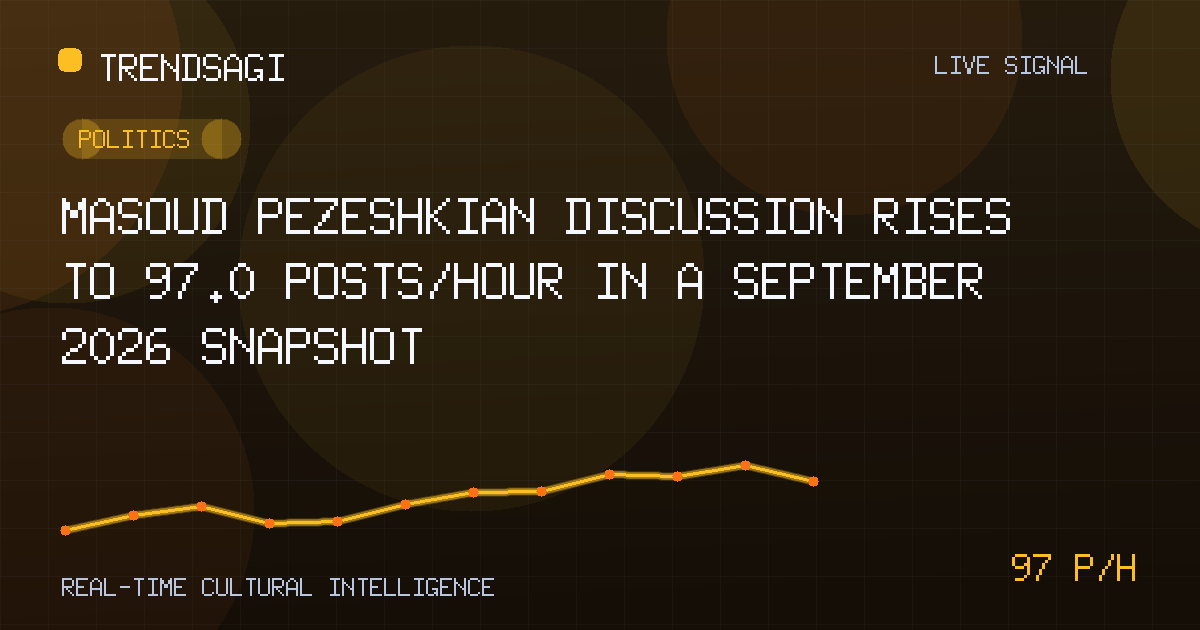
Masoud Pezeshkian discussion rises to 97.0 posts/hour in a September 2026 snapshot
Masoud Pezeshkian discussion recorded 97.0 posts/hour over 891 seconds; learn what the burst shows, what remains unverified and what to check next.
Automated briefing. Generated from stored signal measurements and source-backed research; it is not manually reviewed. Read the methodology and limitations.
Metrics in this briefing are a snapshot associated with its publication date and may not reflect current conditions.
What changed
A concentrated burst of recorded discussion makes Masoud Pezeshkian worth monitoring, but it does not identify a verified political event. At 2026-09-23T17:41:08Z, the snapshot contained 167 posts. The measured change rate was 97.0 posts/hour over an exact 891-second window using three stored observations.
This is a measured snapshot rate, not a live rate, forecast, reach estimate, engagement figure or count of distinct people. The supported takeaway is that posts accumulated quickly within the observed sample. The cause remains unclear: the available record does not link the increase to a particular statement, policy development or news event, and no public reporting has been verified here to explain it.
| Observation | Value |
|---|---|
| Observation time | 2026-09-23T17:41:08Z |
| Measured snapshot rate | 97.0 posts/hour |
| Snapshot volume | 167 posts |
The rate and total answer different questions. The 167 posts describe one snapshot; 97.0 posts/hour describes the pace within the defined window. Neither establishes normal activity across days, platforms or audiences.
Why this topic may be moving
Several explanations remain possible, including a new development, renewed attention to older news, heavy sharing of existing coverage, or a change in the accounts and platforms sampled. Repetition can raise post volume without creating a new event. A short burst can also look large because activity clusters in time. Without event-level verification, choosing one explanation would be speculation.
No verified publisher report or public event can be connected to the burst in the evidence available for this briefing. It would be unsupported to attribute the increase to a speech, interview, policy announcement, electoral development or controversy involving Masoud Pezeshkian. The careful conclusion is not that nothing happened; it is that the observation does not establish what happened or whether the discussion was genuinely new.
A faster stream of posts is evidence of a faster-moving conversation in the sample, not proof of a new event, wider agreement, greater influence or a change in policy.
Why it matters
For editors and readers following political news about Masoud Pezeshkian, a high-volume signal is most useful as a prompt to check the underlying story. It cannot establish whether a claim is accurate, whether officials have made a new statement, or whether discussion reflects support, criticism or both. Intensity and meaning are separate.
Researchers and communications analysts should also resist translating posts into people. The snapshot does not report unique authors, locations, account histories or engagement. A small number of active accounts could contribute many posts. That possibility does not show that activity was coordinated; checking the distribution is necessary before making that judgment.
The immediate value is triage: identify whether a credible development exists, establish when it first appeared, and compare original material with subsequent reactions. If the burst is recirculation, the relevant story may be an amplification pattern. If it follows a verifiable event, that event and its timing should be documented before the increase is summarized as political momentum.
Checks for the next update
- Confirm the trigger. Look for a timestamped, attributable report identifying a specific development and explaining the timing. Separate a new event from renewed discussion of an older one.
- Compare the next window. Obtain another rate over a defined interval. A comparable 891-second measurement would show whether the 97.0 posts/hour pace persisted, slowed or stopped.
- Inspect concentration. Look at how posts and repeated wording are distributed across accounts and sources. Repetition can indicate amplification, but does not by itself establish a coordinated campaign.
- Preserve the sample. Keep the observation time, post count, rate, collection method and platform coverage together so follow-up measurements are genuinely comparable.
What to watch next
The strongest follow-up would connect the burst to a verifiable event and distinguish original discussion from copied reactions. Useful signals include independent reporting of a new statement, a clearly sourced first appearance, and later commentary that adds interpretation rather than repeating a claim. None of those developments is established by the current snapshot.
Persistence matters too. A comparable 891-second rate at or above 97.0 posts/hour would show that the observed pace continued; a lower rate would favor a shorter spike. A rising post total alongside a falling measured rate would indicate continued accumulation at a slower pace. These are conditions to test, not claims about what happened after 2026-09-23T17:41:08Z.
Watch for changes in the conversation's composition. Original analysis, official documentation, identifiable reporting and reactions from distinct accounts serve different evidentiary purposes. Together they can help distinguish a new information event from concentrated amplification or sustained attention. An explanation should be dated and attributed, not inferred from speed alone.
If the rate falls without a verified event, the conclusion is limited: the burst subsided, while its cause remained uncertain. A confirmed event would justify reassessing its timing and significance. Until then, this is a rapid snapshot of discussion—not evidence of a shift in public sentiment or political support.
Methodology and limitations
The rate comes from three stored observations across an exact 891-second window ending at 2026-09-23T17:41:08Z. The snapshot contains 167 posts. The selection method, platform coverage and deduplication choices are not described, so the sample's representativeness cannot be assessed.
No earlier comparison rate is supplied, so the departure from normal activity cannot be quantified. The record does not identify unique accounts, engagement, sentiment, geography or the sequence of events. The observation time does not establish when discussion began, or whether attention continued afterward.
No external publisher fact is included because none could be verified here. Movement is therefore established only for the recorded sample, not its cause. A like-for-like follow-up observation and direct public evidence are needed to test the alert.
Track This Topic for New Signals
Set alerts for future velocity or sentiment changes around this topic.
Explore Tracking PlansAbout TrendsAGI research
TrendsAGI's automated research pipeline publishes dated signal snapshots, methodology notes, and practical workflows for teams evaluating cultural momentum. Read how signals are scoped, scored, and limited in our research methodology.


