902-second window · 2 observations · Measured Oct 8, 2026, 1:26 PM UTC · Provider: go_recent_snapshot_v2
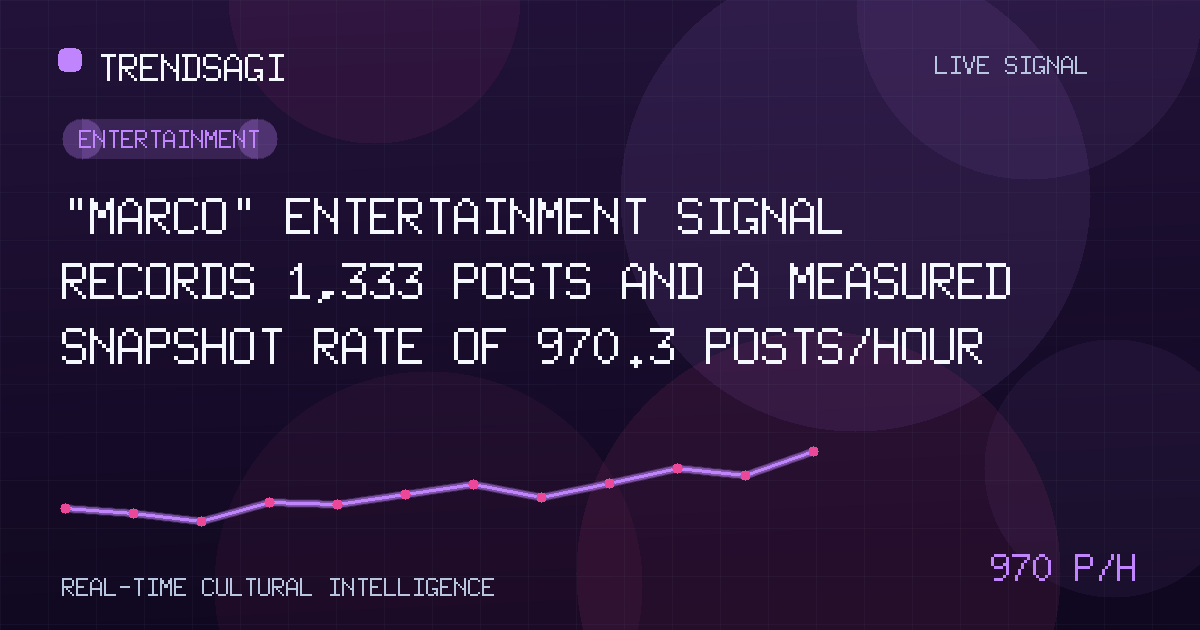
“Marco” entertainment signal records 1,333 posts and a measured snapshot rate of 970.3 posts/hour
“Marco” has 1,333 snapshot posts and a measured snapshot rate of 970.3 posts/hour; the entity and cause remain unverified.
Automated briefing. Generated from stored signal measurements and source-backed research; it is not manually reviewed. Read the methodology and limitations.
Metrics in this briefing are a snapshot associated with its publication date and may not reflect current conditions.
What changed
The entertainment topic labeled “Marco” recorded 1,333 posts in the latest stored snapshot at 2026-10-08T13:26:29Z. The direct finding is a measured rise in observed posting during the captured window; the record does not establish which person, work, story, or event the label represents, or why activity increased.
The measured snapshot rate was 970.3 posts/hour over an exact 902-second window using two stored observations. It describes how quickly the stored collection changed during that interval. It is not a live or current rate, forecast, reach, engagement, or unique-person count, and the separate 1,333-post snapshot volume is not a rate.
| Observation time | Measured snapshot rate | Snapshot volume |
|---|---|---|
| 2026-10-08T13:26:29Z | 970.3 posts/hour | 1,333 posts |
Why this topic may be moving
“Marco” is an ambiguous topic label, and the stored Entertainment category does not resolve it. Several mechanisms could produce the observed activity:
- A release, appearance, controversy, meme, or other focal point may have supplied a reason for posting.
- Posts may refer to multiple people or works named Marco, making the label an aggregate rather than a single event.
- A short-lived discovery effect may have increased activity without a durable public development.
- Reposting, duplication, coordinated amplification, or collection behavior may also contribute.
No verified public context in the available record ties the activity to a specific catalyst. Those are hypotheses, not explanations. A useful public-search check would need to resolve the label, match exact post language, and connect a dated event to the observation window.
The strongest conclusion is temporal, not causal: the stored signal shows increased posting, but it does not identify the news event responsible.
What the signal can and cannot establish
The signal establishes that the stored Entertainment topic labeled “Marco” contained 1,333 posts at the stated observation time and changed at the measured snapshot rate during the stated window. That is enough to prioritize verification and further collection.
- It does not establish the identity meant by “Marco.”
- It does not show sentiment, originality, or the share of posts that were reactions, commentary, or reposts.
- It does not reveal unique authors, audience size, impressions, engagement, geography, or platform coverage.
- It does not distinguish organic attention from coordinated or automated activity.
- It does not prove that any external event caused the change.
The empty stored description leaves no entity metadata to check. As a result, the rate is a direct statement about the collection, not yet a sound proxy for public interest in a particular subject.
Why it matters
For editors and publishers, the signal is a prompt to investigate, not a headline by itself. Writing that “Marco is trending” without identifying Marco would hide the main uncertainty. The measured rate can justify checking recent snapshots and public sources, but it cannot support a causal sentence such as “X caused the spike” until a verified event is matched to the posts and timing.
For platform teams, community managers, researchers, and communications teams, the distinction matters because aggregation errors can redirect moderation, response, or monitoring work. A fast rate may reflect a genuine event, several unrelated entities, or amplification. Each calls for a different response, so operational decisions should wait for label resolution and evidence from the underlying posts.
What to watch next
The most useful next checks are concrete and falsifiable:
- Persistence: Collect additional complete snapshots. Repeated high measured snapshot rates would support sustained attention; a quick return to ordinary volume would point to a brief spike.
- Entity consistency: Sample posts and record what “Marco” refers to, including names, titles, handles, and linked works. Split mixed references before combining conclusions.
- Event alignment: Look for a dated, verifiable announcement or report that directly matches the dominant post language and the observed window. Relevance must be explicit, not based only on timing.
- Source and duplication patterns: Compare distinct originating posts with repetitions, quote-posts, and near-duplicate text. Concentration in a small source set would require caution before calling the signal broadly representative.
- Conversation quality: Classify a sample by reaction, explanation, promotion, complaint, or coordination, and note whether sentiment changes after a verified event appears.
- Metric separation: Keep snapshot volume, measured posts/hour, unique accounts, and engagement as separate fields. Do not use one as a substitute for another.
Until those checks are complete, the defensible characterization is an “Marco” Entertainment signal with 1,333 snapshot posts and a 970.3 posts/hour measured snapshot rate, while its cause remains unclear.
Methodology and limitations
The measured snapshot rate comes from two stored observations spanning exactly 902 seconds. With only those observations, the dataset cannot show a longer trend curve, seasonality, or whether activity persisted. The calculation is useful for detecting change inside the captured window, but its sensitivity to the observation boundaries is unknown.
The 1,333 figure is the latest snapshot volume, not a rate. The signal does not provide a prior baseline, account-level deduplication, sampling method, sentiment distribution, or verified entity metadata. Accordingly, it cannot support claims about unique participants, public reach, organic popularity, or causation.
Any external facts used later should come from a verified publisher and be attributed in the prose. Public search can help confirm a proposed catalyst, but it cannot repair ambiguity in the underlying post sample. The correct next step is therefore validation of identity, timing, and source diversity rather than extrapolation from the rate alone.
Track This Topic for New Signals
Set alerts for future velocity or sentiment changes around this topic.
Explore Tracking PlansAbout TrendsAGI research
TrendsAGI's automated research pipeline publishes dated signal snapshots, methodology notes, and practical workflows for teams evaluating cultural momentum. Read how signals are scoped, scored, and limited in our research methodology.