894-second window · 3 observations · Measured Oct 3, 2026, 11:06 AM UTC · Provider: go_recent_snapshot_v2
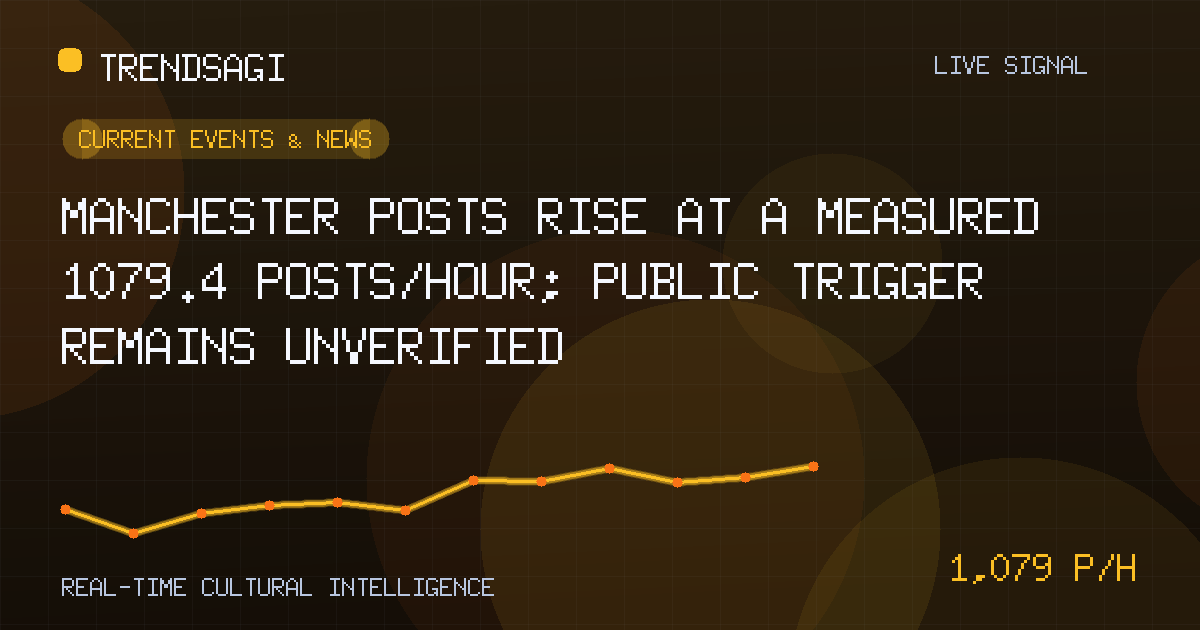
Manchester posts rise at a measured 1079.4 posts/hour; public trigger remains unverified
Manchester posts increased at a measured 1079.4 posts/hour over 894 seconds; this briefing explains the evidence limits and practical checks before acting.
Automated briefing. Generated from stored signal measurements and source-backed research; it is not manually reviewed. Read the methodology and limitations.
Metrics in this briefing are a snapshot associated with its publication date and may not reflect current conditions.
What changed
The Manchester topic shows a rise in captured-post activity, but no verified public trigger has been established. The defensible conclusion is that the signal moved; the reason for that movement remains unresolved.
Across an exact 894-second window using 3 stored observations, the measured snapshot rate was 1079.4 posts/hour. The latest snapshot, observed at 2026-10-03T11:06:59Z, contained 1125 posts. Those are different measures: the first describes change within the window, while the second is the volume captured at one observation.
| Observation time | 2026-10-03T11:06:59Z |
|---|---|
| Measured snapshot rate | 1079.4 posts/hour over an exact 894-second window using 3 stored observations |
| Snapshot volume | 1125 posts |
The rate is retrospective and snapshot-specific. It is not a live or current rate, forecast, reach, engagement total, or count of unique people. Its value is to direct further checks around that observed window.
Why this topic may be moving
No public context was verified that ties this rise to a named event, announcement, or incident. The signal’s Current Events & News classification is an editorial bucket, not evidence of a cause.
Because “Manchester” is a broad label, several mechanisms could produce activity without any one of them being the true public explanation.
- Event-driven attention: People may be responding to breaking local news, an official announcement, or a disruption.
- Scheduled attention: A fixture, performance, conference, or public deadline could concentrate posts.
- Label overlap: A person, organization, team, or wider story may use the same place name while the underlying issue is not local.
- Platform amplification: Reposts, repeated wording, or keyword-matching effects could increase captured activity without an equivalent increase in unique participants.
These are testable possibilities, not confirmed explanations. Confidence should rise only when the post sample and independent public evidence converge on the same event, place, and time.
A fast change in captured posts is evidence of movement in the monitored stream, not proof of a particular cause, public consensus, or equivalent growth in unique participants.
Why it matters
The movement is useful as an investigation lead, especially for a broad place label where unrelated stories can be pooled. It becomes risky when a high posting rate is treated as proof that a particular claim is true.
- Residents: Use the alert to seek local confirmation, not as a substitute for location-specific information.
- Public-facing organizations: Verify the facts before amplifying or responding, especially when the underlying trigger is unknown.
- Journalists: Trace the earliest available posts and demand corroboration before turning volume into a narrative.
- Researchers and monitors: Preserve the distinction between posts, accounts, people, reach, and engagement when reporting the movement.
What the signal can and cannot establish
The signal establishes the observation time, the latest captured volume, the supplied measured snapshot rate, and the direction of change inside the stated window. It identifies a label-level movement that merits inspection.
It does not establish any of the following:
- which event, if any, caused the movement;
- whether the posts concern the city itself rather than a broader use of its name;
- whether posts are original, copied, or automated;
- the sentiment, factual accuracy, or representativeness of the discussion;
- the platform mix, unique-account count, audience size, or real-world reach;
- whether the measured rate persisted after the window.
What to watch next
The next useful evidence should narrow the explanation rather than merely add more volume.
- Earliest usable posts: Inspect the first accessible items around the observation, not only the most-shared later posts. Record their timestamps, asserted facts, named locations, and source links.
- Subtopic consistency: Sample the captured posts and classify them as local news, sport, culture, transport, politics, organizations, unrelated name matches, or unclear. A single dominant thread would support a specific explanation; mixed threads would point toward label overlap.
- Independent corroboration: Check relevant public authorities, event organizers, venues, operators, and reputable reporting for statements that match the place, time, and details in the posts. Do not treat repetition of an unsupported claim as corroboration.
- Separate persistence from size: In later snapshots, compare the new measured posts/hour with 1079.4 posts/hour and the new snapshot volume with 1125 posts as separate reference points. A volume increase is not itself a higher rate.
- Repetition and provenance: Look for identical wording, near-simultaneous bursts, repost chains, and accounts that add no original information. These checks can reveal amplification, but they do not by themselves identify who started the discussion.
- Local relevance and tone: Check whether participants identify a Manchester connection and code a sample for claims and sentiment. Keyword presence alone establishes neither location nor public mood.
Methodology and limitations
The reported 1079.4 posts/hour figure is a measured snapshot rate supplied for an exact 894-second window using 3 stored observations. The 1125-post figure is the latest snapshot volume at 2026-10-03T11:06:59Z. The figures are kept distinct and are not extrapolated.
The observation time marks the collection moment, not the time of any underlying event. No baseline, longer time series, source-level metadata, platform mix, geographic filter, or deduplication method is supplied. Consequently, the signal cannot show whether the rate was unusual for this label, whether activity was sustained, or how representative it was.
Public verification did not establish a trigger, so no event or actor is named as the cause. The appropriate use of this briefing is as a source-checking alert: it documents a measured movement while leaving its explanation open.
Track This Topic for New Signals
Set alerts for future velocity or sentiment changes around this topic.
Explore Tracking PlansAbout TrendsAGI research
TrendsAGI's automated research pipeline publishes dated signal snapshots, methodology notes, and practical workflows for teams evaluating cultural momentum. Read how signals are scoped, scored, and limited in our research methodology.