15-minute window · 3 observations · Measured Sep 30, 2026, 6:21 PM UTC · Provider: go_recent_snapshot_v2
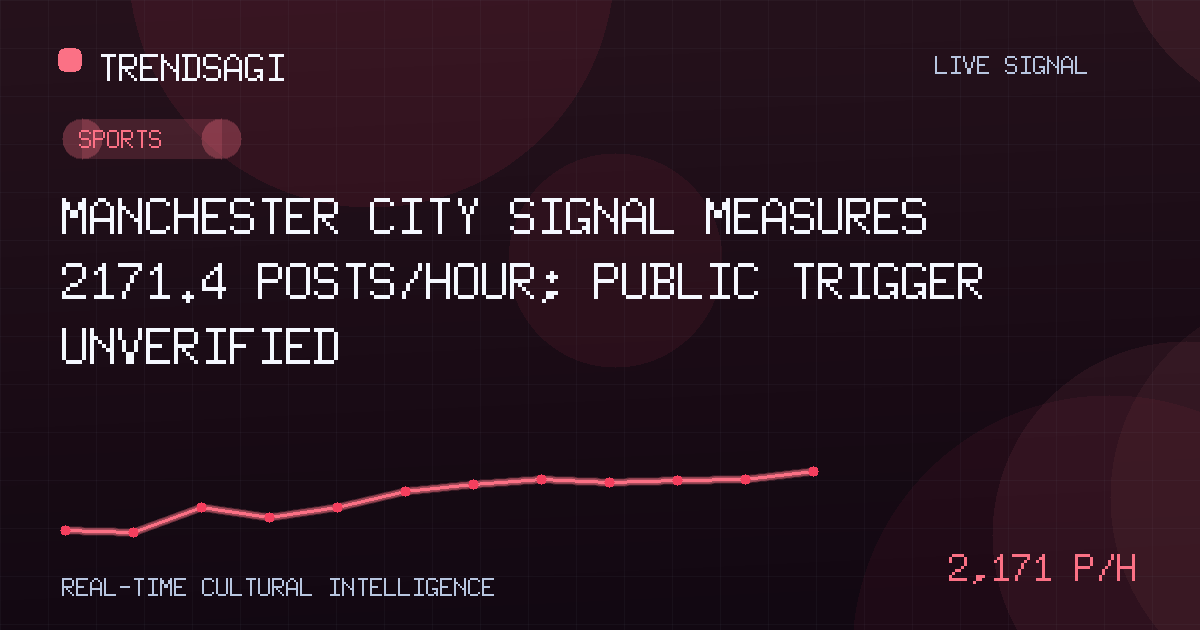
Manchester City signal measures 2171.4 posts/hour; public trigger unverified
Manchester City's latest signal records 1043 posts and 2171.4 posts/hour over 900 seconds, while the public trigger remains unverified.
Automated briefing. Generated from stored signal measurements and source-backed research; it is not manually reviewed. Read the methodology and limitations.
Metrics in this briefing are a snapshot associated with its publication date and may not reflect current conditions.
What changed
The stored signal shows a rapid rise in recorded posting around Manchester City: the latest snapshot contains 1043 posts, and the measured snapshot rate is 2171.4 posts/hour. The defensible answer is that posting activity increased during the measured window, while the event behind that increase remains unverified.
That rate was measured over an exact 900-second window using 3 stored observations, with the snapshot observed at 2026-09-30T18:21:34Z. It is a measured historical snapshot rate—not a live or current rate, forecast, reach figure, engagement total, or count of unique people.
| Metric | Stored value |
|---|---|
| Observation time | 2026-09-30T18:21:34Z |
| Measured snapshot rate | 2171.4 posts/hour |
| Latest snapshot volume | 1043 posts |
No verified match result, fixture, lineup, transfer, injury update, club announcement, award event, or controversy is attached to the signal. It would therefore be unsafe to name any one of them as the cause. What is established is increased activity; what triggered it is still unclear.
Why this topic may be moving
A football topic can accelerate for several reasons, and the topic label alone does not distinguish among them. The most useful interpretation is therefore a prompt for event verification, not evidence that a particular story occurred.
- Match-cycle attention: A result, fixture, lineup, major moment, disciplinary decision, or table consequence could generate concentrated reaction.
- Team news: Selection, availability, suspension, injury, or player-development news could place the club at the center of discussion.
- Transfer or contract discussion: A move, contract development, departure, or rumor could produce rapid commentary.
- Official or media moment: A club statement, player interview, press conference, award event, or broadcast appearance could prompt sharing.
- Secondary amplification: A clip, meme, exchange, or post from a widely followed account could carry the topic beyond ordinary football discussion.
These are candidate mechanisms, not findings. A proposed explanation should be accepted only when its timing and claims can be checked against a verified public source.
A trend signal can establish that posts accumulated; it cannot, by itself, establish which event caused them, whether authors agreed, or whether one narrative dominated.
What the signal can and cannot establish
The record directly supports a limited set of conclusions:
- Manchester City was the tracked topic, assigned to the Sports category.
- The collection recorded 1043 posts in the latest snapshot.
- The calculated measured snapshot rate was 2171.4 posts/hour for the defined window.
- The observation was timestamped, but no verified catalyst is included in the stored signal.
It does not establish sentiment, agreement, originality, or the identity of posters. It also cannot show how many people saw the posts, whether the activity was spontaneous, or whether discussion was positive, negative, factual, satirical, or automated. The signal covers a short measurement window and supplies no prior baseline with which to judge how long the increase will last.
Why it matters
The rate is useful as an alert for editors, supporters, researchers, and monitoring teams, but its meaning depends on the next verification step.
- Supporters and followers: High posting activity can help surface a developing story, but it is not confirmation that a rumor is true or that the club has taken a particular position.
- Journalists and editors: The alert can guide reporting priorities, provided that posts are checked against primary or independently verified information before being treated as news.
- Researchers and benchmarkers: The figures provide a defined observation, but comparisons are meaningful only if collection methods and measurement windows are consistent.
- Sponsorship and communications teams: The signal indicates attention within the measured feed, not favorable sentiment, audience quality, or commercial value.
What to watch next
A useful follow-up should seek corroboration and explanation rather than simply collect more screenshots or reposted headlines.
- Time alignment: Determine whether post timestamps cluster around a match, announcement, broadcast, or another identifiable event.
- Narrative concentration: Review a representative sample and classify the claims being repeated, challenged, or contradicted.
- Account composition: Separate club-linked accounts, journalists, supporters, commentators, news publishers, and automated or coordinated accounts.
- Primary confirmation: Look for a verified club, player, competition, or reputable publisher statement that matches the circulating claim and timing.
- Entity scope: Check whether the discussion concerns the senior team, another Manchester City team, an individual player, a match, or broader club business.
- Distribution: Compare platforms, languages, and geographic concentrations to determine whether activity is broad or localized.
- Persistence: Check later complete windows for continued elevation, a second spike, or a rapid return to the prior pattern.
The strongest confirmation would be a verified event timestamp followed by a clear concentration of original posts discussing that event. Without that connection, the trigger should remain explicitly unknown.
Methodology and limitations
This briefing uses the canonical stored signal: a snapshot observed at 2026-09-30T18:21:34Z, categorized as Sports. The measured change rate was 2171.4 posts/hour over an exact 900-second window using 3 stored observations. It is described here as a measured snapshot rate to preserve that historical and collection-specific context.
The 1043-post value is latest snapshot volume, while 2171.4 is the measured posts/hour figure for the separate measurement window. They are not interchangeable. Because the raw observations and collection definitions are not supplied, the calculations cannot be independently reconstructed, segmented, or reconciled from this record.
Posts are publications, not necessarily people. Repetition, copied content, cross-posting, and automated activity may affect the volume. The signal provides no sentiment, source distribution, platform mix, geography, engagement data, unique-person count, or comparison baseline. It therefore cannot establish causation, public consensus, reach, or a sustained trend. No verified public context accompanies the stored signal, so the reason for the movement remains unclear.
Track This Topic for New Signals
Set alerts for future velocity or sentiment changes around this topic.
Explore Tracking PlansAbout TrendsAGI research
TrendsAGI's automated research pipeline publishes dated signal snapshots, methodology notes, and practical workflows for teams evaluating cultural momentum. Read how signals are scoped, scored, and limited in our research methodology.