15-minute window · 3 observations · Measured Sep 27, 2026, 10:06 AM UTC · Provider: go_recent_snapshot_v2
Man City topic measures 1720.2 posts/hour; reason for movement is unverified
A Man City snapshot recorded 1720.2 posts/hour and 757 posts; the trigger is unverified, with practical checks and watch signals.
Automated briefing. Generated from stored signal measurements and source-backed research; it is not manually reviewed. Read the methodology and limitations.
Metrics in this briefing are a snapshot associated with its publication date and may not reflect current conditions.
What changed
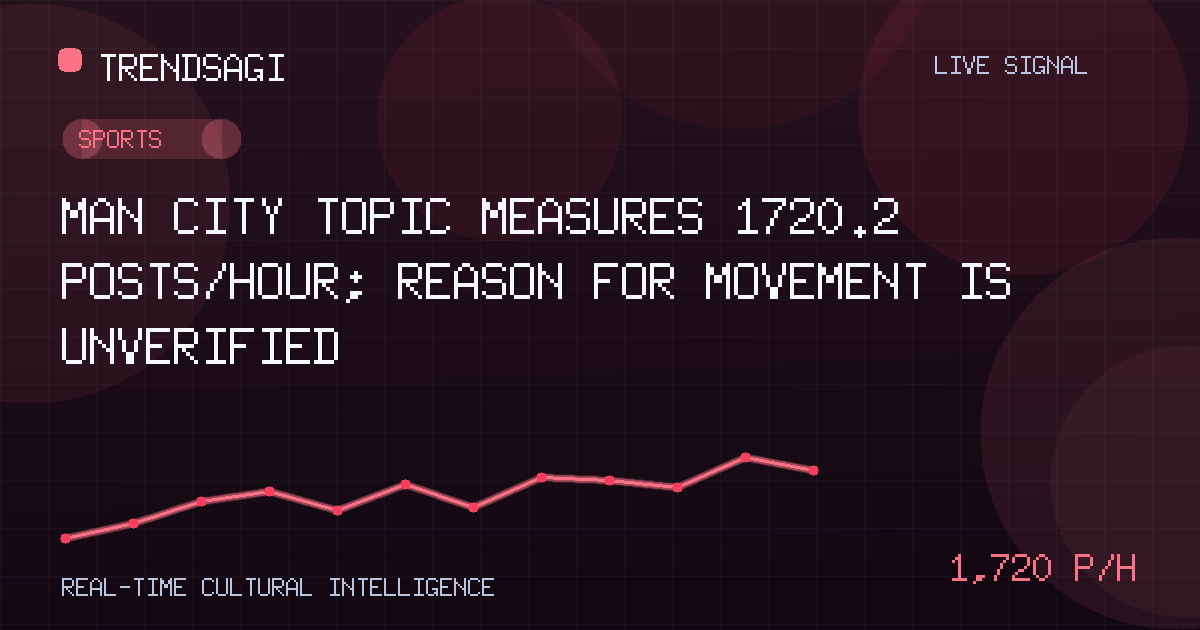
The Man City topic registered a measured snapshot rate of 1720.2 posts/hour, but the reason for the movement is not verified. The defensible conclusion is short-window posting activity around the label, not a confirmed club event.
The latest snapshot contained 757 posts at 2026-09-27T10:06:23Z. The posts/hour figure was measured from 3 stored observations over an exact 900-second window. It is a historical snapshot measurement—not a live rate, forecast, reach, engagement total, or count of unique people.
| Observation time | 2026-09-27T10:06:23Z |
|---|---|
| Measured snapshot rate | 1720.2 posts/hour |
| Latest snapshot volume | 757 posts |
Why this topic may be moving
No specific match result, fixture, transfer, injury, club announcement, or other public development has been verified as the trigger. No verified public context was available to tie the short label to a time-aligned story. The label also does not show whether posts directly discuss the club or merely use its name. Assigning the movement to a headline would go beyond the evidence.
Several explanations remain testable, but none is established:
- Event-led attention: A genuine, timestamped development may have prompted reaction, but a credible page must directly connect it to Man City.
- Official or media pickup: A statement or report may have been reposted, allowing repeated content to lift the rate without adding independent confirmation.
- Entity ambiguity: Match chatter, commentary, memes, or unrelated text may share the label; topic matching alone cannot resolve the subject.
- Conversation artifact: Replies, duplicate wording, coordinated reactions, or potentially automated posting may affect volume. The signal does not establish any of these explanations.
The key test is chronological: a credible item should directly concern the entity and be timestamped early enough to plausibly precede the surge. Even then, timing and relevance make it a leading explanation, not proof from volume alone.
A measured posting rate shows editors where attention accelerated; it does not identify the event that caused it. Until a credible, time-aligned source is verified, the cause remains unconfirmed.
Why it matters
For supporters and general readers, this is a prompt to check whether something material happened, not a substitute for a reliable report. Conversation can be heavy while facts remain disputed, and a consequential announcement can matter even if attention is brief.
- Journalists and editors: Use the topic as a lead-generation alert; verify the event, publication time, and relevance before treating activity as significance.
- Club, player, and supporter communities: Determine whether the posts reflect shared information, speculation, criticism, or a separate issue.
- Risk and reputation teams: Do not equate volume with harm, sentiment, reach, or reliability; inspect content and sources.
- Data readers: Require an entity definition, time window, and metric definition before interpreting the rate.
The shorthand label is a caution. It can combine several story lines, so an aggregate spike may conceal multiple smaller conversations rather than one dominant event.
What to watch next
A useful follow-up should identify the first credible event and the first surge, rather than simply collect more posts. Begin with the exact 900-second interval ending at 2026-09-27T10:06:23Z and preserve the collection rules for comparison.
- Find the earliest surge: Review the first concentration of posts in time order and note whether they introduce facts, quote an existing item, reply, or repeat wording.
- Verify chronology: Compare publication times with the interval. A page published after the surge may describe it but cannot alone explain the onset.
- Resolve the entity: Sample driving posts and confirm that Man City is the subject, not a passing mention. Split story lines only where the text supports it.
- Corroborate independently: Seek a direct official statement or credible publishers addressing the same claim; independent agreement is stronger than copies.
- Inspect content quality: Separate original reporting from replies, reactions, quotations, memes, and repeated text, then test momentum under duplicate-content controls.
- Measure persistence: Compare later windows using identical definitions. A brief spike and sustained activity imply different explanations.
Concrete watch signals are:
- A credible item directly naming the club and timestamped at or before the surge begins.
- Early high-volume posts tracing to a specific, verifiable origin rather than anonymous assertion.
- Independent credible publishers converging on the same development without sharing one source.
- Later comparable windows showing whether the measured rate persists or declines.
- Discussion becoming specific about an event, rather than only repeating the topic label.
- A correction or clarification from a relevant official source.
Methodology and limitations
This briefing uses the supplied signal: 3 observations, an exact 900-second window, a measured snapshot rate of 1720.2 posts/hour, and latest snapshot volume of 757 posts at 2026-09-27T10:06:23Z. The values are reported as provided, without recalculation.
The main limitations are:
- Different metric types: Snapshot volume is a count at an observation; posts/hour is a pace measurement. The figures should not be combined without scope and aggregation definitions.
- No baseline: Without prior activity, the signal cannot establish how unusual the rate is or show who generated the posts.
- Unknown coverage: Platform, geography, language, sampling, deduplication, and account-authenticity rules were not supplied.
- No content conclusions: The signal does not measure sentiment, stance, accuracy, engagement, reach, or unique people, and cannot represent the wider public by itself.
- No verified cause: No public source ties the movement to a specific event, so the rate is a follow-up alert rather than an explanation.
Bottom line: the observation establishes measured Man City posting activity and a 757-post snapshot, but not its cause. The next useful evidence is a verified, directly relevant event aligned to the onset.
Track This Topic for New Signals
Set alerts for future velocity or sentiment changes around this topic.
Explore Tracking PlansAbout TrendsAGI research
TrendsAGI's automated research pipeline publishes dated signal snapshots, methodology notes, and practical workflows for teams evaluating cultural momentum. Read how signals are scoped, scored, and limited in our research methodology.