908-second window · 3 observations · Measured Oct 5, 2026, 3:56 PM UTC · Provider: go_recent_snapshot_v2
Malaysia-labeled monitor records 2545.6 posts/hour; trigger remains unverified
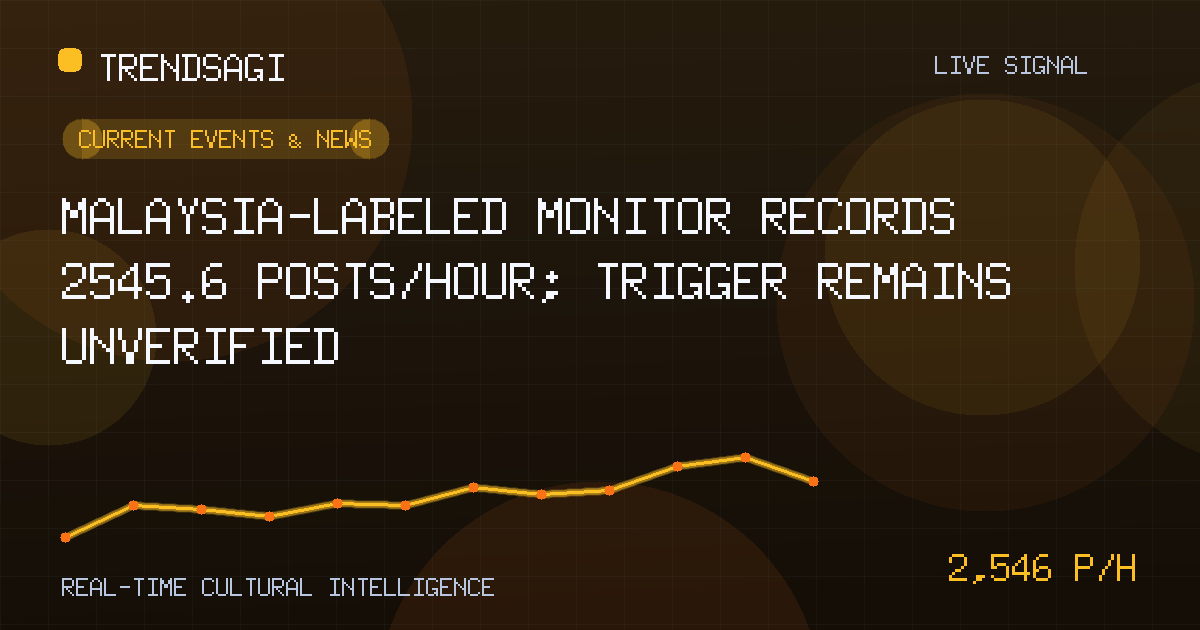
The stored Malaysia-labeled monitor shows 2545.6 posts/hour over an exact 908-second window and 1125 posts; the trigger remains unverified.
Automated briefing. Generated from stored signal measurements and source-backed research; it is not manually reviewed. Read the methodology and limitations.
Metrics in this briefing are a snapshot associated with its publication date and may not reflect current conditions.
What changed
The stored feed carrying the Malaysia label shows a concentrated burst of posting activity, but the available record does not provide enough verified context to identify the news event or other trigger behind it. The latest stored snapshot reported 1125 posts at 2026-10-05T15:56:48Z.
The measured change rate is 2545.6 posts/hour across an exact 908-second window using 3 stored observations. That is a measured snapshot rate for this captured interval—not a live rate, forecast, reach figure, engagement count, or estimate of unique people. The cause of the movement remains unclear.
| Measure | Stored value |
|---|---|
| Observation time | 2026-10-05T15:56:48Z |
| Measured snapshot rate | 2545.6 posts/hour |
| Exact measurement window | 908 seconds |
| Supporting observations | 3 |
| Latest snapshot volume | 1125 posts |
What the signal establishes
The strongest defensible conclusion is narrow: posts carrying the monitored label were arriving at the recorded pace during the measured interval. The system registered 2545.6 posts/hour, while the latest snapshot separately reported 1125 posts. Those values establish a burst inside the monitored corpus; they do not establish why it occurred, what the posts meant, or whether the label accurately described each item.
Neither value is a proxy for public opinion. A post count can rise because important news broke, because an existing story returned to circulation, because many accounts repeated one item, or because the monitoring system captured a broader set of ambiguous uses of the label. The signal also does not show whether the activity was concentrated in Malaysia, elsewhere in the world, or on a single platform.
The measured posting rate can justify a verification check without justifying a causal headline. The defensible status is fast monitored activity with an unverified trigger.
Why this topic may be moving
The available record contains no verified public development that can be matched confidently to the stored timeline. Naming a specific catalyst would therefore exceed the evidence. Possible mechanisms to test—not facts to report—include:
- A genuine breaking-news event may have prompted original reporting and follow-up discussion.
- A scheduled political, sporting, economic, or public-information event may have focused attention.
- An older report may have been recirculated after gaining renewed visibility.
- The broad label may capture more than direct country news, including a place name, organization, market reference, or personal name.
- A platform or collection effect may have increased captured posts without an equivalent rise in distinct conversation.
- Repetition or coordinated amplification may make activity appear broader than it is, although neither can be inferred from the stored signal.
The key distinction is between a real event and a real spike in captured posts. Both may be present, but the supplied signal establishes only the latter. Even if a relevant event is later confirmed, timing alignment and content relevance would still need to be shown.
Why it matters
Fast country-labeled chatter can change editorial priorities, customer-support demand, public-information needs, and risk monitoring. It matters because it provides an efficient prompt for verification, not because volume alone demonstrates significance or truth.
- News editors and fact-checkers should use the signal to identify what must be confirmed before assigning a news cause.
- Communications and public-information teams should determine whether the conversation concerns their organization, audience, or operating environment before responding.
- Businesses, policy analysts, and market observers should inspect the underlying posts rather than treating a country label as evidence of economic or political impact.
- Researchers should retain the raw observations and collection settings if they intend to compare this burst with normal activity or broader datasets.
Readers also need separation between attention and importance. A large number of posts can indicate intense attention, but it cannot establish that an issue is true, urgent, representative, or close to a particular event.
What to watch next
Use specific, falsifiable checks rather than filling the causal gap with the most plausible story.
- Specific event match: Look for a named event and a timestamp that aligns with the measured window. A page merely about Malaysia is not an explanation.
- Independent convergence: Check whether multiple credible reports describe the same event and core facts. A single viral claim is not confirmation.
- Rate persistence: Compare later windows of the same length. Remaining near 2545.6 posts/hour would indicate continued pace; a steep decline would indicate a fading burst. Either result still needs a cause.
- Semantic focus: See whether posts repeatedly name the same event, place, organization, or claim. If no shared subject emerges, label ambiguity becomes more plausible.
- Repetition quality: Separate original posts from copies, quote chains, and scheduled or automated activity. The stored record cannot distinguish them.
- Authoritative response: Watch for a matching official statement, correction, denial, or clarification. Such material could support causal attribution; silence alone cannot disprove an event.
- Independent reach: Check whether verified activity spans separate public sources or remains confined to one platform. The stored observation does not establish broader reach.
A useful editorial standard is to name a trigger only when a specific event, a compatible timeline, and a verifiable public record all line up. Until then, report the measured rate and state that the cause is unverified.
Methodology and limitations
The 2545.6 posts/hour figure is a measured snapshot rate derived from 3 stored observations across an exact 908-second window and associated with 2026-10-05T15:56:48Z. The 1125-post figure is snapshot volume, a separate count. It is not a rate, denominator, or audience estimate, and it should not be used to extrapolate.
The dataset supplies no previous baseline, platform coverage, language coverage, collection geography, deduplication rules, account uniqueness, sentiment, engagement, or organic-versus-coordinated classification. It therefore cannot establish how large the change was relative to normal activity, how many people participated, or what they believed.
Nor can it establish the nationality or location of posters. The Malaysia label is used here only as a monitor label, not proof that every post concerned the country. No external event is named because the available record did not contain a sufficiently verified public match to the timeline. The appropriate conclusion is therefore a fast monitored signal with an unverified cause, not a verified national trend with a known catalyst.
Track This Topic for New Signals
Set alerts for future velocity or sentiment changes around this topic.
Explore Tracking PlansAbout TrendsAGI research
TrendsAGI's automated research pipeline publishes dated signal snapshots, methodology notes, and practical workflows for teams evaluating cultural momentum. Read how signals are scoped, scored, and limited in our research methodology.