901-second window · 3 observations · Measured Sep 26, 2026, 12:55 AM UTC · Provider: go_recent_snapshot_v2
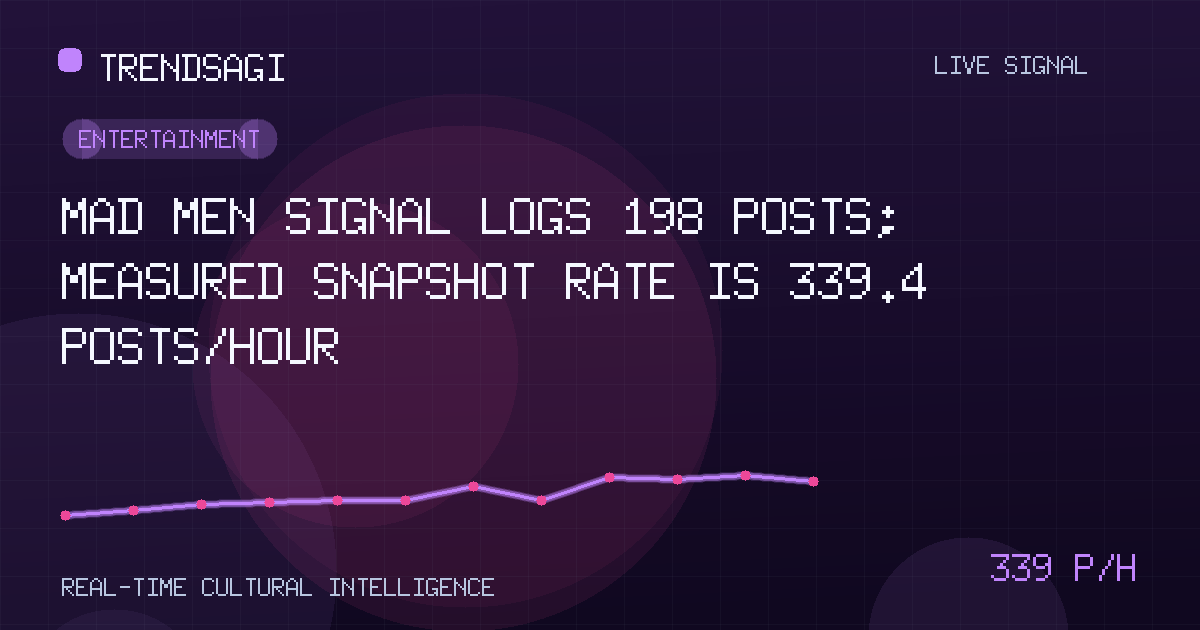
Mad Men signal logs 198 posts; measured snapshot rate is 339.4 posts/hour
A stored “Mad Men” snapshot logged 198 posts and a measured 339.4 posts/hour; here is what is established, what remains uncertain, and what to verify next.
Automated briefing. Generated from stored signal measurements and source-backed research; it is not manually reviewed. Read the methodology and limitations.
Metrics in this briefing are a snapshot associated with its publication date and may not reflect current conditions.
What changed
Answer: The stored signal for Mad Men captured 198 posts in its latest snapshot, observed at 2026-09-26T00:55:52Z. That identifies a discussion burst worth checking, but it does not identify the cause. No specific news event, release, controversy, or other public catalyst is verified in the available record.
Measured change: The measured snapshot rate was 339.4 posts/hour over an exact 901-second window using 3 stored observations. It is a retrospective measure of activity in that window—not a live or current rate, forecast, reach figure, engagement figure, or unique-person count. With no historical baseline supplied, it also does not prove a record increase.
| Observation time | Measured snapshot rate | Latest snapshot volume |
|---|---|---|
| 2026-09-26T00:55:52Z | 339.4 posts/hour | 198 posts |
Why this topic may be moving
The reason for the movement is still unclear. The stored signal contains counts and timing but no post text, named sources, link targets, or matched event. A verified explanation would require a concrete item that demonstrably preceded or accompanied the cluster; the available record does not provide one.
Several mechanisms are plausible and should be treated only as hypotheses: resurfacing older media, newly published commentary, a distribution change, a controversy attached to someone associated with the topic, or repeated use of the phrase in a broader media and advertising discussion. None of those possibilities is confirmed by this signal.
The label may also be combining different conversations. Without reading a representative sample, an editor cannot tell whether posts concern a particular work, a person, the expression “mad men,” or unrelated uses of the same words. That semantic uncertainty is a material limit on causal interpretation.
The signal is evidence of a short-window burst in labeled posting, not yet evidence of a new cultural event or a durable revival in interest.
What the signal establishes
The strongest conclusions are narrow and useful:
- Presence: The monitored snapshot contained 198 posts assigned the topic label at the stated time.
- Velocity: The stored observations produced a measured snapshot rate of 339.4 posts/hour across the stated window.
- Verification priority: The rate provides a concrete reason to check for a shared trigger, repeated source material, or unusually concentrated posting.
It does not establish:
- Cause: There is no verified catalyst tied to the initial cluster.
- Scale beyond the sample: The supplied figures do not reveal total conversation volume, unique authors, organic reach, or exposure outside the monitored collection.
- Audience character: They do not show sentiment, geography, platform mix, or whether discussion was supportive, critical, or neutral.
- Persistence: A short observation window cannot show whether attention continued after the snapshot.
Why it matters
For media and entertainment editors, this is a verification lead rather than a ready-made story. The signal can direct attention to a fast-moving label without forcing an unsupported claim about a particular event. A responsible update should wait for a dated source, inspect the posts themselves, or find a clear pattern connecting the activity to an identifiable subject.
For marketing, social, and audience teams, high label velocity should not be treated as consensus. Repeated wording, shared links, or a narrow set of prolific accounts can make a topic appear broader than it is. Conversely, independently authored posts discussing distinct angles would provide stronger evidence of wider attention.
For researchers, the topic label is only the starting unit. Semantic drift, duplicate reposts, and changes in collection coverage can all affect interpretation. Any serious analysis therefore needs post-level review and account-level context before drawing conclusions about public interest.
What to watch next
The most useful follow-up checks are concrete:
- Earliest credible item: Check whether a report, interview, clip, announcement, or other primary item predates the cluster. Independent follow-up can reinforce relevance, but an article published only after the activity cannot by itself explain the initial burst.
- Representative post sample: Read early and widely circulated posts, record what “Mad Men” denotes, and note recurring claims. A shared subject or source is stronger causal evidence than the label alone.
- Repetition and coordination: Compare wording, links, timing, and account overlap. Narrow repetition may indicate amplification; varied, independently authored posts would support a broader conversation. Neither pattern alone proves intent.
- Comparable follow-up: Use the same collection logic and measurement window to see whether activity continues, recedes, or stops. Do not compare a future live count directly with this measured snapshot rate.
- Audience breadth: If available, inspect unique accounts, publishers, platforms, and geography. Activity across independent sources is meaningfully different from many posts from a narrow set.
- Concrete watch signals: A verified pre-cluster item, repeated references to a new phrase or media asset, diverse independent citations, and sustained comparable activity would strengthen the trend interpretation.
Methodology and limitations
The measurement uses 3 stored observations across an exact 901-second window, with the latest snapshot logged at 2026-09-26T00:55:52Z. The 198-post figure is snapshot volume; the 339.4 posts/hour figure is a measured snapshot rate. They describe different aspects of the signal and should not be combined or treated as interchangeable.
No sampling frame, account-level deduplication, historical comparison, sentiment coding, geographic breakdown, post excerpts, or verified external context accompanies the signal. Consequently, the cause remains unverified, and this result should guide further checking rather than serve as proof of a durable trend. No external catalyst is asserted because none could be verified.
Track This Topic for New Signals
Set alerts for future velocity or sentiment changes around this topic.
Explore Tracking PlansAbout TrendsAGI research
TrendsAGI's automated research pipeline publishes dated signal snapshots, methodology notes, and practical workflows for teams evaluating cultural momentum. Read how signals are scoped, scored, and limited in our research methodology.


