15-minute window · 3 observations · Measured Sep 23, 2026, 8:36 PM UTC · Provider: go_recent_snapshot_v2
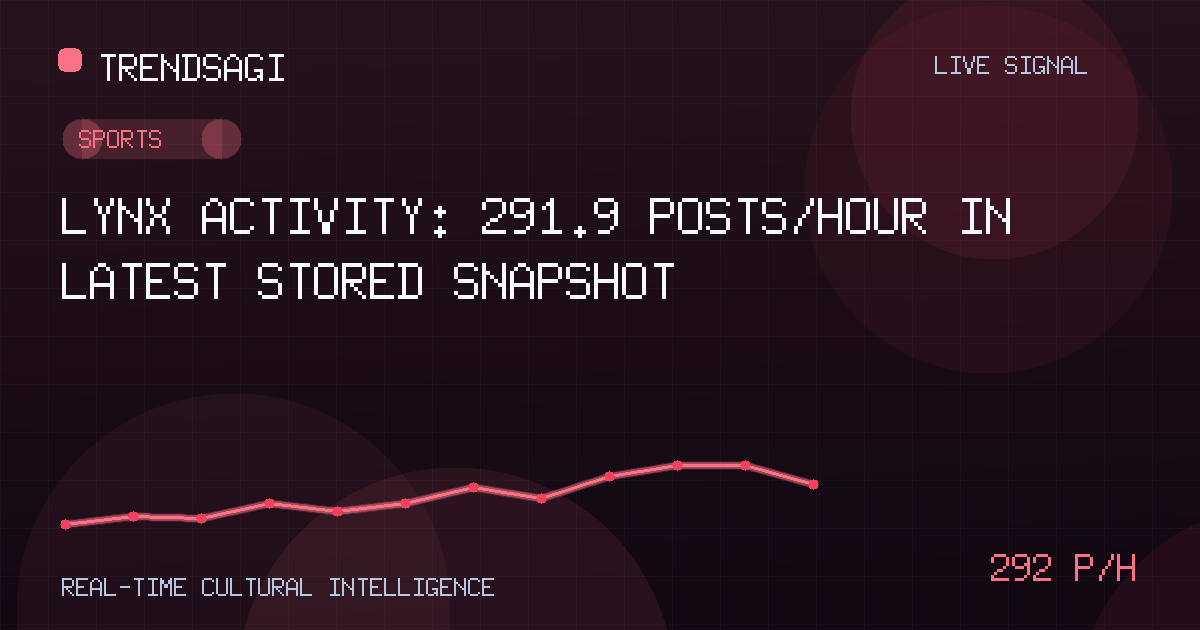
Lynx activity: 291.9 posts/hour in latest stored snapshot
Lynx shows 291.9 measured posts/hour in the latest stored snapshot; review the verified limits, open questions, and next checks.
Automated briefing. Generated from stored signal measurements and source-backed research; it is not manually reviewed. Read the methodology and limitations.
Metrics in this briefing are a snapshot associated with its publication date and may not reflect current conditions.
What changed
The sports-tagged topic “Lynx” shows a measurable cluster of posting activity, but no verified catalyst is established in the available record. It is useful as a monitoring signal, not proof that a particular team, game, or news event caused the activity.
The latest stored observation, taken at 2026-09-23T20:36:41Z, contained 411 posts. The measured change rate was 291.9 posts/hour over an exact 900-second window using 3 stored observations. This is a measured snapshot rate from the supplied record, not a live/current rate, forecast, reach, engagement, or count of unique people.
| Observation time | 2026-09-23T20:36:41Z |
|---|---|
| Measured snapshot rate | 291.9 posts/hour |
| Exact measurement window | 900 seconds |
| Stored observations used | 3 |
| Latest snapshot volume | 411 posts |
Why this topic may be moving
No verified public context identifies why the topic is moving. The label is not entity-resolved: the record does not specify which team, competition, athlete, or other sports subject “Lynx” denotes. The stored category supplies a broad classification, not a particular event.
A label-level cluster can reflect several different conversations. Volume alone cannot distinguish a reaction to news from unrelated uses of the same word, repeated content, or coordinated posting. These are possibilities to investigate, not findings about this signal. Resolving the subject and examining the actual posts are necessary before choosing among them.
Use Google Search to test candidate explanations against the observation date and time. Begin with the exact label, then try plausible entity names to generate candidates; confirm the identity against the posting sample. A public result should be treated as an explanation only if it independently matches both the subject and the timing. A merely related headline is not enough. The cause remains unclear until that match is established.
Why it matters
Sports editors and social-desk teams should care because a fast-moving label can be checked before it becomes a headline. Verification should come before causal language: a newsroom can accurately report the observed activity while leaving its reason unresolved.
Team, league, athlete, or event communications teams should check whether the label refers to their subject. If it does, a developing story may warrant attention; if it does not, attributing the cluster to them would be unsafe. Community managers and moderators should inspect the posts for spam, repetition, or coordinated behavior before interpreting the activity as broad organic interest.
Analysts should also avoid treating the figures as evidence of audience size, sentiment, or market impact. They establish posting frequency in a specific label and window, not the people behind the posts or their importance.
A measured posting rate can establish that activity occurred in a label and time window; it cannot, by itself, establish the event behind that activity.
What to watch next
- Entity resolution: Identify the exact team, league, player, event, or other subject represented by “Lynx.” Confirm that the sampled posts use the label in that sense.
- A matching public catalyst: Use Google Search around 2026-09-23T20:36:41Z to look for an independently corroborated announcement, result, or incident that fits both the subject and timing.
- Comparable follow-up measurements: Compare later rates with 291.9 posts/hour only when the measurement definition is consistent. Do not compare a new snapshot count directly with a posts/hour rate. Another observation would update the picture but would not alone establish a lasting trend.
- Post composition: Check whether posts are original, repeated, quoted, or automated, and whether discussion is concentrated among a small set of accounts. The stored figures cannot answer those questions.
- Conversation content: Read a representative sample for factual claims, reactions, confusion about the label, criticism, or support. Posting volume alone provides no sentiment reading.
- Persistence and distribution: Look for continued activity in later windows and a clear match to a specific community. Neither persistence nor geographic or language concentration is established here.
Methodology and limitations
The reported rate is 291.9 posts/hour over an exact 900-second window using 3 stored observations, with the reported measurement timestamp of 2026-09-23T20:36:41Z. The separate latest snapshot volume is 411 posts. Snapshot volume is not a rate, and this briefing does not reconstruct the rate from the volume or infer missing observations.
The “Sports” category is a stored classification, not entity resolution. No baseline, sentiment breakdown, location data, author counts, source distribution, or duplication analysis is supplied. Consequently, the record cannot establish relative growth, the reason for the activity, whether the posts are organic, or their real-world significance.
No causal explanation is asserted because no corroborating public context has been verified. That does not establish that no event occurred; it means a candidate event and this measured activity should not be treated as connected without evidence.
Track This Topic for New Signals
Set alerts for future velocity or sentiment changes around this topic.
Explore Tracking PlansAbout TrendsAGI research
TrendsAGI's automated research pipeline publishes dated signal snapshots, methodology notes, and practical workflows for teams evaluating cultural momentum. Read how signals are scoped, scored, and limited in our research methodology.


