891-second window · 3 observations · Measured Oct 8, 2026, 9:56 AM UTC · Provider: go_recent_snapshot_v2
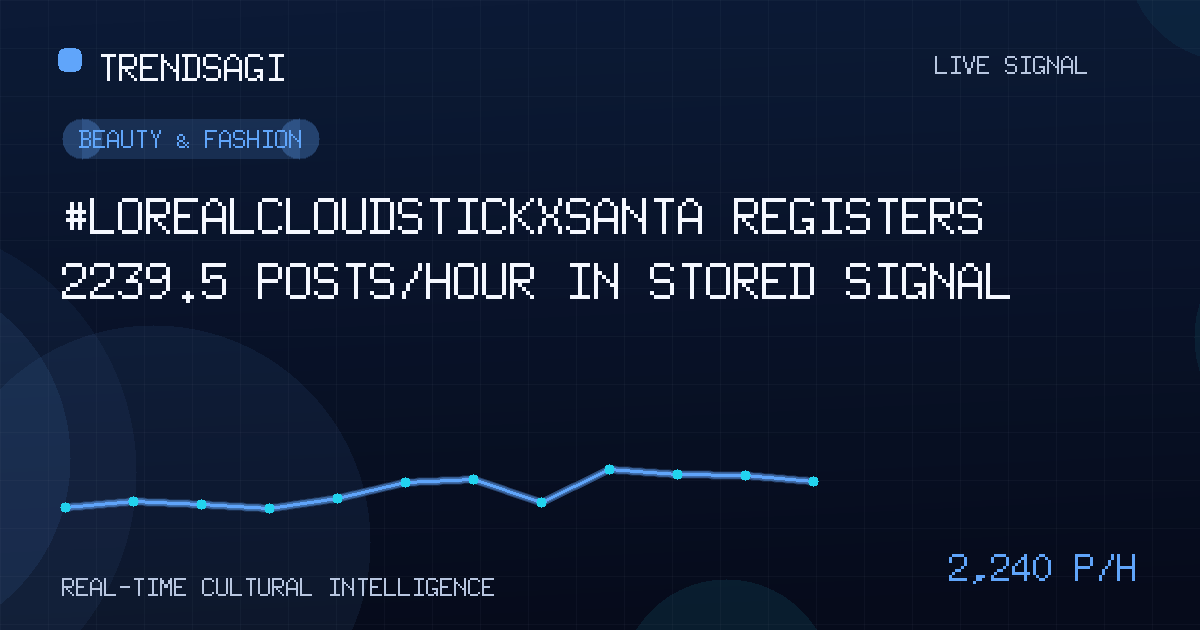
#LOrealCloudStickxSanta registers 2239.5 posts/hour in stored signal
#LOrealCloudStickxSanta shows 2239.5 posts/hour and 1180 snapshot posts; the trigger, audience, reach, and persistence still need verification.
Automated briefing. Generated from stored signal measurements and source-backed research; it is not manually reviewed. Read the methodology and limitations.
Metrics in this briefing are a snapshot associated with its publication date and may not reflect current conditions.
What changed
The stored signal for #LOrealCloudStickxSanta shows a measured snapshot rate of 2239.5 posts/hour at the latest observation, but the reason for the movement is not verified. No specific public source has been confirmed as the trigger, so the activity should not be presented as a proven product launch, collaboration, promotion, or seasonal release.
The rate was measured at 2026-10-08T09:56:28Z over an exact 891-second window using 3 stored observations. The latest snapshot volume was 1180 posts. Snapshot volume is a separate count, not a rate; neither metric establishes reach, engagement, a live forecast, or unique people.
| Metric | Stored value |
|---|---|
| Observation time | 2026-10-08T09:56:28Z |
| Measured snapshot rate | 2239.5 posts/hour |
| Measurement basis | Exact 891-second window using 3 stored observations |
| Latest snapshot volume | 1180 posts |
What the signal can establish
The defensible finding is that the monitored series registered meaningful posting velocity at the stated timestamp. That is enough to justify a prompt source check, but not enough to describe the signal as a broad consumer trend or a confirmed commercial event.
- Observed velocity: The stored series calculated a 2239.5 posts/hour snapshot rate.
- Snapshot scale: The latest observation contained 1180 posts, although the supplied data does not identify how many distinct accounts created them.
- Editorial classification: The topic is stored under Beauty & Fashion, which helps route it to relevant teams but does not verify that every matching post concerns the same subject.
The alert establishes that the monitored series registered a short-window rate; it does not identify who posted, why they posted, whether those posts were independent, or whether the activity continued.
The signal also lacks an account-level sample, engagement data, geographic distribution, sentiment, and an earlier comparison window. Without those, it cannot establish historical significance, organic interest, audience size, or sales relevance.
Why this topic may be moving
The wording appears to combine what looks like a brand name, Cloud Stick, x, and Santa. That syntax invites a product, collaboration, or holiday interpretation, but it is only a reading of the label—not verification of an official campaign or relationship.
Several mechanisms could explain the measured activity, and each requires a different verification path:
- Source amplification: An initial brand, retailer, creator, or publication post could have been copied rapidly. The origin and repost chain are not supplied.
- Product or retail attention: Posts about demonstrations, availability, pricing, or gifting could produce concentrated activity if a verified product source exists. None is confirmed here.
- Seasonal framing: Santa-related wording may encourage informal use of the label even without a formal seasonal campaign. That possibility does not establish one.
- Repetition or coordination: Shared wording, links, or media could inflate posting velocity without representing equivalent independent interest.
- Label ambiguity: Alternate spellings, capitalization changes, or unrelated uses might be combined by a collection system. The query and normalization rules are not provided.
None of these explanations is an established finding. The cause remains unclear until the earliest attributable source, the propagation pattern, and any relevant public statement align. In particular, the word x does not prove a collaboration, and Santa does not prove a holiday edition.
Why it matters
For a beauty or fashion organization, this is a verification task before it becomes a communications decision. The rate may reflect a campaign, a product-information need, a coordinated burst, or a collection artifact, each with a different response.
- Brand and social teams should verify ownership and campaign status before publishing reactive content or repeating product claims.
- Retailers and customer-service teams should check whether the label is tied to a real listing or availability question before preparing responses.
- Creators and reviewers should not treat posting volume as proof of product popularity, efficacy, or consumer sentiment.
- Trend and media analysts should keep the rate and snapshot volume separate and avoid describing either as audience reach.
The immediate risk is not simply missing a trend. It is assigning a confident campaign narrative to a spike whose source, persistence, and audience composition remain unknown.
What to watch next
- Trace the source chain: Use an exact Google search for the label, inspect the earliest identifiable posts, and distinguish original material from direct copies. Later amplification should not be mistaken for origin.
- Verify an attributable explanation: Look for a relevant brand, retailer, creator, or publication statement that explicitly connects the label to an activity. Do not infer a collaboration from wording alone.
- Rebuild the activity curve: Continue collecting comparable windows and record the measured rate separately from snapshot volume. A short spike that quickly recedes has a different interpretation from sustained posting velocity.
- Audit participation quality: Check the number of distinct accounts, original versus reposted content, account history, repetition, language, and geography. This will help distinguish diverse interest from a concentrated burst.
- Test practical relevance: Classify whether posts are asking about a product, price, availability, gifting, usage, criticism, or something unrelated. Then check attributable retail listings, outbound links, inventory changes, and reader questions if access is available.
Evidence of an attributable source, independent follow-on posts, and continued measured activity would justify stronger coverage. If no source chain emerges and the rate recedes, the signal should remain a low-confidence, short-lived monitoring event rather than a confirmed market trend.
Methodology and limitations
The reported 2239.5 posts/hour figure is a measured snapshot rate derived from 3 stored observations across an exact 891-second window at 2026-10-08T09:56:28Z. It is not a live or current rate, forecast, reach, engagement result, or unique-person count. The separate snapshot volume of 1180 posts should not be added to the rate or used to infer total activity outside the observed window.
The exact window may be sensitive to where its observations begin and end. Without a prior baseline, the result cannot be ranked as historically high or low. The stored category is Beauty & Fashion, while the stored narrative description is empty, so there is no supplied context explaining the label or its collection method.
No independently verified public explanation was available for this briefing. Consequently, the change is measurable but its cause is not. Account-level content, collection rules, sentiment, engagement, geography, and commercial outcomes would be required before making broader claims.
Track This Topic for New Signals
Set alerts for future velocity or sentiment changes around this topic.
Explore Tracking PlansAbout TrendsAGI research
TrendsAGI's automated research pipeline publishes dated signal snapshots, methodology notes, and practical workflows for teams evaluating cultural momentum. Read how signals are scoped, scored, and limited in our research methodology.


