1017-second window · 2 observations · Measured Sep 23, 2026, 4:10 PM UTC · Provider: go_recent_snapshot_v2
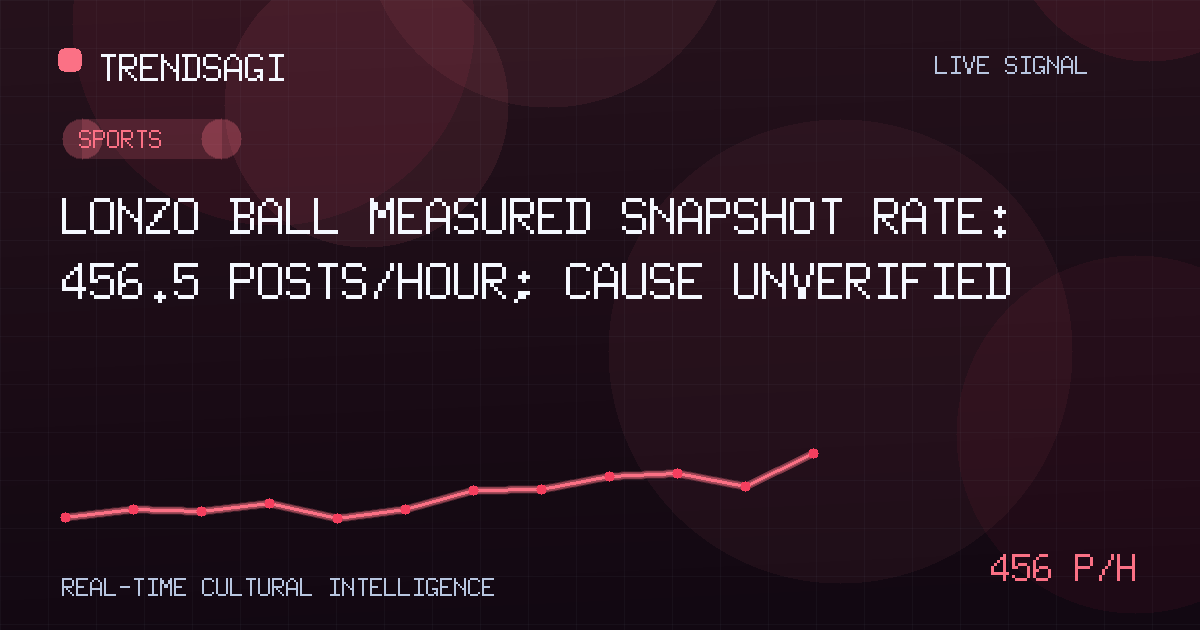
Lonzo Ball measured snapshot rate: 456.5 posts/hour; cause unverified
A stored Lonzo Ball snapshot measured 456.5 posts/hour; the rise is clear, but editors should verify the cause before treating it as breaking news.
Automated briefing. Generated from stored signal measurements and source-backed research; it is not manually reviewed. Read the methodology and limitations.
Metrics in this briefing are a snapshot associated with its publication date and may not reflect current conditions.
What changed
Lonzo Ball was associated with a measured rise in tracked discussion in the latest stored snapshot, but its cause is not verified. The supported conclusion is that posting activity around his name increased in the observed window—not that a particular basketball event occurred.
The measured snapshot rate was 456.5 posts/hour over an exact 1017-second window, based on 2 stored observations and measured at 2026-09-23T16:10:53Z. The latest snapshot volume was 444 posts. This is a retrospective snapshot rate, not a live rate, forecast, reach estimate, engagement measure, or count of unique people.
| Observation time | Measured snapshot rate | Latest snapshot volume |
|---|---|---|
| 2026-09-23T16:10:53Z | 456.5 posts/hour | 444 posts |
Why this topic may be moving
The available record contains no verified public context establishing why the topic is moving. It is classified as Sports, but the signal has no accompanying event description. It would be unsupported to attribute the increase to a game, injury, roster decision, contract, or announcement without a source connecting that event to the observed activity.
Several mechanisms could produce this pattern, and the current evidence does not distinguish among them:
- A new basketball development may have prompted reaction, but no such event is established here.
- A clip, quotation, or older report may have been recirculated, increasing visibility without a new underlying event.
- Posts may be concentrated around one shared item rather than many independent conversations.
- A broader conversation may have amplified discussion in a way the topic classification does not identify.
A measured rise tells you where to look next, not what happened. A strong explanation would connect the observation timing, the originating content, and independently verified public context. Without that chain, “unexplained increase in tracked discussion” is the most accurate description.
For a named person, repetition can establish that a name appeared in captured posts; it cannot, by itself, establish that the underlying claim is true, that the event is new, or that the person took a particular action. A later discovery of a relevant event would also need its publication time checked against the observation window.
Why it matters
The signal gives editors a reason to investigate a possible development, not a basis for announcing one. Its strongest supported finding is temporal: captured posting activity rose during the measured window. Its principal weakness is explanatory: no catalyst has been verified.
- News editors can prioritize verification, then seek a primary source before publishing a causal headline.
- Team, league, and player stakeholders should check for a genuine new statement before responding to the apparent attention.
- Audience and media teams should treat the signal as a monitoring lead, not proof of broad interest, sentiment change, or commercial impact.
- Trend researchers should keep the measured change rate and snapshot volume separate: 456.5 posts/hour describes measured change, while 444 posts describes captured presence at the observation time.
The 444-post snapshot could contain many distinct conversations, several reactions to one item, or substantial duplication. Each case has a different editorial meaning, and the signal does not distinguish them. Nor does it show whether participants agree. A fast increase in mentions can coexist with disputed, negative, neutral, or positive reactions; none should be inferred from post count alone.
What to watch next
Verification should follow the chain from content to timing to cause rather than start with a preferred explanation.
- Find the originating content. Review substantive posts inside the observed window, trace repeated wording or media to an earlier source, and separate original material from copying or reposting.
- Test the proposed event. Look for a timestamped announcement or a reputable publisher’s report that actually concerns Lonzo Ball and circulated during the window. A later explanation must not be written as if it caused an earlier increase.
- Inspect concentration. Check whether the latest 444-post snapshot is dominated by one link, clip, quotation, account cluster, or recurring claim. Also review any documented limits on duplicate and repost collection.
- Compare like measures. Compare a subsequent measured rate with 456.5 posts/hour, and compare a subsequent snapshot volume separately with 444 posts. A rate and a snapshot count are not interchangeable.
- Require a supported catalyst. If independent sources establish a new event that preceded the activity, report it with attribution and timing. If they do not, retain the label “cause unverified” and avoid promoting a rumor into an explanation.
Concrete follow-up signals are a primary-source explanation preceding the cluster, independent follow-on reporting, and subsequent measured rates that sustain or reverse this movement. If none appears, the signal remains a short-window attention alert—not a confirmed news event or a durable trend.
Methodology and limitations
The measured snapshot rate comes from 2 stored observations across the exact 1017-second window, with the result recorded at 2026-09-23T16:10:53Z. The latest snapshot volume of 444 posts is a separate count. The former describes how quickly the captured post count changed between observations; the latter describes how many posts were present in the latest snapshot. Neither figure establishes reach, engagement, unique people, or sentiment.
The limited observations constrain confidence in persistence. The available record does not expose the underlying post text, source links, account distribution, or verified event context. It therefore cannot establish whether the movement came from original reporting, public reaction, reposting, duplication, or unrelated uses of the name.
Coverage also depends on what the monitoring system captured. The snapshot is not a population total, and the measured rate is not a complete measure of activity elsewhere. No forecast is warranted from this short window. If verification does not identify a public event, the most accurate characterization is an unexplained increase in tracked discussion.
Track This Topic for New Signals
Set alerts for future velocity or sentiment changes around this topic.
Explore Tracking PlansAbout TrendsAGI research
TrendsAGI's automated research pipeline publishes dated signal snapshots, methodology notes, and practical workflows for teams evaluating cultural momentum. Read how signals are scoped, scored, and limited in our research methodology.