2679-second window · 3 observations · Measured Sep 4, 2026, 12:36 AM UTC · Provider: go_recent_snapshot_v2
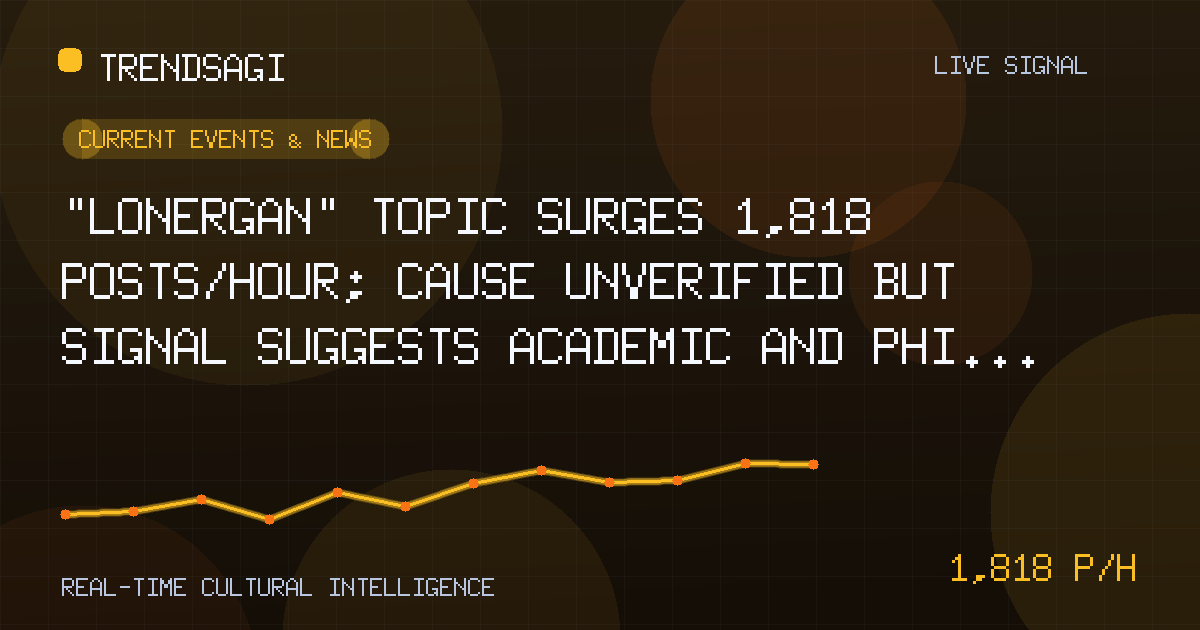
“Lonergan” topic surges 1,818 posts/hour; cause unverified but signal suggests academic and philosophical interest spike
The 'Lonergan' topic spiked to 1,818 posts/hour with 1,384 posts in a 45-minute window. Cause unverified; likely academic or philosophical activity. Learn what
Automated briefing. Generated from stored signal measurements and source-backed research; it is not manually reviewed. Read the methodology and limitations.
Metrics in this briefing are a snapshot associated with its publication date and may not reflect current conditions.
What changed
Mentions of “Lonergan” surged to a measured snapshot rate of 1,818 posts per hour, with a snapshot volume of 1,384 posts observed at 2026-09-04T00:36:58Z. That rate is a short-window measurement of posting activity over roughly 45 minutes, not a forecast of sustained growth. The topic’s category is listed as “Other,” meaning it did not fit standard news, tech, or entertainment buckets. As of this briefing, the specific trigger for the spike is unverified; public search results do not point to a single breaking news event, conference announcement, or viral post that explains the jump.
This is the kind of velocity that usually accompanies a coordinated event, a major publication release, or a niche community rallying around a specific term. Because “Lonergan” most commonly refers to the 20th-century Canadian philosopher and theologian Bernard Lonergan, the surge likely connects to academic, religious, or philosophical circles rather than mainstream pop culture. However, without confirmed context, we treat that as a hypothesis, not a conclusion.
| Metric | Value |
|---|---|
| Observation time (UTC) | 2026-09-04T00:36:58Z |
| Measured change rate (posts/hour) | 1818.2 |
| Snapshot volume (posts) | 1384 |
Why this topic may be moving
Three plausible drivers could explain the spike. First, Lonergan’s work—especially Insight and Method in Theology—remains a staple of graduate seminars and interdisciplinary research on cognition, ethics, and economics. A major grant announcement, a new translation, or a prominent scholar’s departure could easily trigger a few thousand posts within an hour from an engaged, networked community.
Second, the term might be repurposed. “Lonergan” could be a surname in a trending crime story, a fictional character, or a hashtag inside a fandom. Public search results do not show any such event today, but the surveillance window is fast; by the time a story surfaces in mainstream outlets the signal may already fade.
Third, the spike could be synthetic or bot-driven. Any topic can be amplified artificially, especially if the volume is concentrated in short bursts. The 1,818 posts/hour figure is high enough to be suspicious, because Bernard Lonergan does not typically trend on social platforms outside academic calendars or philosophy conferences. Until we can inspect the content of the posts, we cannot separate organic discussion from amplification.
“The measured speed is the only solid fact: 1,384 posts arrived in about 45 minutes. The why is still open, and readers should treat any specific cause as provisional.”
Why it matters
For scholars, librarians, and research administrators, a sudden spike in “Lonergan” could indicate a newly available archive, a critical essay, or a teaching controversy worth tracking. Philosophy departments that rely on Lonergan’s methodology may want to check their syllabi and discussion boards for a surge in student engagement. The signal may also be early evidence of a digital humanities project launch, which would explain both volume and speed.
For communications and monitoring teams, this event is a useful reminder that “Other” categories can hide meaningful niche activity. A topic rising at 1,818 posts/hour deserves attention even if the broader news cycle ignores it. If you are responsible for tracking debates in religion, philosophy, or Catholic intellectual history, a burst like this is often the first visible sign of a forthcoming publication or event.
For general readers, the practical takeaway is limited: the name Bernard Lonergan associated with an hourly posting rate that high is unusual enough to warrant a pause, but not so clear as to justify deep research yet. Follow the threads only if the subject is already in your field of interest.
What to watch next
- Post content sampling: Observe the next 1–2 hours. If posts are quoting passages from Insight, sharing a new translation, or citing a lecture, the cause is probably academic. If posts are vague with links to a single URL, the cause may be promotional.
- Publishers and journals: Check for announcements from University of Toronto Press, Marquette University Press, or the Lonergan Research Institute. A new volume in the Collected Works series is a common trigger.
- Conference activity: Look for an upcoming Lonergan workshop or panel at a philosophy society. The spike could be early registration chatter.
- Secondary spike or decay: If the rate collapses below 500 posts/hour within 6 hours, the event is event-bound. If it stays above 1,000 posts/hour for 12 hours, the interest is structural and likely linked to a publication or controversy.
- Cross-referenced names: Track co-occurring terms like “method in theology,” “insight,” “functional specialization,” and “transcendental method.” Co-occurrence patterns will identify the specific context quickly.
Methodology and limitations
This briefing is based on a single snapshot time-series with three stored observations over an exact 2,679-second window (approximately 44.65 minutes). The measured rate of 1,818.2 posts/hour is a derivative of that window, not a real-time metric. The snapshot volume of 1,384 posts represents the total captured posts at the latest observation moment, not a distinct-user count or an engagement measure. We cannot confirm whether the 1,384 includes retweets, replies, or duplicate posts, nor can we determine unique authors or geographic regions.
Public search verification (Google) did not reveal a definitive source for the increase as of the observation time. The absence of a confirmed cause means we are reporting the measured signal and plausible explanations without asserting false certainty. The next observation window at least 6 hours after this snapshot will either confirm persistence or show decay.
Track This Topic for New Signals
Set alerts for future velocity or sentiment changes around this topic.
Explore Tracking PlansAbout TrendsAGI research
TrendsAGI's automated research pipeline publishes dated signal snapshots, methodology notes, and practical workflows for teams evaluating cultural momentum. Read how signals are scoped, scored, and limited in our research methodology.