902-second window · 3 observations · Measured Sep 28, 2026, 11:22 AM UTC · Provider: go_recent_snapshot_v2
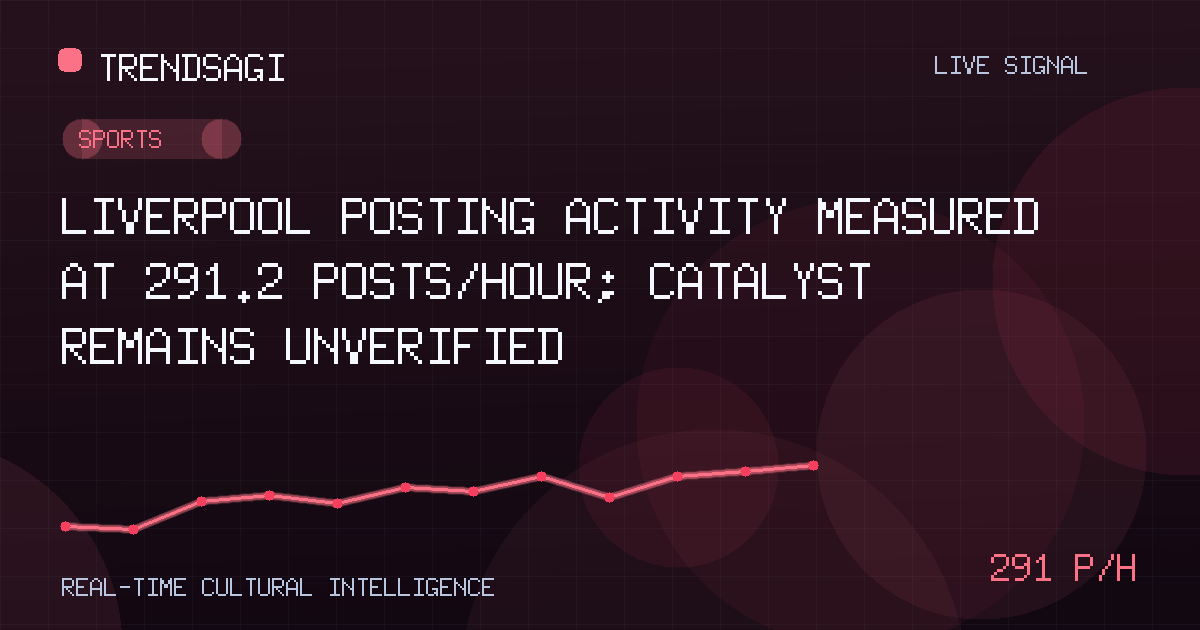
Liverpool posting activity measured at 291.2 posts/hour; catalyst remains unverified
Liverpool's latest snapshot has 727 posts; its measured snapshot rate was 291.2 posts/hour. The catalyst is unverified; these checks clarify what matters next.
Automated briefing. Generated from stored signal measurements and source-backed research; it is not manually reviewed. Read the methodology and limitations.
Metrics in this briefing are a snapshot associated with its publication date and may not reflect current conditions.
What changed
Liverpool has a concentrated spike in recorded posting activity, but the available evidence does not establish what triggered it. The latest snapshot contains 727 posts; no verified public context ties that activity to a particular match, transfer, injury, announcement, or controversy.
The measured snapshot rate was 291.2 posts/hour over an exact 902-second window using 3 stored observations, recorded at 2026-09-28T11:22:09Z. It describes the pace within that measured window, not a live or current rate, forecast, reach, engagement result, or count of unique people.
| Observation time | Measured snapshot rate | Latest snapshot volume |
|---|---|---|
| 2026-09-28T11:22:09Z | 291.2 posts/hour | 727 posts |
For editors and analysts, the useful conclusion is precise but limited: Liverpool-related posting accelerated in the observation, while the story causing it remains unidentified.
Why this topic may be moving
The record categorizes Liverpool as Sports. That context makes sporting discussion plausible, but it does not identify a specific team event or news item. The signal also has no explanatory description. No verified public context accompanies the measurement, so attributing the spike to a fixture, result, squad move, injury, managerial decision, or media report would go beyond the evidence.
Several mechanisms could produce this pattern:
- A confirmed event could have prompted simultaneous updates, reactions, and reposting.
- A rumor, disputed claim, or older item could have been recirculated faster than the original story.
- Attention could have concentrated on a player, manager, opponent, or broader issue without one item causing every post.
- Collection effects, such as source mix or duplicate content, could contribute to the observed volume.
The strongest supported conclusion is that Liverpool-related posting accelerated in the observed window. Naming a match, club decision, transfer, or controversy as the cause would require timestamped evidence that is not present here.
What the signal can—and cannot—establish
It is important to separate measurement from interpretation. The record supports a narrow set of factual statements:
- Observed activity: The latest supplied snapshot contains 727 Liverpool-related posts at the stated observation time.
- Measured snapshot rate: The supplied calculation reports 291.2 posts/hour across an exact 902-second window using 3 observations.
- Classification: Liverpool is assigned to the Sports category.
It does not establish a normal baseline, percentage increase, historical record, or statistical significance. It also cannot show sentiment, whether posts were supportive or critical, where authors were located, which platforms they used, how many unique authors were represented, or whether activity was organic. Most importantly, it cannot identify causation.
Who should care, and why
The signal is most useful to people who need to respond quickly without confusing attention with explanation:
- Liverpool supporters and fan-community managers need to distinguish confirmed information from rumor and see whether conversation remains focused on the same subject.
- Sports editors and reporters should align the spike with timestamped public reporting before attaching a narrative to it.
- Media and social analysts can use the snapshot as a prompt to inspect which entities and phrases are driving the volume.
- Communications, reputation, and sponsorship-monitoring teams may need the surrounding context before interpreting reputational exposure; raw volume alone does not show risk or sentiment.
What to watch next
The following checks would turn an unexplained spike into a decision-ready brief:
- Persistence: Collect the next stored observations and compare later measured snapshot rates with 291.2 posts/hour. Keep snapshot volume separate, using 727 posts only as the latest volume reference.
- Catalyst timing: Check timestamped official club communications, match reporting, and reputable news published around the observed window. A close time match is supporting evidence; a similarly worded older item may point to recirculation.
- Entity and phrase concentration: Rank the posts by recurring player, manager, opponent, competition, transfer, injury, or claim references. This will show whether conversation has one focus or several unrelated threads.
- Original-source integrity: Identify where claims first appeared, how often they were copied, and whether high-volume accounts are duplicating one source. Do not count repeated content as independent confirmation.
- Audience and geography: Break the signal down by language and location where collection permits. A global conversation and a local reaction require different interpretation.
- Second-wave behavior: Look for a new cluster after likely clarification, response, or reaction. A sustained discussion is different from one sharp burst, even when both produce high posting rates.
Until those checks are complete, the editorial label should remain an unexplained Liverpool attention spike rather than a fixture story, transfer story, or club-news event. That wording preserves the observed change without implying a cause.
Methodology and limitations
The supplied measurement is based on 3 stored observations across an exact 902-second window. It reports a measured snapshot rate of 291.2 posts/hour at 2026-09-28T11:22:09Z, while the latest snapshot volume is 727 posts. Those figures describe different aspects of activity and must not be treated as interchangeable. The measured snapshot rate is retrospective, not live.
No baseline period, comparison topics, source-platform breakdown, author counts, sentiment labels, or explanatory event record is supplied. That prevents a defensible claim that the activity is unusually high, sustained, globally distributed, or caused by a specific development. No verified public context accompanies the supplied record, so the cause should remain explicitly marked as unverified rather than filled with a plausible sporting narrative.
Track This Topic for New Signals
Set alerts for future velocity or sentiment changes around this topic.
Explore Tracking PlansAbout TrendsAGI research
TrendsAGI's automated research pipeline publishes dated signal snapshots, methodology notes, and practical workflows for teams evaluating cultural momentum. Read how signals are scoped, scored, and limited in our research methodology.


