897-second window · 2 observations · Measured Sep 28, 2026, 1:54 PM UTC · Provider: go_recent_snapshot_v2
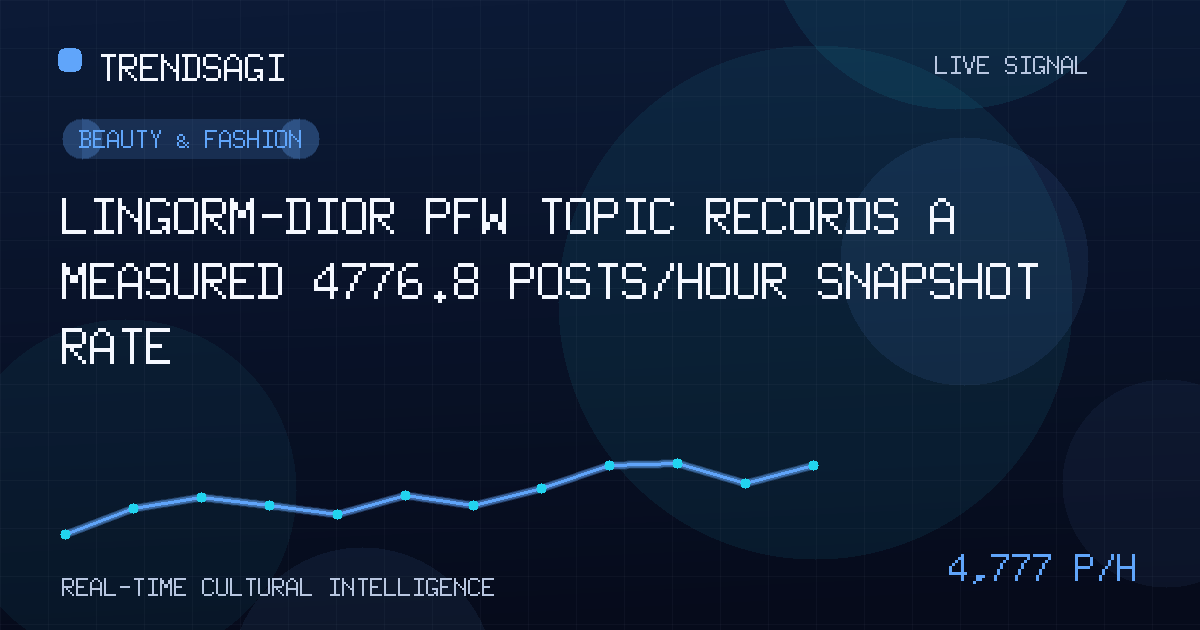
Lingorm–Dior PFW topic records a measured 4776.8 posts/hour snapshot rate
The Lingorm–Dior PFW topic logged 1800 posts and a measured 4776.8 posts/hour snapshot rate; editors explain what remains unverified.
Automated briefing. Generated from stored signal measurements and source-backed research; it is not manually reviewed. Read the methodology and limitations.
Metrics in this briefing are a snapshot associated with its publication date and may not reflect current conditions.
What changed
The tracked “Lingorm Fly to Dior PFW” topic registered a concentrated burst of social posts around the latest observation, but the available record does not establish what triggered it. The defensible read is a short-window spike requiring verification, not proof of sustained momentum, a confirmed appearance, or a relationship involving the entities named in the label.
| Observation time | 2026-09-28T13:54:47Z |
|---|---|
| Measured snapshot rate | 4776.8 posts/hour |
| Latest snapshot volume | 1800 posts |
The measured change was 4776.8 posts/hour over an exact 897-second window using 2 stored observations; the latest snapshot at 2026-09-28T13:54:47Z contained 1800 posts. The figure is a measured snapshot rate, not a live or current rate, forecast, reach, engagement, or unique-person count. Snapshot volume is a count of captured posts, not a rate.
Why this topic may be moving
No verified public explanation accompanies the signal, so the cause remains unclear. The wording of the label suggests a possible event-related discussion, but a topic label is not evidence that an appearance happened, that an organization confirmed it, or that the underlying claim is accurate. A causal explanation needs a traceable source.
Several mechanisms could produce this posting pattern:
- Primary event evidence: A confirmed appearance, announcement, photograph, or video could have started rapid pickup. That explanation would require matching primary evidence and credible timing.
- Conversation and visual reaction: Clothing, styling, behavior captured in a clip, or comparison with another public figure could have amplified an initial post. The citation chain would show whether discussion referred to new information or merely recycled material.
- Label or entity ambiguity: A mistranslation, account-name collision, mistaken identity, or unclear use of “fly to” could combine unrelated posts. Exact wording, linked identities, images, and originating accounts would need checking.
- Distribution amplification: Reposting, repeated media, coordinated timing, or recommendation by high-reach accounts could extend visibility without representing a comparable increase in original reporting.
These are hypotheses, not findings. A sound briefing should distinguish the initial trigger from the mechanism that amplified it and should avoid presenting either as fact until verification is complete.
What the signal can and cannot establish
The signal establishes short-interval velocity within the sampled topic. It gives editors a reason to inspect the cluster quickly and shows where discussion was concentrated enough to register a high measured posting rate.
It does not establish:
- Who first introduced the underlying claim or whether that claim is true.
- How many distinct people authored, read, or reacted to the posts.
- Whether the volume consists mainly of original reporting, reactions, quotes, duplicates, or spam.
- Whether the movement is positive, negative, or simply informational.
- Whether the pattern extends beyond the observed window, appears across platforms, or represents wider public interest.
- Whether a verified connection exists among Lingorm, Dior, and the event referenced by the label.
The limited observation structure also matters. With 2 stored observations across an exact 897-second window and no stated historical baseline, the signal cannot establish whether this is unusual for the topic, how it compares with previous event cycles, or whether momentum will persist.
Why it matters
A measured snapshot rate is a trigger for verification, not proof of what happened, why it happened, or how many people care.
The immediate value is editorial triage rather than conclusion drawing.
- Fashion and celebrity desks can use the signal to locate primary posts and determine whether there is genuinely new material worth covering.
- Brand and communications teams may need to monitor possible association, reputational discussion, or misinformation involving a named organization.
- Creators and audiences need to avoid treating a high-volume label as confirmation of attendance, endorsement, or event participation.
- Trend and social analysts should test duplication, entity matching, and collection boundaries before comparing this signal with other topics.
Speed creates a verification risk: an unconfirmed post can become widely repeated before its original context is checked. The right response is therefore not to amplify the label automatically, but to trace it back to verifiable evidence.
What to watch next
- Persistence: Look for additional observations outside the current 897-second window. A rate that remains elevated would support a continuing burst; a rapid decline would indicate a shorter-lived spike. Neither outcome can be forecast from the current record alone.
- The earliest substantive posts: Identify the first direct statement, original image, or video and follow its citations backward. A precise publication time and clear provenance are more useful than a later repost count.
- Primary confirmation: Check relevant official channels for Lingorm, Dior, and the event or its organizers. A direct post, authenticated account, event listing, or clearly sourced media report would materially strengthen the event explanation.
- Label integrity: Resolve what “fly to” means in the originating language, whether names and account handles refer to the intended entities, and whether search variants are merging unrelated subjects.
- Content quality: Separate distinct original posts from duplicates, quote posts, reactions, automated accounts, and repeated media. Account overlap and tightly synchronized posting can indicate amplification rather than independent attention.
- Distribution and geography: Determine which platforms, languages, regions, and account types are driving the topic. Concentration in a narrow community is different from pickup by independent news or fashion publications.
- Corroboration or correction: Look for independent reporting, official clarification, or a documented correction. Those signals would help determine whether the movement reflects a confirmed event, a developing story, or a labeling error.
Methodology and limitations
The rate reported here comes from 2 stored observations separated by an exact 897-second interval and is stated as 4776.8 posts/hour. The associated latest snapshot contains 1800 posts at 2026-09-28T13:54:47Z. These values describe the supplied tracking record, not the full lifecycle of the conversation.
The record does not specify platform coverage, collection boundaries, the snapshot’s underlying time span, duplicate handling, geographic or language coverage, or whether all matching posts were included. It also provides no verified external explanation for the movement. Accordingly, this briefing reports the measured short-term change while treating possible causes as unverified hypotheses.
Track This Topic for New Signals
Set alerts for future velocity or sentiment changes around this topic.
Explore Tracking PlansAbout TrendsAGI research
TrendsAGI's automated research pipeline publishes dated signal snapshots, methodology notes, and practical workflows for teams evaluating cultural momentum. Read how signals are scoped, scored, and limited in our research methodology.


