895-second window · 3 observations · Measured Sep 28, 2026, 2:55 PM UTC · Provider: go_recent_snapshot_v2
Lingling Kwong topic measured at 619.1 posts/hour; cause remains unverified
The Lingling Kwong signal shows 363 posts and a measured 619.1 posts/hour burst; here is what is known, unknown, and worth checking next.
Automated briefing. Generated from stored signal measurements and source-backed research; it is not manually reviewed. Read the methodology and limitations.
Metrics in this briefing are a snapshot associated with its publication date and may not reflect current conditions.
What changed
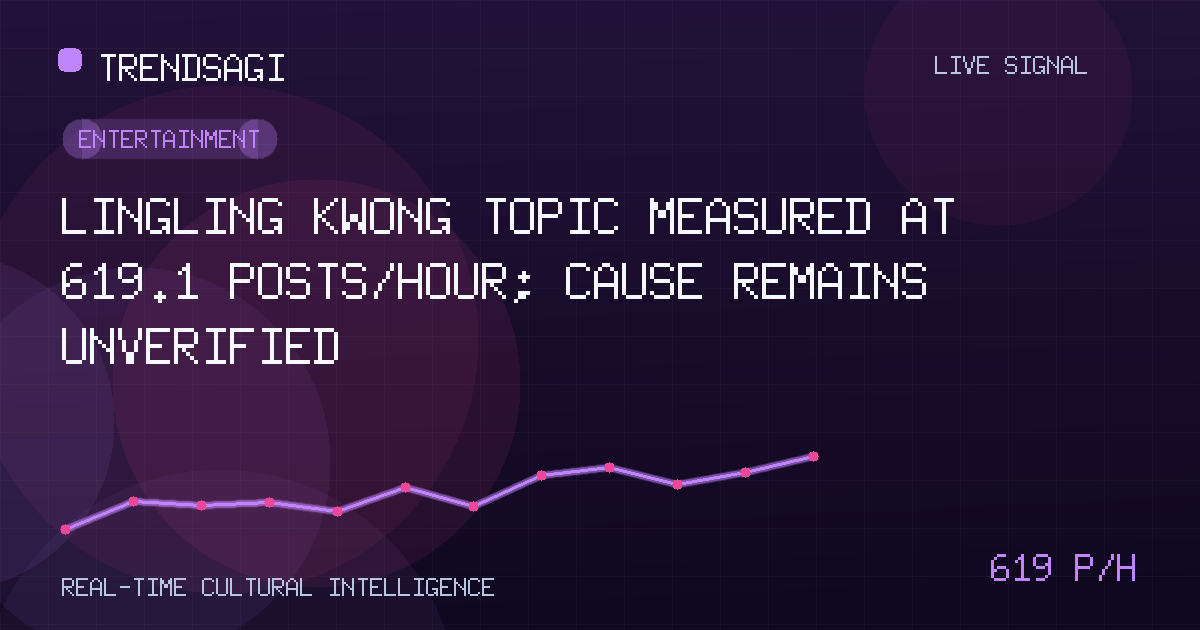
A concentrated burst of posts labeled Lingling Kwong appears in the stored signal. At the latest observation, the snapshot contained 363 posts; separately, the measured change rate was 619.1 posts/hour across an exact 895-second window. The direct answer is narrow: a high-volume, short-window burst is confirmed, but the available record does not identify a verified news event, statement, controversy, or media appearance as its cause.
The 619.1 figure is a measured snapshot rate based on 3 stored observations, not a live or current rate, forecast, reach, engagement, or unique-person count. Because no ordinary baseline is supplied, the signal cannot show whether the burst is exceptional for this topic; it establishes activity during the measured window.
| Metric | Stored value |
|---|---|
| Observation time | 2026-09-28T14:55:02Z |
| Measured posts/hour | 619.1 posts/hour |
| Latest snapshot volume | 363 posts |
What the signal establishes
The 363-post snapshot and the 619.1 posts/hour rate describe different aspects of the same signal and should not be treated as interchangeable. Snapshot volume is the latest stored count of posts. The rate describes measured posting pace over the exact 895-second window. Neither measure, by itself, reveals who was posting or why.
- Timing: The finding is anchored to 2026-09-28T14:55:02Z and does not describe activity after that observation.
- Scale: Without account, language, geography, or duplication fields, 363 posts cannot be converted into independent speakers, unique reach, or informed public reaction.
- Content: The signal does not establish sentiment, accuracy, agreement, or whether the posts were original, replies, quotations, or copies.
The defensible finding is a concentrated burst of discussion labeled Lingling Kwong; attributing it to a particular event requires a verified public source whose timing matches the onset of the posts.
Why this topic may be moving
No specific public catalyst is verified for this briefing. Several mechanisms could produce this shape of activity, but they are hypotheses to test rather than explanations supported by the current evidence.
- A new development: A reported event or newly available statement could cause a rapid response if it is directly connected to the topic label.
- Media pickup: A story, broadcast, interview, or social post could expose the label to a larger audience and accelerate repeated posting.
- A dispute or clarification: Conflicting claims, corrections, criticism, or a response to an earlier statement could prompt reaction and counter-posting.
- Platform dynamics: Repetition, ranking effects, a coordinated campaign, or automated copying could make the topic appear more active than the underlying number of distinct voices suggests.
These possibilities should not be ranked as likely causes until post-level timing and a matching external source are available.
Why it matters
The spike is a monitoring signal, not yet an explained event. That distinction affects how quickly information teams, researchers, communications practitioners, and readers should respond.
- For editors: Treat the topic as worthy of verification, but avoid a causal headline until the trigger is confirmed.
- For researchers: Preserve the query, collection window, post text, and account overlap so the apparent movement can be compared with a historical baseline.
- For communications and public-interest teams: Watch for unsupported claims and corrections, especially if repetition is mistaken for independent confirmation.
- For readers: High posting volume indicates attention, not credibility or importance. A crowded topic can still be driven by rumor, duplication, or a narrow but intense exchange.
The practical risk is amplification: a vague explanation can spread faster than the verification needed to support it.
What to watch next
The next checks should distinguish a durable change in attention from a brief burst, then identify what—if anything—started it.
- Persistence: Compare later snapshots with this observation. A rapid return to the topic's ordinary pattern would weaken any claim of sustained momentum; continued activity would justify closer monitoring.
- Onset: Reconstruct the earliest posts carrying the label, including timestamps, language, cited links or media, and whether they appear original or copied.
- Source alignment: Look for a credible public source published close to the first wave. A source that appears only after the spike is less useful for explaining its start, though it may explain later growth.
- Audience and duplication: Check overlap among posting accounts, repeated text, repost chains, and changes in language or geography. This helps separate broad discussion from a narrow cluster.
- Primary evidence and correction: Locate any original document, recording, statement, or official response behind the discussion and note whether credible sources correct, confirm, or fail to substantiate the circulating claim.
A useful escalation would combine continuing volume with verified timing and multiple independent sources. More posts without those elements would indicate activity, not causation.
Methodology and limitations
This briefing uses the stored observation at 2026-09-28T14:55:02Z. It reports the supplied measured snapshot rate of 619.1 posts/hour over an exact 895-second window using 3 stored observations, alongside the separate latest snapshot volume of 363 posts. The figures are not extrapolated beyond that observation.
No baseline, collection query, historical series, post-level content, geography, language mix, account identities, engagement, or deduplication method is supplied. The signal therefore cannot establish unique participation, reach, sentiment, truth, cause, or duration. No external fact is used to assign a trigger because a causal public source could not be verified. The next evidentiary upgrade is a timestamped match between the earliest relevant posts and reliable public context, followed by fresh snapshots to test whether attention persists.
Track This Topic for New Signals
Set alerts for future velocity or sentiment changes around this topic.
Explore Tracking PlansAbout TrendsAGI research
TrendsAGI's automated research pipeline publishes dated signal snapshots, methodology notes, and practical workflows for teams evaluating cultural momentum. Read how signals are scoped, scored, and limited in our research methodology.


