907-second window · 3 observations · Measured Oct 8, 2026, 6:56 AM UTC · Provider: go_recent_snapshot_v2
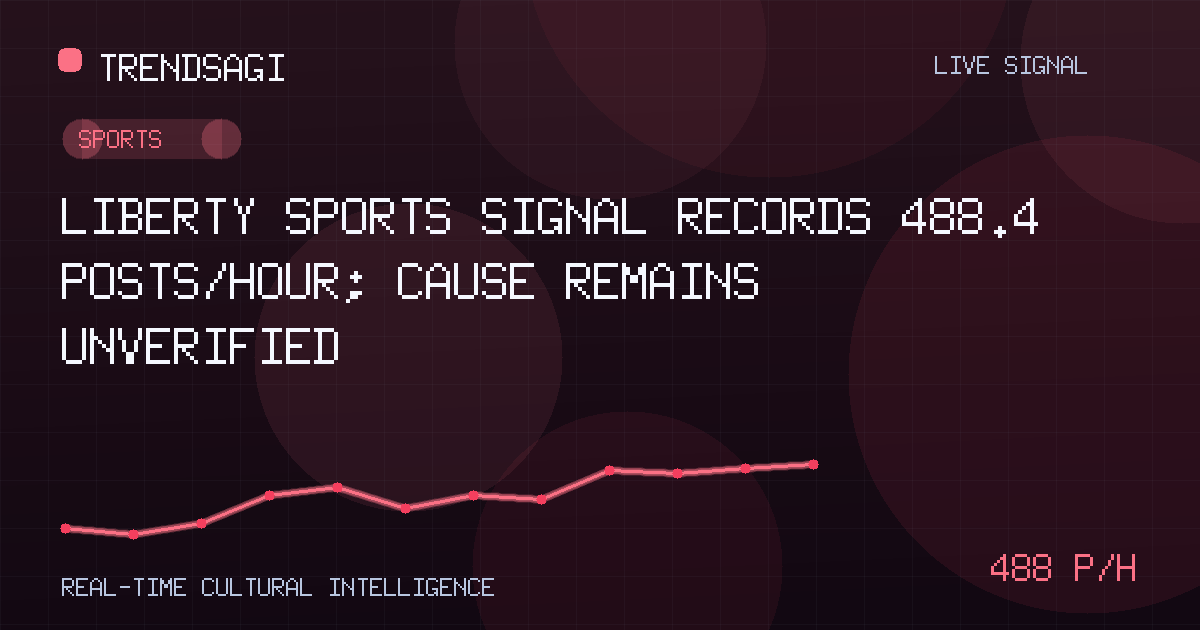
Liberty sports signal records 488.4 posts/hour; cause remains unverified
The Liberty sports signal measured 488.4 posts/hour over 907 seconds and captured 256 posts; entity and catalyst checks are still needed.
Automated briefing. Generated from stored signal measurements and source-backed research; it is not manually reviewed. Read the methodology and limitations.
Metrics in this briefing are a snapshot associated with its publication date and may not reflect current conditions.
What changed
The latest “Liberty” snapshot contains 256 posts, while the stored series shows a measured snapshot rate of 488.4 posts/hour over an exact 907-second window. The rate was measured from 3 stored observations at 2026-10-08T06:56:50Z; it is not a live rate, forecast, reach figure, engagement total, or unique-person count.
The direct answer is that the stored record shows a reportable activity signal around “Liberty,” but the reason for the movement is not verified. The Sports category supplies broad context, not a specific event. No public evidence has been verified against the same subject and moment, so attributing the signal to a game, team, athlete, announcement, controversy, or incidental use of the label would be speculation.
| Measure | Stored value |
|---|---|
| Observation time | 2026-10-08T06:56:50Z |
| Measured snapshot rate | 488.4 posts/hour |
| Latest snapshot volume | 256 posts |
Why this topic may be moving
No verified catalyst is available. These are plausible mechanisms to test, not established explanations:
- Entity mixing: Posts under the same label may refer to different sporting subjects. Without matched names, account context, and hashtags, several conversations may have been combined.
- Event response: A result, roster update, injury, schedule release, award, or controversy could prompt immediate posting. No specific event is verified here.
- Second-order amplification: Reaction to already-public posts can increase volume without a separate news development. The post sample is not available to test this possibility.
- Classification noise: A Sports-category post may mention “Liberty” incidentally, making the topic label broader than the underlying story.
Until those explanations are checked against post-level evidence and verified public reporting, the movement has a measured magnitude but no defensible cause.
The useful distinction is between attention and explanation: the series measures posting activity associated with “Liberty,” but it does not yet identify the event, audience, or meaning behind that activity.
Why it matters
An unresolved topic signal can still matter to editors because the label may be masking the real story. It matters most to sports desks, audience teams, communications staff, and researchers deciding whether coverage or monitoring is warranted. It matters less as evidence of public opinion: posting activity is not the same thing as attitude.
What the signal establishes
- The latest stored snapshot contains 256 posts.
- The measured rate is 488.4 posts/hour, based on 3 observations across 907 seconds.
- The topic was classified as Sports within the stored record.
- The activity is relevant for editorial verification, even without a known catalyst.
What it does not establish
- Whether the rate is high relative to a normal Liberty baseline.
- Whether all posts concern the same team, athlete, event, or concept.
- Whether the conversation is positive, negative, neutral, or mixed.
- Whether public reporting, fan reaction, or another mechanism caused the movement.
- Whether activity continued after the observation or came from distinct people.
What to watch next
A useful follow-up should resolve identity before interpretation. These checks are designed to turn an ambiguous alert into a defensible story.
- Resolve “Liberty.” Inspect account names, hashtags, mentions, and post context to identify the named subject. Keep distinct entities separate rather than assuming they share a referent because they share a label.
- Reconstruct the sequence. Find the earliest substantive posts, note what they cite, and trace which later posts are original reporting, quotation, paraphrase, or repetition.
- Verify the catalyst with Google Search. Look for timestamped pages from publishers that explicitly describe the same event. A page is explanatory only when its entity, event, and timing align; popularity alone is not causation.
- Repeat the measurement consistently. Keep the query, matching rules, deduplication approach, and observation window unchanged. Report snapshot volume separately from measured posts/hour.
- Inspect composition. Review source mix, repeated text, languages, locations, and account types for concentration, duplication, or unrelated uses of the label.
- Check substantive content. Extract recurring claims and reactions, then compare them with verified reporting. Do not infer sentiment from keyword frequency alone.
Concrete watch signals
- Entity convergence: Posts repeatedly naming the same team, athlete, event, or place.
- Event alignment: Verified reporting that matches the post language and timing.
- Persistence: Comparable observations showing activity above the subject’s established baseline.
- Signal quality: More distinct, substantive posts after duplicate and quoted material is separated.
Methodology and limitations
The measurement combines 3 stored observations over 907 seconds and reports 488.4 posts/hour; 256 is the latest snapshot volume. These figures answer different questions and should not be substituted. The timestamp identifies the stored observation, not present conditions.
The available record does not include the raw post sample, query definition, account-level matches, deduplication, historical baseline, geography, language, sentiment, or verified public catalyst. The signal therefore cannot establish scale relative to normal, persistence, authenticity, or causation. Use it as a verification alert, and add a specific cause only when public evidence matches the entity, event, and time.
Track This Topic for New Signals
Set alerts for future velocity or sentiment changes around this topic.
Explore Tracking PlansAbout TrendsAGI research
TrendsAGI's automated research pipeline publishes dated signal snapshots, methodology notes, and practical workflows for teams evaluating cultural momentum. Read how signals are scoped, scored, and limited in our research methodology.


