1795-second window · 3 observations · Measured Oct 1, 2026, 9:56 AM UTC · Provider: go_recent_snapshot_v2
Lethal Entertainment Signal: 782 Posts and a 784.3 Posts/Hour Snapshot Rate
The Lethal entertainment signal logged 782 posts and a measured 784.3 posts/hour snapshot; here is what it means and what to verify next.
Automated briefing. Generated from stored signal measurements and source-backed research; it is not manually reviewed. Read the methodology and limitations.
Metrics in this briefing are a snapshot associated with its publication date and may not reflect current conditions.
What changed
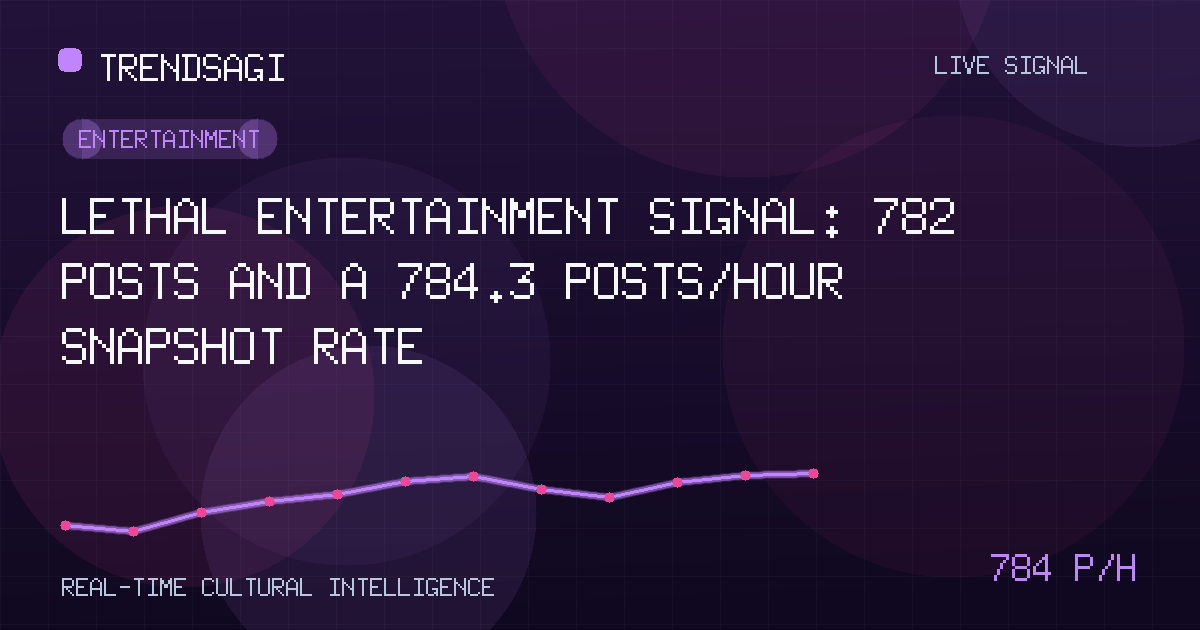
The stored entertainment-category signal labeled “Lethal” contained 782 posts in its latest snapshot at 2026-10-01T09:56:40Z. The defensible conclusion is limited: the monitored topic showed observable posting activity at that timestamp, but the available record does not identify what “Lethal” refers to or establish a cause.
The measured change rate was 784.3 posts/hour over an exact 1795-second window using 3 stored observations. This is a measured snapshot rate, not a live or current rate, forecast, reach, engagement, or unique-person count. Because the component observations and an earlier baseline are not supplied, the record also cannot show whether activity was rising, falling, or merely moving quickly within that window.
| Observation time | Measured snapshot rate | Latest snapshot volume |
|---|---|---|
| 2026-10-01T09:56:40Z | 784.3 posts/hour | 782 posts |
The two figures answer different questions. Snapshot volume is the size of the latest stored collection; measured snapshot rate describes posting throughput during the specified historical window. The 782 figure is not a rate, and the 784.3 figure is not a total audience or a count of distinct authors.
Why this topic may be moving
No verified cause can be assigned from the available context. There is no stored topic description, and the label “Lethal” is not entity-specific on its face. It could represent a title, a person or character referenced by that word, a search phrase, or several entertainment subjects grouped under one monitoring label. Each possibility would require inspection of the underlying posts before it could support a news claim.
The Entertainment category supplies useful context but does not resolve that ambiguity. Several mechanisms are worth testing, none of which should be reported as the explanation without confirmation:
- A dated release, trailer, episode, casting announcement, awards item, or other entertainment update may have started a concentrated reaction.
- A controversy, interview, ranking, retrospective, or older media clip may have been recirculated.
- A creator post, fandom development, dispute, or meme may have prompted faster publishing and reposting.
- The apparent movement may partly reflect monitoring effects, such as repeated links, a broadened keyword match, or a change in the sources being collected.
Without a source-level review or a verified public catalyst, the reason the label was moving remains unclear. “Lethal” should therefore be described as an observed entertainment signal, not yet as a confirmed news event.
The stored signal shows that posts carrying or assigned to “Lethal” were present at a defined observation point and moved at a measured rate during a defined window. It does not show that one event, entity, or audience caused that movement.
Why it matters
For editors and coverage teams, the immediate risk is entity confusion. A broad label can combine unrelated posts or pull in incidental uses of the word. Before “Lethal” becomes the subject of a headline, editors should inspect representative items, identify the named people or works involved, and verify any claimed catalyst. A numerical signal is a reason to investigate, not evidence of what happened.
For media and social analysts, the measurement is useful for prioritizing a review queue. It is not enough to call the activity a surge, breakout, or spike. Those descriptions imply comparison with a prior period or a recognizable acceleration, neither of which is established by the supplied figures. The phrase “measured change” should not be interpreted as proof that the rate increased.
For creators, communications teams, and community managers, the signal can prompt a faster check of whether discussion is converging on one official update or fragmenting across several subjects. It can also reveal whether apparent momentum comes mainly from original posts, repeated links, audience reactions, or automated-looking publishing patterns. Those distinctions matter when deciding whether a conversation merits a response.
For researchers, the episode illustrates why post counts, posting rates, and audience size must remain separate. A monitored collection can show sustained activity without establishing how many people participated, how widely the material traveled, or whether sentiment was positive, negative, or mixed.
What to watch next
- Like-for-like rate persistence: Compare subsequent 1795-second windows using the same collection method and source coverage. Repeated observations near, above, or below 784.3 posts/hour would help show whether the burst persists, intensifies, or fades.
- Snapshot follow-through: Check later snapshot volumes, but compare them with 782 only when the capture scope is equivalent. A changed count would indicate changed observed volume, not necessarily more unique participants or greater reach.
- Entity convergence: Review the names, titles, hashtags, links, and phrases appearing alongside “Lethal.” Watch for one dominant referent emerging or for several unrelated clusters sharing the label.
- A timestamped catalyst: Look for a first-party announcement or credible reporting published before the measured window. If a claimed event appears only afterward, it cannot explain the activity already observed in that window.
- Source and duplication patterns: Examine platform diversity, account concentration, repeated text, and shared URLs. Multiple copies from one source should not automatically be counted as independent conversation.
- Content mix: Separate original reporting, reactions, criticism, jokes, supportive posts, and shared media. This shows whether the signal represents a substantive event, recurring conversation, or simply content being copied.
- Decay or revival: Note whether activity declines after the snapshot or returns around another dated development. Repeated alignment with a verifiable event would provide stronger causal evidence than volume alone.
Methodology and limitations
The observation timestamp is 2026-10-01T09:56:40Z. The rate of 784.3 posts/hour was measured over an exact 1795-second window using 3 stored observations. “Measured snapshot rate” is used deliberately: it describes that historical window and should not be presented as activity continuing after the timestamp.
No earlier baseline, component observation values, platform list, geographic breakdown, account totals, engagement data, sentiment analysis, duplication analysis, or monitoring-query logic is supplied. Consequently, the signal cannot establish trend direction, duration, cause, authenticity, organic versus coordinated activity, audience size, or business impact. It can establish only the recorded observation conditions.
The practical next step is entity resolution followed by catalyst verification. Until both are completed, the responsible conclusion is that “Lethal” registered 782 posts in the latest snapshot and a measured 784.3 posts/hour over the stated window, while the reason for the movement remains unverified.
Track This Topic for New Signals
Set alerts for future velocity or sentiment changes around this topic.
Explore Tracking PlansAbout TrendsAGI research
TrendsAGI's automated research pipeline publishes dated signal snapshots, methodology notes, and practical workflows for teams evaluating cultural momentum. Read how signals are scoped, scored, and limited in our research methodology.