897-second window · 2 observations · Measured Sep 29, 2026, 2:56 AM UTC · Provider: go_recent_snapshot_v2
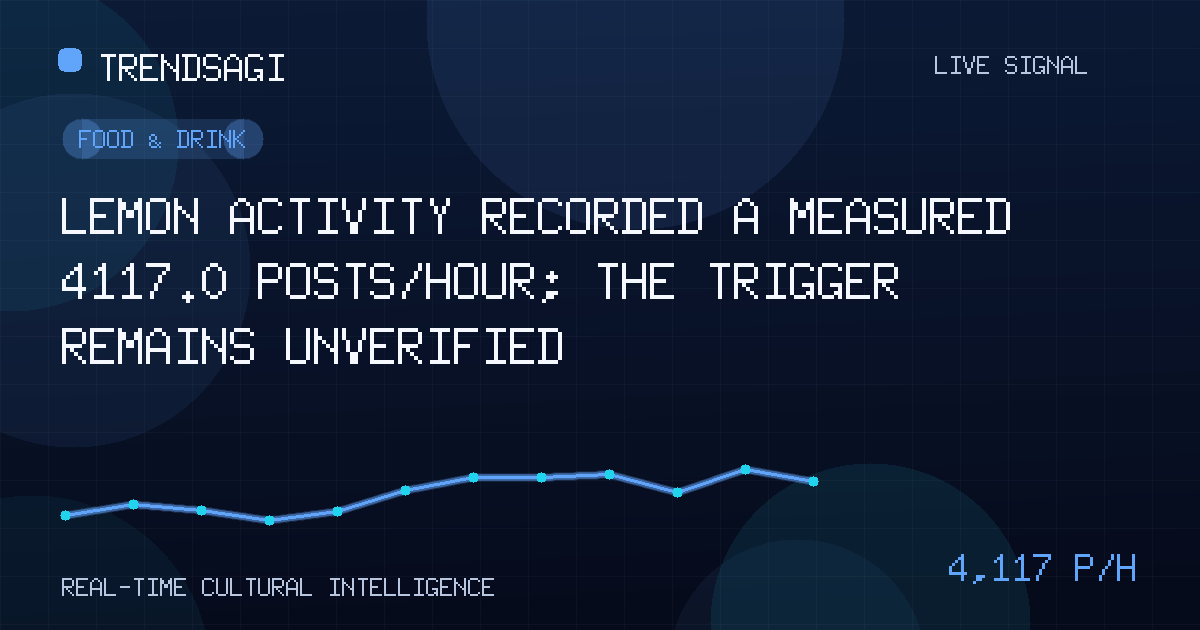
Lemon activity recorded a measured 4117.0 posts/hour; the trigger remains unverified
Lemon recorded 4117.0 posts/hour in a measured snapshot; teams should verify the shared referent and trigger before acting on the rise.
Automated briefing. Generated from stored signal measurements and source-backed research; it is not manually reviewed. Read the methodology and limitations.
Metrics in this briefing are a snapshot associated with its publication date and may not reflect current conditions.
What changed
Lemon posts showed a measured burst in monitoring, but the signal does not establish why. The latest stored snapshot contains 1800 posts at 2026-09-29T02:56:11Z. The movement is worth investigation, yet it cannot by itself be tied to a recipe trend, product launch, news event, or cultural moment.
Across an exact 897-second window based on 2 stored observations, the measured change was 4117.0 posts/hour. This is a measured snapshot rate for that historical window—not a live rate, forecast, reach figure, engagement count, or unique-person count. The 1800 posts are snapshot volume; 4117.0 posts/hour is the change measure between observations, so the figures answer different questions.
| Metric | Stored observation |
|---|---|
| Observation time | 2026-09-29T02:56:11Z |
| Measured snapshot rate | 4117.0 posts/hour |
| Exact observation window | 897 seconds |
| Observations used | 2 |
| Latest snapshot volume | 1800 posts |
Why this topic may be moving
The cause remains unclear. No contemporaneous, publisher-verified context accompanies the stored signal, and the category label alone cannot verify the subject. “Lemon” may be being used literally, as a flavor or food term, or in unrelated senses; that is a validation question, not a conclusion.
- Referent mixing: A one-word label can combine the fruit, a flavor, slang, a name, or other uses in one total. That could create activity without a single underlying story.
- Food-related discussion: If the relevant posts concern the ingredient, recipes, menus, or products, a narrower trend may be present. The stored signal verifies none of those subjects.
- Repeated content: Quotes, reposts, copied text, or coordinated promotion may raise raw post volume without representing equally broad discussion. The data does not distinguish these patterns.
- Collection effects: A change in query matching or collection behavior could alter the count. With only 2 observations, a measurement change cannot be ruled out.
Until one of these possibilities is tested, the responsible description is “rising Lemon chatter with an unverified trigger,” not a claim about demand or a specific event.
The most defensible conclusion is not that lemon is broadly popular, but that monitored Lemon activity rose at 4117.0 posts/hour during the stored window. Its meaning remains unresolved until the posts reveal a shared referent and the timing is checked against verified context.
Why it matters
For food and drink teams, the immediate value is speed of triage, not immediate action. A genuine burst could indicate an ingredient or flavor conversation worth examining; a mixed or duplicated burst could be noise. The distinction affects editorial coverage, inventory planning, campaign monitoring, and whether a brand should investigate further.
- Retailers and brands: Check product relevance and conversation quality before treating post volume as consumer interest.
- Editors: Look for a concrete subject and attributable evidence rather than writing a trend story from the label alone.
- Researchers: Preserve the query, collection method, time, and deduplication approach so the movement can be compared.
- Platform and risk teams: Check for spam, repetition, or coordinated use if the underlying post data is available.
A general reader should also resist translating post volume into market size. Chatter can be plentiful, but its meaning depends on who is posting, what they mean, and whether the activity persists.
What the signal can and cannot establish
The evidence supports a narrow conclusion: at the recorded observation, the monitoring system assigned 1800 posts to “Lemon,” and the supplied change calculation measured 4117.0 posts/hour over 897 seconds using 2 observations. The stored category is “Food & Drink.”
That is enough to establish the timing and measured size of a monitored burst, and to justify a prompt content audit. It does not establish:
- the event, behavior, or conversation that caused the movement;
- whether the posts are organic, original, or distinct;
- the number of unique people, their locations, or their languages;
- sentiment, engagement quality, reach, purchases, or sales;
- whether the posts genuinely concern food; or
- whether the increase continued beyond the observed window.
What to watch next
The most useful follow-up checks are:
- Collect a fresh snapshot with unchanged collection rules. Compare its volume and measured change with this observation to see whether the burst holds, softens, or reverses.
- Audit a representative post sample. Record the dominant referent, whether it is literal food talk, and any repeated phrasing. Do not infer the trend from the most visible items alone.
- Separate originals from repetition. Group identical or near-identical text and distinguish quotes, reposts, and promotional reuse where metadata permits.
- Break down the stream. Check language, geography, source type, and account patterns for concentration; these cuts can reveal whether one community is driving the total.
- Seek timing-matched public context. A credible explanation should be published at or near the observation and refer to the same subject. Publisher-attributable evidence would strengthen the briefing; coincidence would not.
- Track quality and persistence. Look for continued original posts, substantive replies, and recurrence in later windows. Raw count alone cannot show engagement or durability.
The decisive follow-up is convergence: a narrower subject, multiple independent posts, and verified timing. If those do not align, retain the event as an ambiguous monitoring spike rather than a substantive trend.
Methodology and limitations
This briefing uses the canonical stored signal as recorded. The rate of 4117.0 posts/hour was supplied from 2 observations across an exact 897-second window ending at the stated observation time. No prior baseline, raw post text, query definition, language mix, geography, account counts, engagement data, deduplication record, or verified publisher context is provided. The result is therefore descriptive rather than causal and supports monitoring and further validation, not a forecast or a conclusion about lemon demand, culture, or behavior.
Track This Topic for New Signals
Set alerts for future velocity or sentiment changes around this topic.
Explore Tracking PlansAbout TrendsAGI research
TrendsAGI's automated research pipeline publishes dated signal snapshots, methodology notes, and practical workflows for teams evaluating cultural momentum. Read how signals are scoped, scored, and limited in our research methodology.