906-second window · 3 observations · Measured Oct 9, 2026, 4:55 PM UTC · Provider: go_recent_snapshot_v2
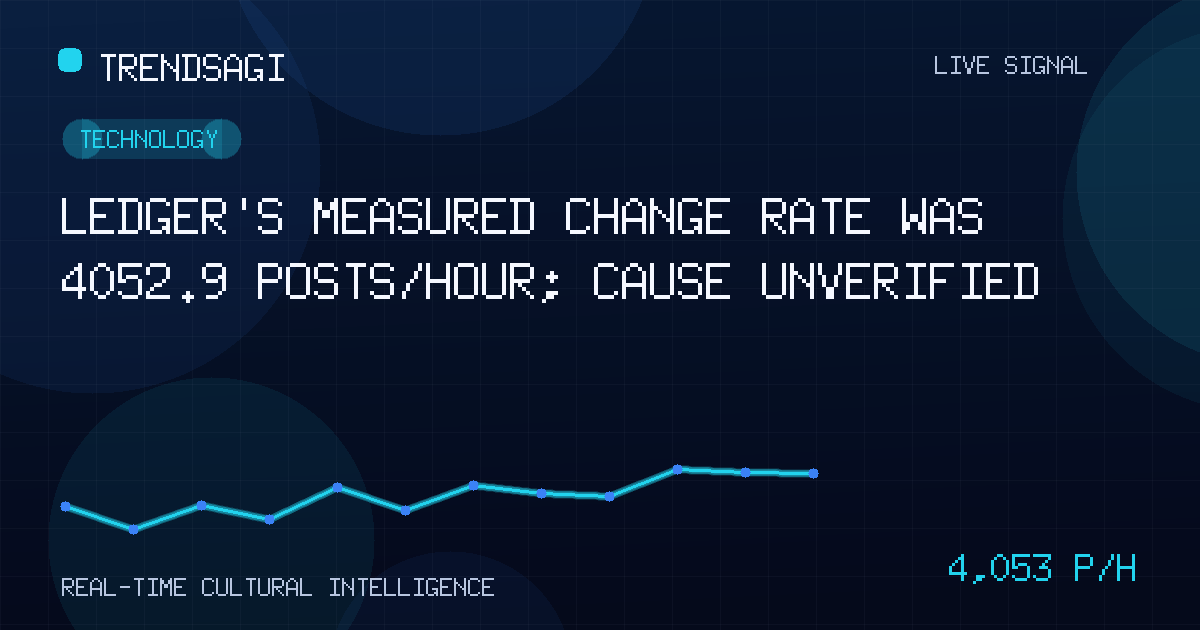
Ledger’s measured change rate was 4052.9 posts/hour; cause unverified
Ledger’s 4052.9 posts/hour snapshot rate captures a 906-second window, while the trigger, audience, and significance remain unverified.
Automated briefing. Generated from stored signal measurements and source-backed research; it is not manually reviewed. Read the methodology and limitations.
Metrics in this briefing are a snapshot associated with its publication date and may not reflect current conditions.
What changed
Ledger registered a measured posting change of 4052.9 posts/hour in the latest stored window, but the available evidence does not identify a verified catalyst. This is an item to investigate, not yet a confirmed trend narrative: the movement could reflect a concentrated event, repeated discussion, keyword collision, or a change in collection coverage, and the record does not distinguish among those possibilities.
The rate was measured from 3 stored observations across an exact 906-second window, with the snapshot observed at 2026-10-09T16:55:51Z. The latest snapshot contained 2181 posts. Posts/hour is a measured snapshot rate, not a live or current rate, forecast, reach, engagement total, or unique-person count. The 2181 figure is snapshot volume, not a rate; the record does not explain how the two measures relate, so they should be reported separately.
| Observation time | 2026-10-09T16:55:51Z |
|---|---|
| Measured posts/hour | 4052.9 |
| Snapshot volume | 2181 posts |
Why this topic may be moving
No explanatory description accompanies the observation, and the topic label does not resolve which Ledger is being tracked. The Technology category offers broad classification, but it cannot establish whether the posts concern the same entity or subject. Without a representative sample, even the identity of the conversation remains uncertain.
Several explanations are possible, but none is verified by the stored record. A public announcement, a product or security event, a regulatory development, a social controversy, a platform spike, or mixing among unrelated uses of the label could each produce clustering. These are hypotheses for checking, not findings about this signal.
The strongest conclusion supported by the evidence is that tracked Ledger posting activity changed during the observed window; the evidence does not establish why.
No verified public trigger is available for attribution, so this briefing does not assign the movement to news, a company action, or a broader industry shift. That distinction matters: a precise activity measurement can be useful even when its cause is unknown, but it cannot support a causal headline on its own.
Why it matters
For editors, communications teams, security researchers, and technology watchers, the signal is best treated as triage. It identifies a short period that deserves inspection; it does not say whether the discussion is important, accurate, negative, or organic.
- Newsrooms and analysts: Avoid converting a burst of posts into a claimed event before confirming the subject and catalyst.
- Product and communications teams: Determine whether the label maps to their organization and whether a real issue or simply ambiguous matching is present.
- Security teams: Check for substantiated incident reporting only after matching the conversation to a verified entity and timeline.
The number also needs careful language. It does not reveal sentiment, geography, audience size, source diversity, or whether copying and automated activity contributed. Because no baseline is supplied, the rate cannot be described as normal, unusually high, accelerating, or sustained relative to Ledger’s longer history.
What to watch next
The immediate priority is to replace ambiguity with evidence. A useful follow-up should answer these questions in order:
- Resolve the label. Inspect representative posts and identify the named entity, product, account, or subject. Record competing meanings separately rather than combining them into one trend.
- Build the timeline. Compare post timestamps with the start of the measured window and with subsequent complete windows under the same collection method.
- Find a verified trigger. Check public reporting and first-party statements, then attribute any confirmed event to its publisher. If no trigger can be verified, retain “cause unclear.”
- Test concentration. Measure how posts are distributed across sources and repeated phrases. A tight cluster may indicate amplification, but concentration alone does not prove coordination.
- Compare the measures. Preserve 2181 as the latest snapshot volume and 4052.9 posts/hour as the measured snapshot rate; do not use either as a proxy for the other.
- Establish persistence. Check whether activity continues in later windows, recedes, or shifts to a different theme, using consistent query and collection rules.
Concrete watch signals are continued activity after the observed window, convergence on one verified event, a clear majority of posts repeating the same claim, or a split between unrelated meanings of “Ledger.” Also watch for corrections, denials, and changes in the dominant theme. Those signals would help distinguish a durable event from a brief keyword-driven burst.
Methodology and limitations
This briefing uses the canonical snapshot observed at 2026-10-09T16:55:51Z. The measured change rate comes from 3 stored observations over an exact 906-second window; the latest snapshot volume is 2181 posts. The rate describes the observed posting change and should not be treated as a live feed, forecast, total audience, or engagement metric.
The record does not provide a historical baseline, comparison period, collection method, sample of individual posts, source distribution, sentiment, or verified event timeline. It also supplies no explanation of why the topic moved. The category and label are metadata, not evidence of causation. Accordingly, the signal can establish a point-in-time change in tracked activity, but it cannot establish the subject’s identity, the reason for the movement, whether participants were unique, or whether the pattern will continue. The appropriate next decision is further verification, not a confident narrative.
Track This Topic for New Signals
Set alerts for future velocity or sentiment changes around this topic.
Explore Tracking PlansAbout TrendsAGI research
TrendsAGI's automated research pipeline publishes dated signal snapshots, methodology notes, and practical workflows for teams evaluating cultural momentum. Read how signals are scoped, scored, and limited in our research methodology.