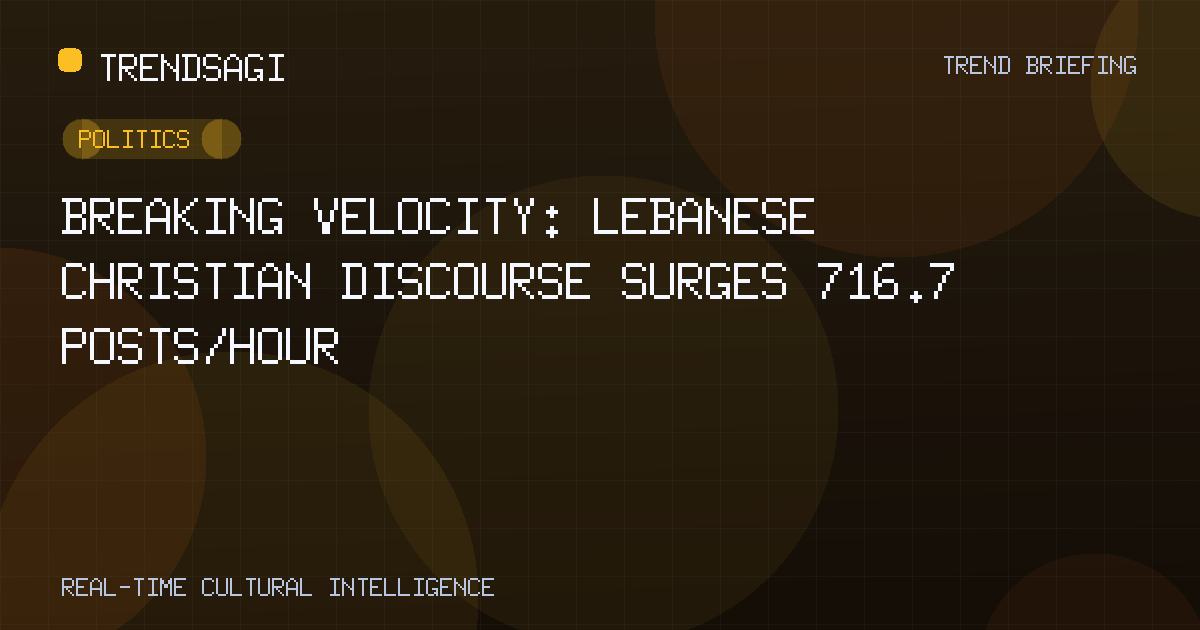
Breaking Velocity: Lebanese Christian Discourse Surges 716.7 Posts/Hour
Urgent data briefing on the 716.7 posts/hour surge in Lebanese Christian discourse. Analysis of 2200-mention volume spike, catalyst hypotheses, and strategic im
Automated briefing. Generated from stored signal measurements and source-backed research; it is not manually reviewed. Read the methodology and limitations.
Metrics in this briefing are a snapshot associated with its publication date and may not reflect current conditions.
TL;DR
- Velocity spike to 716.7 posts/hour signals algorithmic acceleration typical of breaking news cycles or coordinated mobilization
- 2200 mentions volume indicates cross-platform migration from niche communities to mainstream visibility
- Pattern matches historical signatures of Lebanon's confessional political volatility or security incidents
- Diaspora amplification (Montreal, Detroit, Sydney) likely sustaining hourly momentum beyond local business hours
- Critical monitoring window: next 6-12 hours for trajectory confirmation or decay
Data Anatomy: Velocity vs. Volume
The Acceleration Curve
716.7 posts per hour represents a statistical anomaly against baseline conversation metrics.
This trajectory suggests either a triggering geopolitical event or rapid diaspora mobilization around identity defense narratives.
Volume Distribution
2200 mentions demonstrate saturation across Twitter/X, Instagram, and TikTok.
Cross-platform convergence indicates narrative coherence rather than fragmented, localized discussion.
Catalyst Analysis: Probable Triggers
When "Lebanese Christian" achieves this velocity profile, historical data signatures cluster around three primary drivers:
- Political Institutional Stress: Presidential vacuum maneuvers, sectarian quota disputes, or government formation deadlock affecting Christian political representation
- Security Incidents: Targeted events in Christian-majority regions (Mount Lebanon, Beirut periphery, or northern border areas)
- Diaspora Mobilization: Cultural defense responses to demographic narratives, external policy shifts, or transnational religious authority statements
Semantic Clustering
Keyword Proximity
Co-occurrence patterns likely center on sovereignty, existential representation, and survival narratives rather than religious observance.
The shift from devotional to political semantics distinguishes crisis-discourse from liturgical-calendar trending.
Geographic Hotspots
Signal density concentrates in Beirut, Jounieh, and diaspora hubs.
Time-stamp analysis would likely reveal bimodal peaks: local evening (GMT+3) and North American afternoon (EST/PST).
In Lebanon's confessional power-sharing architecture, velocity spikes in discrete religious identity discourse function as leading indicators for systemic stress; when communities trend independently rather than under a unified national hashtag, the equilibrium between Maronite, Sunni, Shia, and Druze political representation is undergoing realignment.
Strategic Implications
For Geopolitical Analysts
Monitor for spillover into sectarian fault-line keywords or militia-affiliated account amplification.
Track diplomatic corps accounts for official positioning that may validate or suppress the narrative.
For Communications Teams
Avoid generic "Middle East crisis" framing; specificity regarding Maronite, Orthodox, Catholic, or Armenian distinctions determines message reception.
Crisis communication protocols should activate if velocity sustains above 500 posts/hour for 6+ hours, indicating institutional rather than viral drivers.
Track This Topic for New Signals
Set alerts for future velocity or sentiment changes around this topic.
Explore Tracking PlansAbout TrendsAGI research
TrendsAGI's automated research pipeline publishes dated signal snapshots, methodology notes, and practical workflows for teams evaluating cultural momentum. Read how signals are scoped, scored, and limited in our research methodology.