1880-second window · 2 observations · Measured Oct 5, 2026, 1:56 AM UTC · Provider: go_recent_snapshot_v2
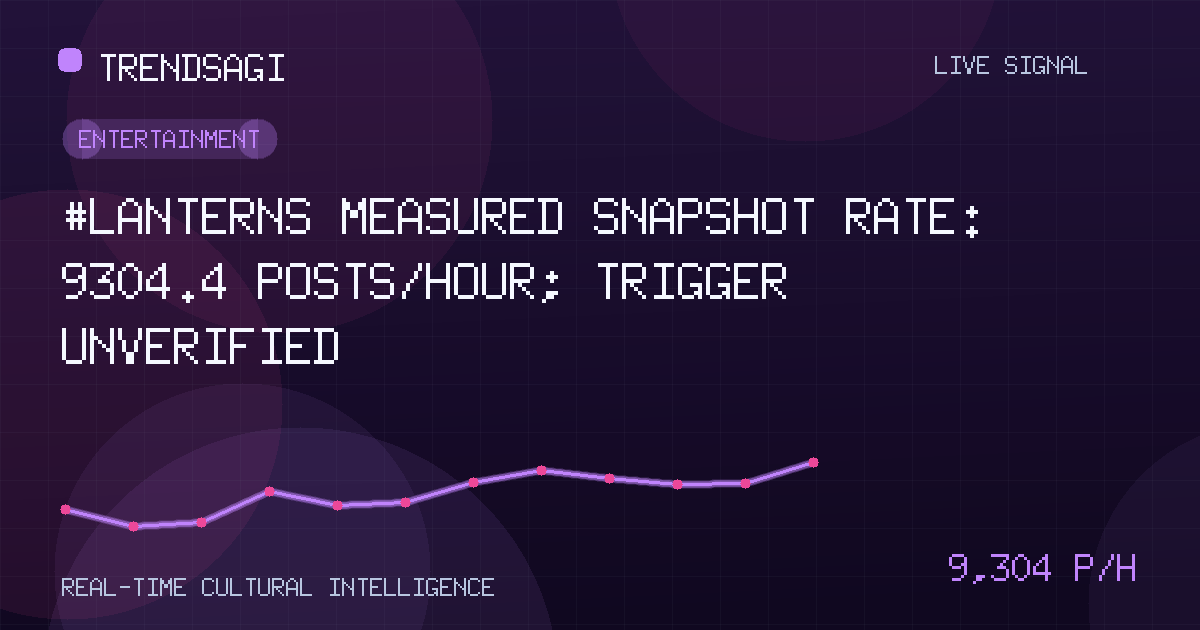
#Lanterns measured snapshot rate: 9304.4 posts/hour; trigger unverified
#Lanterns recorded a measured snapshot rate of 9304.4 posts/hour; the cause is unverified, with clear checks for editors and analysts.
Automated briefing. Generated from stored signal measurements and source-backed research; it is not manually reviewed. Read the methodology and limitations.
Metrics in this briefing are a snapshot associated with its publication date and may not reflect current conditions.
What changed
The #Lanterns signal shows a concentrated short-window activity spike, but its public trigger is not verified. The defensible conclusion is narrow: posting accelerated during the measured interval, yet the available evidence does not tie that acceleration to a particular release, event, clip, controversy, campaign, or audience response.
The measured snapshot rate was 9304.4 posts/hour over an exact 1880-second window using 2 stored observations, with the measurement recorded at 2026-10-05T01:56:30Z. The latest snapshot volume was 6000 posts. These answer different questions: the measured snapshot rate describes collection speed during the interval, while the snapshot volume describes the observed post count. Neither is a live forecast, reach, engagement total, or unique-person count.
| Observation time | Measured snapshot rate | Latest snapshot volume |
|---|---|---|
| 2026-10-05T01:56:30Z | 9304.4 posts/hour | 6000 posts |
Why this topic may be moving
Several mechanisms could produce this pattern. They are hypotheses to test, not verified explanations:
- Event-driven attention: A release, performance, announcement, or themed occasion could create a timed cluster; no such trigger is confirmed.
- Format-driven virality: A clip, meme, controversy, or participation format could prompt imitation and reposting. The record does not show which, if any, occurred.
- Promotion or coordination: Paid, organic, influencer, or coordinated activity could lift volume without broad cultural relevance. The source mix is unknown.
- Hashtag ambiguity: The label may combine unrelated uses or quoted material. Without reviewing the posts, the snapshot cannot be treated as one coherent conversation.
The stored Entertainment category provides useful routing, not causal proof. It describes how the signal was classified, not what prompted it. A content audit is necessary before describing #Lanterns as an entertainment event rather than a collection of posts that merely share a label.
Why it matters
This signal matters because a fast-moving label can outrun verification. It should change the monitoring priority, not the certainty of the story.
- Editors: Decide whether there is a reportable development only after matching the timing to verified public evidence.
- Audience and community teams: Read the posts to learn whether people are reacting to one subject or using a common label for different things.
- Brand and marketing teams: Treat the burst as a prompt for relevance checks, not evidence of demand, sales, or campaign effectiveness.
- Researchers: Preserve definitions for the measured snapshot rate and snapshot volume before comparing this observation with another dataset.
The responsible conclusion is not that a specific cause is known. It is that #Lanterns produced a measured short-window burst, while the trigger and persistence remain unverified.
What to watch next
The next useful work is a sequence of checks, ideally on the same platform and with unchanged collection rules:
- Sample the content. Review posts inside the exact 1880-second interval and adjacent periods. Record what entities, themes, media, and events the label actually connects.
- Align the timeline. Compare post timestamps with the first appearance of any clip, announcement, or discussion. A cause that predates the burst is stronger than one reported afterward.
- Verify the trigger. Look for a named publisher's contemporaneous report or a direct announcement from an identifiable organization, creator, or event account. Reposts alone are not confirmation.
- Test composition. Separate original posts from copies, reactions, automated activity, and unrelated uses. Check whether a small set of accounts accounts for most visible activity.
- Establish persistence. Compare preceding and following 1880-second windows under the same definitions. A single elevated interval may reflect a launch or discovery event rather than durable momentum.
- Check reach beyond one surface. Determine whether the label is appearing independently on other public sources or whether distribution is confined to the monitored collection.
Concrete signals that would strengthen or weaken the briefing
- Strengthen: sustained measured snapshot rate, broader participation, consistent semantics, and a verified trigger aligned with the timing.
- Refine: a sharp rise followed by a quick return to baseline, suggesting a time-bounded event.
- Qualify: multiple meanings, repeated copies, or account concentration, making the aggregate label less representative.
Methodology and limitations
The measured snapshot rate is based on 2 stored observations across the exact 1880-second window ending at 2026-10-05T01:56:30Z. It detects change between those observations but cannot reveal the shape within the interval. It does not establish a normal baseline or indicate whether the level is high compared with earlier periods.
The 6000-post snapshot is an observed volume, not a posts/hour value. The supplied record does not state that it shares the measured interval's collection boundary, so the two figures should not be combined arithmetically. Posts also do not establish unique people, organic reach, sentiment, geography, language, or engagement.
No verified publisher evidence or first-party announcement has been established in the available context, so this briefing assigns no external cause. A later update should retain the same metrics, name the public source behind any explanation, and distinguish observed facts from hypotheses.
Track This Topic for New Signals
Set alerts for future velocity or sentiment changes around this topic.
Explore Tracking PlansAbout TrendsAGI research
TrendsAGI's automated research pipeline publishes dated signal snapshots, methodology notes, and practical workflows for teams evaluating cultural momentum. Read how signals are scoped, scored, and limited in our research methodology.