904-second window · 3 observations · Measured Oct 7, 2026, 6:56 AM UTC · Provider: go_recent_snapshot_v2
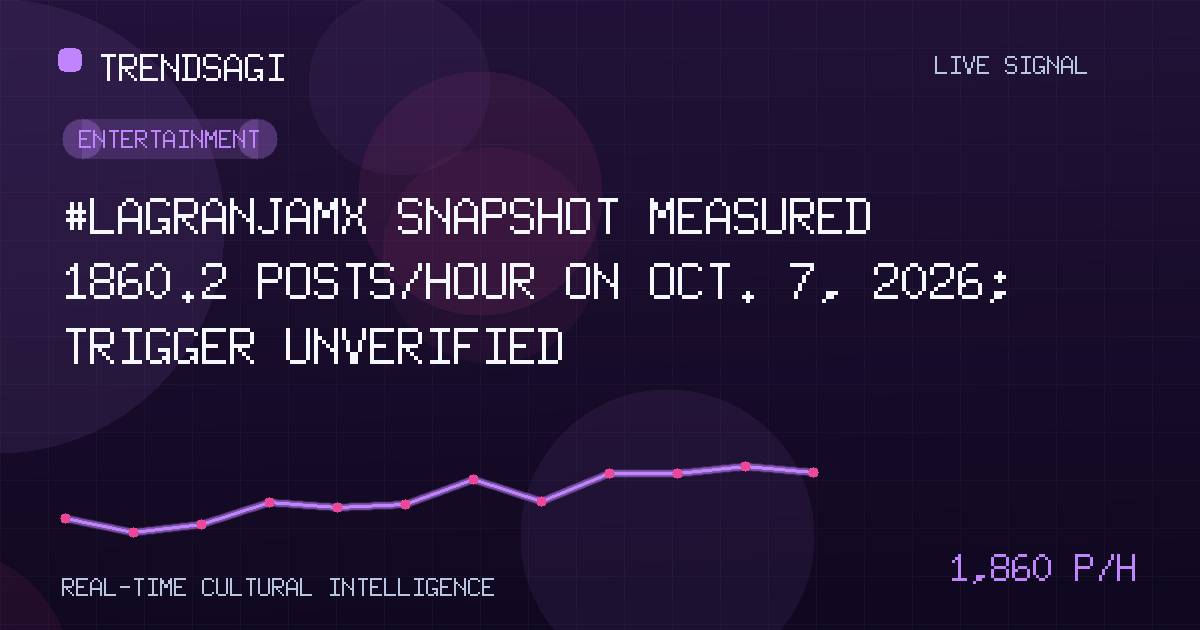
#LaGranjaMX snapshot measured 1860.2 posts/hour on Oct. 7, 2026; trigger unverified
The latest #LaGranjaMX snapshot measured 1860.2 posts/hour over 904 seconds, while the cause of the short-window burst remains unverified.
Automated briefing. Generated from stored signal measurements and source-backed research; it is not manually reviewed. Read the methodology and limitations.
Metrics in this briefing are a snapshot associated with its publication date and may not reflect current conditions.
What changed
#LaGranjaMX registered a measured snapshot rate of 1860.2 posts/hour at 2026-10-07T06:56:23Z. That is the clearest answer to what changed: the observed series shows a concentrated burst of activity across an exact 904-second window based on 3 observations, not a live rate, a forecast, or an estimate of reach.
The latest snapshot volume was 960 posts. Volume and rate answer different questions: 960 describes the captured snapshot, while 1860.2 posts/hour describes the measured change rate. The signal confirms short-window activity, but no verified public trigger is available, so the reason for the movement remains unclear.
| Measure | Observed value |
|---|---|
| Observation time | 2026-10-07T06:56:23Z |
| Measured snapshot rate | 1860.2 posts/hour |
| Exact measurement window | 904 seconds |
| Observations used | 3 |
| Latest snapshot volume | 960 posts |
Why this topic may be moving
No verified public trigger is available for this briefing. The rate establishes a change in activity, not its cause. It would be premature to attribute the burst to a new episode, live event, promotional push, clip, cast announcement, dispute, or platform change. Each is a testable hypothesis, not an established fact about this signal.
Verification should begin with chronology. A public report or first-party announcement would need a timestamp before the measured acceleration and details that match the conversation. A catalyst published after the observation cannot explain the earlier movement. Search results and clusters of repeated wording may help locate a lead, but they need corroboration before becoming the headline explanation.
A measured rate can tell an editor when conversation accelerated; it cannot identify the event behind the movement, the people who posted, or whether the pattern will continue.
Until that evidence is available, the responsible description is that #LaGranjaMX showed a measured short-window burst with an unverified trigger. This preserves the useful part of the signal without turning speculation into reporting.
What the signal can and cannot establish
The signal supports a narrow, defensible conclusion:
- Observed change: The series recorded a measured snapshot rate of 1860.2 posts/hour during the specified window.
- Snapshot size: The latest captured snapshot contained 960 posts, which is a volume count rather than a rate.
- Timing: The observation is tied to an exact UTC timestamp, allowing a later catalyst to be checked for proper chronology.
- Editorial routing: The signal is classified as entertainment, which helps direct it to the appropriate monitoring desk.
What it does not establish
- The cause of the movement or the event viewers were reacting to.
- Unique participants, total reach, impressions, or engagement.
- Whether sentiment was positive, negative, neutral, or mixed.
- The geographic, demographic, or language distribution of posters.
- A normal baseline, long-term trend, or evidence that the burst will persist.
- Whether the activity was broadly organic, coordinated, copied, or automated.
Why it matters
For social and entertainment editors, the alert says check the topic now, not necessarily publish a causal story now. A specific verified catalyst, together with evidence that discussion is broad and sustained, would provide stronger grounds for added coverage. A numerical burst by itself does not explain why readers should care.
Community, audience, and brand-safety teams should also distinguish breadth from repetition. Activity spread across independent accounts has different implications from a small group repeatedly copying the same item. The current snapshot does not resolve that question, and neither does a larger-looking post count.
Researchers should preserve the observation time, counting method, and window before drawing comparisons. A short event-sensitive interval can be valuable for detecting immediate response, but it is not a substitute for a longer baseline or content-level analysis.
What to watch next
The most useful follow-up evidence would be concrete and observable:
- Persistence: Collect follow-up observations using the same 904-second window and counting method. Sustained elevation would support an ongoing event; rapid fading would indicate a short pulse.
- Catalyst timing: Look for a credible publisher report or first-party announcement timestamped before the measured acceleration.
- Content match: Check whether posts discuss the same subject or instead use the label for unrelated, promotional, or copied material.
- Authenticity: Examine unique post identifiers and the share of exact or near-duplicate wording.
- Account concentration: Determine whether activity is distributed across independent participants or dominated by a small number of high-volume accounts.
- Official participation: Verify any direct contribution from official accounts rather than assuming official involvement from volume alone.
- Next direction: Watch for fading, stable activity, or a separate reacceleration after the recorded observation.
Methodology and limitations
The rate of 1860.2 posts/hour is a measured snapshot statistic calculated from 3 observations over an exact 904-second window and associated with the stated observation time. It should not be described as a live rate, cumulative total, forecast, reach figure, engagement measure, or unique-person count. Converting it into another total would add information not supplied by the signal.
The 960-post value is the latest snapshot volume. It should not be substituted for the measured rate or treated as a count of distinct authors. The short window and limited observation count also prevent strong conclusions about seasonality, a normal baseline, or durable momentum.
No external causal attribution is made because a public trigger could not be verified. Future updates should add a cause only when dated public evidence aligns with both the movement and the observed conversation, while keeping that explanation separate from the measured rate and snapshot volume.
Track This Topic for New Signals
Set alerts for future velocity or sentiment changes around this topic.
Explore Tracking PlansAbout TrendsAGI research
TrendsAGI's automated research pipeline publishes dated signal snapshots, methodology notes, and practical workflows for teams evaluating cultural momentum. Read how signals are scoped, scored, and limited in our research methodology.


