901-second window · 3 observations · Measured Oct 2, 2026, 3:36 PM UTC · Provider: go_recent_snapshot_v2
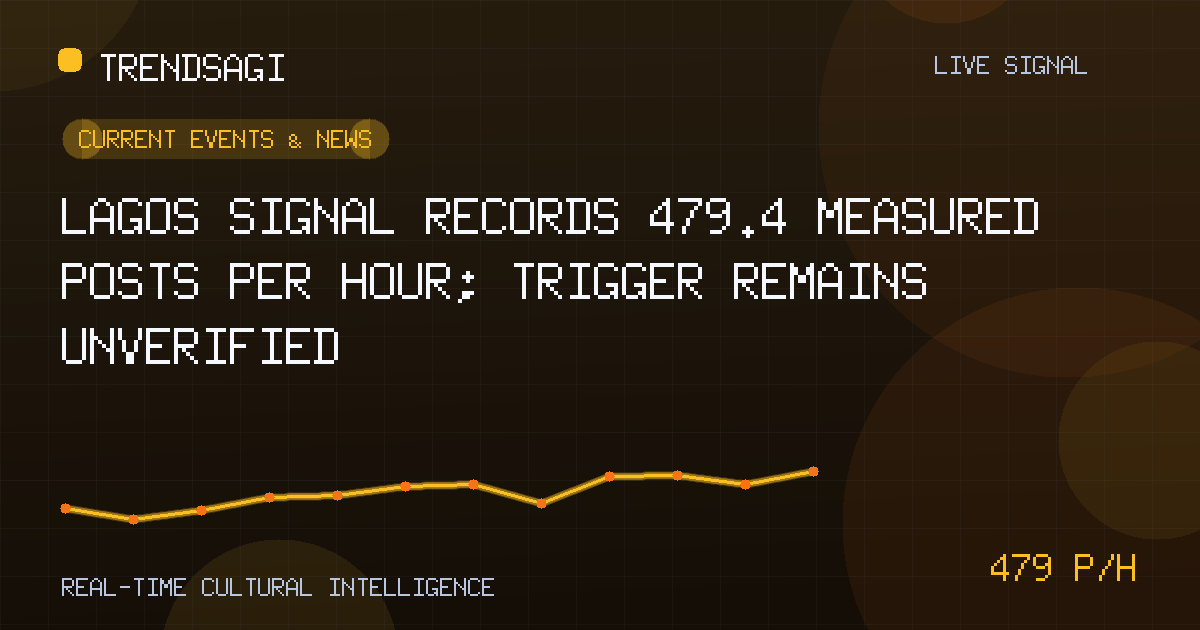
Lagos signal records 479.4 measured posts per hour; trigger remains unverified
The Lagos signal recorded 1531 posts and a measured 479.4 posts/hour; here is what is known, unresolved, and worth checking next.
Automated briefing. Generated from stored signal measurements and source-backed research; it is not manually reviewed. Read the methodology and limitations.
Metrics in this briefing are a snapshot associated with its publication date and may not reflect current conditions.
What changed
The stored Lagos signal records 1531 posts in the latest snapshot, and the measured change is a snapshot rate of 479.4 posts/hour across the available observations. The direct conclusion is limited: the monitored dataset showed posting activity around the Lagos label during the sampled interval, but no verified evidence identifies what triggered it. The aggregate also cannot show that all of those posts concern the same event.
The rate was measured at 2026-10-02T15:36:38Z over an exact 901-second window using 3 stored observations. It is a retrospective snapshot measurement, not a live or current rate, forecast, reach figure, engagement measure, or count of unique people. The cause remains unclear.
| Observation time | Measured snapshot rate | Latest snapshot volume |
|---|---|---|
| 2026-10-02T15:36:38Z | 479.4 posts/hour across an exact 901-second window using 3 stored observations | 1531 posts |
Why this topic may be moving
There is no defensible event attribution in the supplied record. It has no post text, account sample, source distribution, geographic breakdown, or verified contemporaneous report. Naming a specific news event would therefore add a plausible story, not an evidenced finding.
Three non-exclusive possibilities can be tested:
- Event-driven activity: A time-specific development generated new posts that share a common subject.
- Recirculation: Existing content re-entered the feed through sharing, reposting, or renewed attention.
- Measurement effects: Repetition, automation, or label ambiguity inflated the apparent volume.
A measured posting rate is a prompt to verify, not a finding about what happened. The rate can direct attention; only time-aligned evidence can support a causal account.
Until that evidence exists, these remain hypotheses. The strongest supported statement is that the monitored posting pattern moved during the stored window, not why it moved or whether the movement will persist.
What the signal can and cannot establish
The signal is useful as a detection and triage tool. It supports three operational conclusions:
- At the latest snapshot, the stored dataset contained 1531 posts associated with the label.
- Observed changes support a measured snapshot rate of 479.4 posts/hour, providing a benchmark for later comparisons.
- Because the reason is unresolved, verification should precede interpretation or action.
It does not support the following claims:
- That a particular event caused the activity;
- That every post concerns one subject;
- How many unique people posted or were reached;
- Whether activity was organic rather than repetitive or automated;
- What sentiment or factual accuracy the posts contain;
- Where participants were located or how broadly the signal was represented.
Snapshot volume and posts/hour answer different questions. The former is a count attached to the latest observation; the latter is a rate derived from observations over the exact window. Neither reveals audience size.
Why it matters
The distinction between detection and explanation matters because a short-window aggregate can prompt a costly response even when activity is repetitive, narrowly sourced, or semantically mixed.
- Newsrooms: Check whether a verified development aligns with the timing and meaning of the posts.
- Civic and public-safety teams: Treat the signal as a verification trigger, not evidence of an incident.
- Businesses and community organizations: Determine whether the discussion bears on operations without assuming relevance from the label alone.
- Researchers: Obtain item-level data and account checks before estimating participation or opinion.
For all readers, 479.4 posts/hour is more useful as a measurement anchor for the next check than as standalone proof of significance.
What to watch next
A practical verification sequence would be:
- Inspect the underlying items. Review the earliest identifiable posts before and during the exact 901-second window. Record timestamps, text, account type, repost status, and the intended meaning of Lagos. This can reveal whether items share a catalyst or only a label.
- Separate raw volume from distinct content. Group exact and near duplicates, repeated updates, and reshared copies, then examine account concentration. Repeated posts have different implications from broad original discussion.
- Seek time-aligned public context. Compare primary statements and independent reporting with the first observed posts. Record publication times and disagreements rather than assuming the latest report caused the entire window.
- Repeat the measurement consistently. Use the same label, collection method, and a comparable window. Establish a prior baseline and compare both the rate and latest snapshot volume independently.
- Check data quality. Review collection gaps, time-zone handling, language coverage, and possible classification errors. These checks matter because the label alone may mix unrelated meanings.
Concrete watch signals
- Persistence: A subsequent comparable measured rate near 479.4 posts/hour would show whether activity held relative to this snapshot.
- Volume: Movement away from 1531 in a later snapshot would update volume only; a new posts/hour figure requires observed changes.
- Breadth: Activity distributed across many distinct original items rather than a few accounts or duplicated threads.
- Semantic convergence: A growing share of posts explicitly referring to the same event.
- External alignment: A credible report or primary record with a timestamp preceding the rise.
Methodology and limitations
The supplied metric uses 3 stored observations over an exact 901-second window ending at 2026-10-02T15:36:38Z. Latest snapshot volume is 1531 posts. These figures are reported as provided: the rate is not reconstructed, and volume is not relabeled as a rate. No underlying corpus, historical baseline, collection coverage, account-level check, or verified contemporaneous public context is available. With only 3 observations, short-lived bursts may heavily influence the result. The signal can identify where verification is needed, but cannot establish cause, sentiment, authenticity, participant uniqueness, location, reach, or wider public opinion.
Track This Topic for New Signals
Set alerts for future velocity or sentiment changes around this topic.
Explore Tracking PlansAbout TrendsAGI research
TrendsAGI's automated research pipeline publishes dated signal snapshots, methodology notes, and practical workflows for teams evaluating cultural momentum. Read how signals are scoped, scored, and limited in our research methodology.