914-second window · 3 observations · Measured Oct 5, 2026, 6:11 PM UTC · Provider: go_recent_snapshot_v2
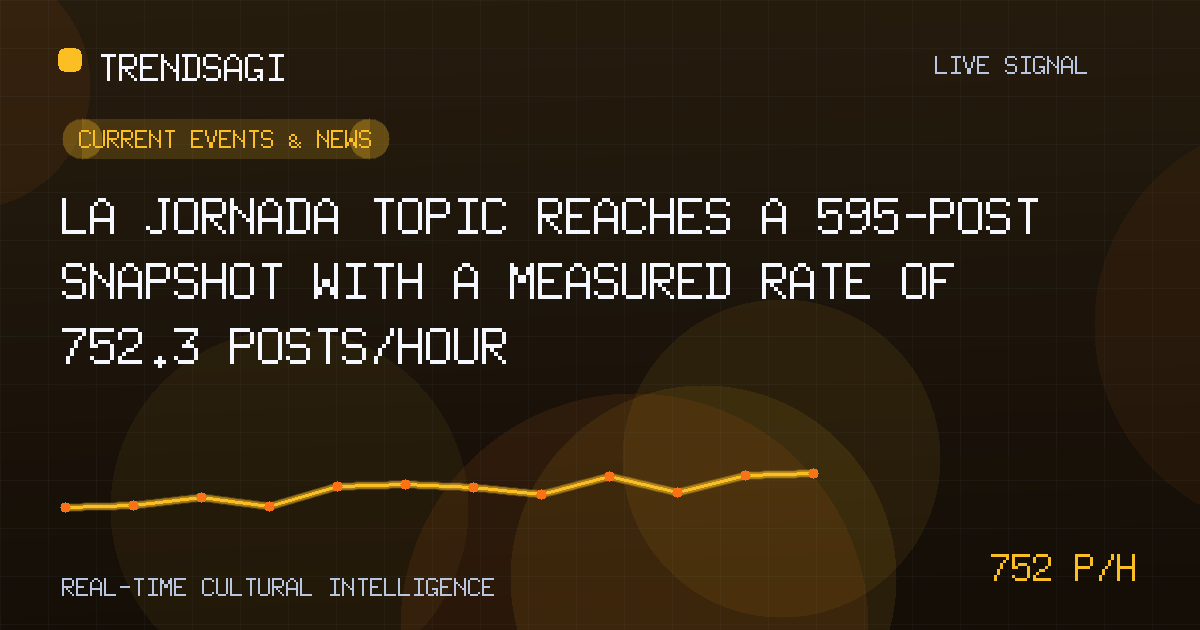
La Jornada topic reaches a 595-post snapshot with a measured rate of 752.3 posts/hour
La Jornada has a 595-post snapshot and a measured 752.3 posts/hour rate; the signal flags a burst but not its cause or what readers should verify.
Automated briefing. Generated from stored signal measurements and source-backed research; it is not manually reviewed. Read the methodology and limitations.
Metrics in this briefing are a snapshot associated with its publication date and may not reflect current conditions.
What changed
Answer: The available signal shows a sharp, short-window burst around the broad label La Jornada, with 595 posts in the latest snapshot. It flags activity worth checking, but it does not identify a triggering story, actor or event; no cause is established by the available evidence.
The measured snapshot rate was 752.3 posts/hour over an exact 914-second window using 3 stored observations, measured at 2026-10-05T18:11:38Z. This is a historical pace within that measurement window—not a live or current rate, forecast, reach figure, engagement count or unique-person count. The rate and snapshot volume describe different aspects of the signal and should not be treated as interchangeable.
| Observation time | Measured snapshot rate | Latest snapshot volume |
|---|---|---|
| 2026-10-05T18:11:38Z | 752.3 posts/hour | 595 posts |
What the signal can establish
The defensible finding is temporal: posts carrying or assigned to this topic were numerous enough to register a rapid measured change around the observation point. The topic label, however, contains no description of what the posts discuss. That makes this a monitoring alert, not yet an explained news trend.
- It can show that the stored series recorded 595 posts at the snapshot and a measured 752.3 posts/hour pace during the specified 914-second window.
- It supports prioritizing a review of the underlying posts because the pace was calculated from 3 observations in a narrow window.
- It cannot show how long the activity will last or whether it exceeds a normal baseline, because neither is supplied.
- It cannot establish unique authors, audience size, sentiment, geography or engagement from post volume alone.
A high posting rate tells editors that recorded posts are clustering; it does not identify the event that caused the clustering or prove that the activity is independent.
The label itself is a major constraint. The series may be grouping references to a publisher, a headline, a quoted phrase or unrelated uses of the same name. Without inspecting matched text, those possibilities cannot be separated. A large count may therefore reflect a coherent event, broad entity matching or repetition, and the stored numbers alone cannot distinguish among them.
Why this topic may be moving
The cause remains unclear because the signal has no description or substantiated external context connecting the burst to a specific public development. Any explanation at this stage would be speculation.
Possible mechanisms include a newly prominent story, a contentious statement, renewed discussion of older news or amplification of one post. These are hypotheses, not findings. The especially important unresolved question is whether the posts share one referent. If they do not, the apparent surge could be a labeling artifact rather than a single trend.
Why it matters
The distinction affects how confidently readers, editors and communication teams should interpret the number. A large burst can justify more scrutiny, but it is not evidence that a claim is important, true or widely endorsed.
- Newsrooms should identify the specific story or event before labeling the movement as a breaking-news trend.
- Press and communications teams should check whether the cluster reflects genuine pickup, controversy or repeated copying.
- Researchers should retain the raw matched text and collection method so that posts, quotations and duplicate distribution are not conflated.
- Readers should treat the post count as a prompt to verify, not as a measure of credibility, importance or consensus.
What to watch next
The next useful step is not another unsupported summary. It is to inspect the matched content and build a timestamped sequence around the measured window.
- Sample the underlying posts. Review items from both ends of the exact 914-second window. Record timestamps, repeated wording, named entities and whether each item is an original mention, citation, quotation or repost. Separate formatting or wording variants before judging coherence.
- Identify the common referent. Determine whether the cluster concerns one publisher, one article, one person or several unrelated subjects. This is the fastest way to test whether the topic label has grouped distinct conversations.
- Trace the earliest substantive item and any primary public source it cites. A credible source that predates the burst would strengthen a causal explanation. An item appearing only after the cluster weakens that explanation.
- Use Google Search to test exact phrases and named entities from the sample. Look for attributable reporting or an official statement that precedes the increase. Do not treat an unsourced social post as confirmation.
- Collect later stored observations and compare whether the measured pace remains elevated, falls or disappears. Also record whether new posts repeat the same subject. This separates a continuing event from a brief naming spike.
Concrete watch signals
- Multiple independent posts converging on one verified event.
- A timestamped public statement or attributable report preceding the cluster.
- Elevated measured snapshot rates in subsequent windows, rather than only this one.
- Posts splitting into unrelated subjects, which would point toward broad label matching.
Methodology and limitations
The reported rate is used as supplied and is not recalculated. It covers an exact 914-second window based on 3 stored observations, measured at 2026-10-05T18:11:38Z. Latest snapshot volume is 595 posts. Snapshot volume is not a rate, and the record does not establish that it is the numerator used for the rate.
The main limitations are the small observation base, absence of a historical baseline and lack of post-level content or provenance. The signal cannot establish unique people, sentiment, reach, engagement, causation or whether activity is organic rather than coordinated repetition. No verified public context accompanies the signal, so the movement is not attributed to any publisher, statement or external development.
Track This Topic for New Signals
Set alerts for future velocity or sentiment changes around this topic.
Explore Tracking PlansAbout TrendsAGI research
TrendsAGI's automated research pipeline publishes dated signal snapshots, methodology notes, and practical workflows for teams evaluating cultural momentum. Read how signals are scoped, scored, and limited in our research methodology.


