892-second window · 2 observations · Measured Oct 4, 2026, 10:25 PM UTC · Provider: go_recent_snapshot_v2
Kyler Murray signal measures 818.9 posts per hour; cause remains unverified
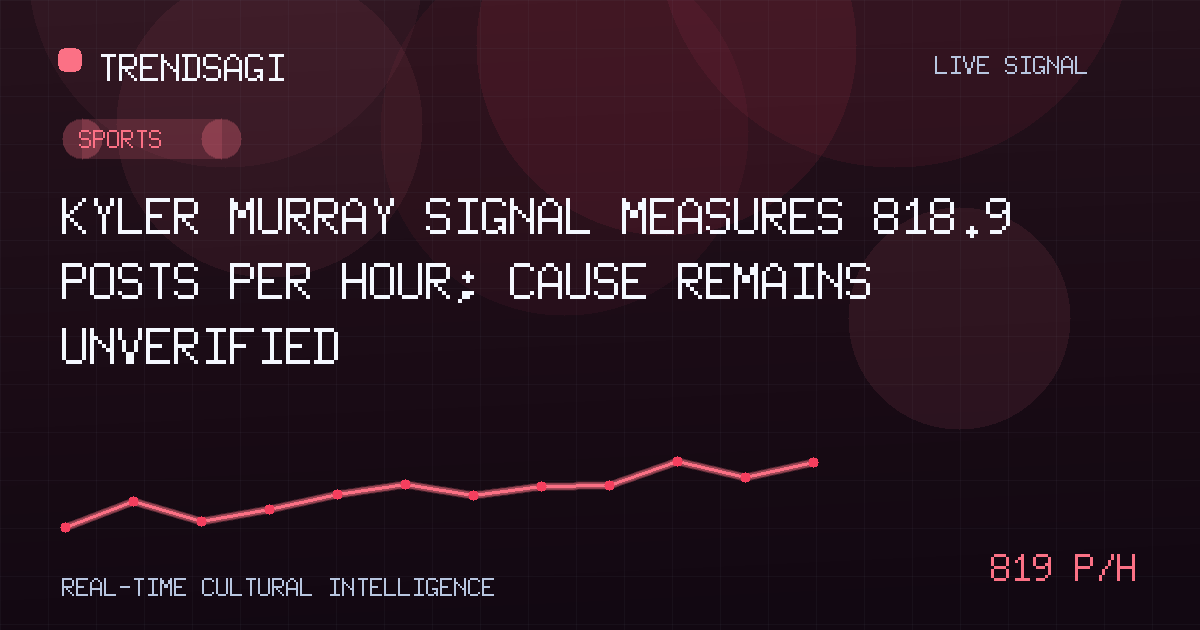
A stored Kyler Murray snapshot measured 818.9 posts per hour over 892 seconds; the cause remains unverified.
Automated briefing. Generated from stored signal measurements and source-backed research; it is not manually reviewed. Read the methodology and limitations.
Metrics in this briefing are a snapshot associated with its publication date and may not reflect current conditions.
What changed
The stored Kyler Murray signal registered a measured snapshot rate of 818.9 posts per hour at 2026-10-04T22:25:44Z, indicating increased post activity during the observed window. No verified public catalyst is established here, so the reason for the movement remains unclear.
The rate was calculated from 2 stored observations across an exact 892-second window. It is a measured snapshot rate, not a live or current rate, forecast, reach metric, engagement metric, or unique-person count. The latest snapshot contained 376 posts, a separate volume total that should not be treated as a rate.
| Observation time | 2026-10-04T22:25:44Z |
|---|---|
| Measured snapshot rate | 818.9 posts/hour |
| Latest snapshot volume | 376 posts |
Why this topic may be moving
There is no verified public context explaining this particular increase. The signal shows that the monitored feed accumulated posts more quickly during the stored interval, but it does not reveal what readers were responding to. Assigning a cause without inspecting the underlying posts would therefore exceed the available evidence.
Because the label is person-focused and categorized as Sports, possible explanations could include a new update, a broadcast clip, commentary connecting Murray to broader team coverage, or recirculation of existing material. These are investigation leads, not findings. A sudden volume increase does not by itself confirm that a new event occurred, that Murray was directly involved, or that the activity was broadly distributed across independent authors.
The strongest supported conclusion is that the monitored Kyler Murray feed accumulated posts more quickly during the stored interval, not that a particular sports event caused the increase.
What the signal establishes
The signal supports a narrow operational conclusion: the latest observation contained 376 posts, and the 2 stored observations yielded a measured change rate of 818.9 posts per hour over 892 seconds. That is enough to prioritize a timely review of the feed and any public reporting available during the same period.
It does not establish:
- the news event, post, clip, or announcement behind the movement;
- whether the posts agreed or disagreed, or whether discussion was positive, negative, or neutral;
- how many distinct people authored the posts or whether automated activity contributed;
- the audience size, impressions, engagement, geography, or influence of those posts; or
- whether the increase persisted beyond the exact observation window.
Why it matters
Sports editors and audience teams should avoid using raw post volume as a substitute for verification. A fast-moving topic can reflect genuine reaction, duplicate commentary, a media clip entering circulation, or a collection artifact. Each possibility calls for a different editorial response.
For Murray-focused publishers, community teams, and analysts, the immediate value is not a conclusion about why attention increased. It is a trigger to examine the source mix, identify the earliest substantive posts, and determine whether independent reporting or primary-source material preceded the cluster. Readers also need separation between measured activity and claims about public significance: 376 posts show collection volume, while 818.9 posts per hour describes the short-window change captured by the stored observations.
What to watch next
- Persistence: Take a fresh observation and compare subsequent movement with this snapshot. A continued elevated rate would indicate that the burst persisted; a quick reversal would be more consistent with a short-lived spike.
- Earliest substantive posts: Review the first credible posts in the window, including their timestamps and sources. Later repetition may be a response to the original item rather than its cause.
- Source diversity: Check whether discussion is spread across independent accounts or concentrated in a narrow group repeatedly publishing similar text, links, images, or video.
- Catalyst verification: Look for timely, attributable public reporting or a primary statement that directly explains the cluster. A verified item published before the surge would strengthen an event-driven interpretation; unrelated coverage would not.
- Topic alignment: Determine whether posts concern Murray directly or mention him as context for a team, opponent, schedule, or broader storyline. Label-level monitoring cannot make that distinction.
- Content characteristics: Sample the actual posts for sentiment, factual claims, and recurring themes. Any sentiment conclusion should be based on coded content rather than inferred from volume.
Concrete confirmation would look like multiple independent posts referencing the same timely, verified development. By contrast, many near-identical excerpts or clips without new reporting would point toward amplification rather than a separate event. Neither pattern is established by the current signal.
Methodology and limitations
The measured rate of 818.9 posts per hour was recorded at 2026-10-04T22:25:44Z from 2 stored observations separated by exactly 892 seconds. The 376-post figure is the latest snapshot volume and uses a different measurement basis. The values should remain separate rather than combined into an implied total, audience estimate, or forecast.
A rate based on 2 observations over a short window may be sensitive to a concentrated burst near either endpoint. Without the underlying post text, source records, collection details, or a longer comparison period, the signal cannot diagnose cause or representativeness. No external catalyst is attributed because none could be verified for this briefing. The appropriate next step is source-level inspection followed by a fresh observation, with the timestamp, measured snapshot rate, and snapshot volume reported independently.
Track This Topic for New Signals
Set alerts for future velocity or sentiment changes around this topic.
Explore Tracking PlansAbout TrendsAGI research
TrendsAGI's automated research pipeline publishes dated signal snapshots, methodology notes, and practical workflows for teams evaluating cultural momentum. Read how signals are scoped, scored, and limited in our research methodology.