888-second window · 3 observations · Measured Oct 2, 2026, 1:41 PM UTC · Provider: go_recent_snapshot_v2
KUN for Valentino records 808 posts in latest snapshot; catalyst unverified
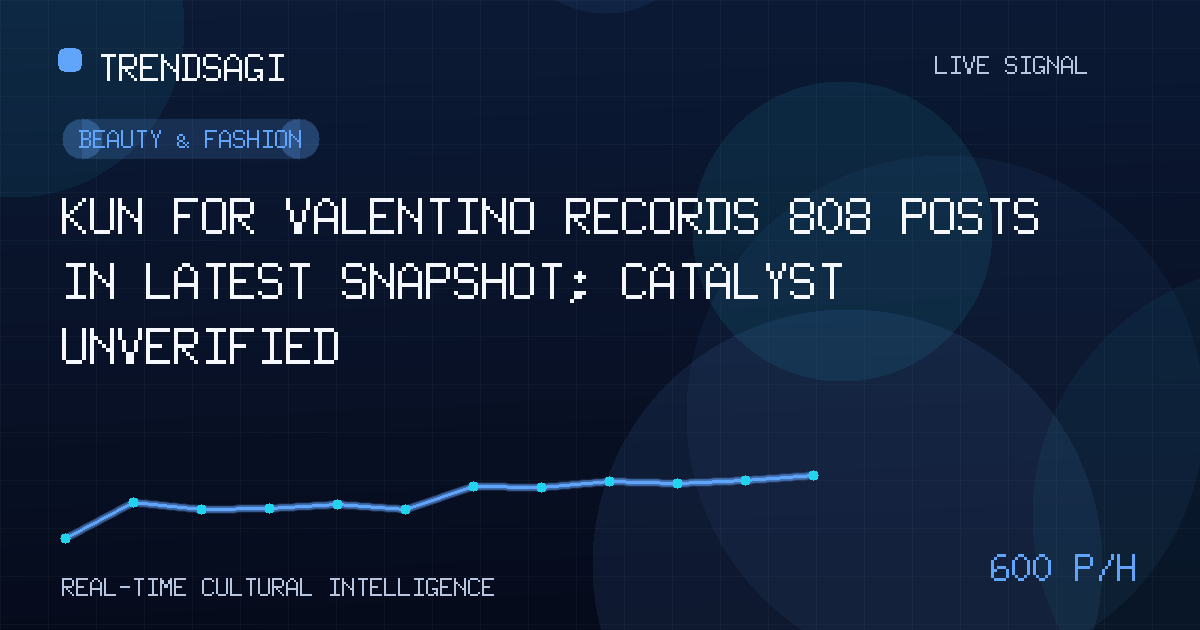
KUN for Valentino recorded 808 posts and a measured 599.9 posts/hour snapshot rate; here is what is known, unclear, and worth checking next.
Automated briefing. Generated from stored signal measurements and source-backed research; it is not manually reviewed. Read the methodology and limitations.
Metrics in this briefing are a snapshot associated with its publication date and may not reflect current conditions.
What changed
“KUN for Valentino” shows a concentrated burst of posting activity, but the available evidence does not identify what triggered it. The latest stored snapshot contains 808 posts. That is enough to justify closer monitoring, not enough to call it a confirmed Valentino launch, campaign, controversy, or broader trend.
The measured change is 599.9 posts/hour, and it should be read strictly as a measured snapshot rate. It covers an exact 888-second window based on 3 stored observations, with the latest observation at 2026-10-02T13:41:39Z. This is not a live or current rate, a forecast, a reach or engagement measure, or a unique-person count.
The snapshot volume and rate are related but distinct. The 808 figure describes the captured post count at the latest observation; the 599.9 posts/hour figure describes change across the narrow observation window.
| Observation time | Measured posts/hour | Snapshot volume |
|---|---|---|
| 2026-10-02T13:41:39Z | 599.9 posts/hour | 808 posts |
Rate basis: exact 888-second window; 3 stored observations.
Why this topic may be moving
The record categorizes the topic as Beauty & Fashion, but its stored signal description is blank. No verified public source identifies an originating post, official campaign, product announcement, interview, incident, or controversy. The data therefore shows a rapid change in matching-post activity without showing what people were responding to.
Several explanations are plausible, but none is established:
- An official or creator-led post could have given people a shared reference; however, no verified post tying the phrase to Valentino is attached.
- Reaction to a collection, product, campaign, or criticism could be spreading under a shortened label, but the stored material identifies no specific event.
- The wording could combine unrelated uses of “KUN” and “Valentino,” creating a misleading match.
- Copies, cross-posts, or coordinated amplification could contribute to the count without a comparable increase in original discussion.
These are verification hypotheses, not findings. The defensible editorial conclusion is that matching-post activity changed quickly while the reason remains unclear.
Why it matters
This signal is useful because it identifies a specific monitoring task: establish provenance before interpretation. The phrase “for Valentino” can sound like a confirmed relationship, but the topic label alone does not prove one. An editor should not turn it into a claim about the fashion house without checking the originating content and relevant official statements.
The broad Beauty & Fashion category also needs validation. Posts may be commentary, promotion, criticism, a name collision, or unrelated chatter captured by the same query. Without a description of the matching method, even the apparent subject cohesion is uncertain.
For analysts, the main value is triage: this is a short-window alert with explicit timing and volume. For readers, the value is avoiding a causal story that the evidence cannot support.
Editorial takeaway: report a short-window burst with an unverified cause, then seek provenance and persistence before assigning a wider trend narrative.
What to watch next
A practical follow-up should move from quantity to meaning:
- Audit the capture. Retrieve the exact query text, matching rules, platform coverage, language and geography filters, and deduplication settings. Confirm the counting unit and whether duplicate handling is applied.
- Inspect the burst. Sample the earliest and latest posts, then classify them as original content, replies, reposts, duplicates, promotion, reaction, criticism, or unrelated material. Report account concentration and repeated wording without labeling accounts automated without evidence.
- Trace the source. Run a date-bounded Google search for the exact phrase and close variants, open the underlying pages, and look for the earliest substantive source. Check whether a relevant official account, named creator, or credible publication explicitly connects KUN with Valentino.
- Verify the relationship. Separate an official association from viewer interpretation. A campaign, collection, product, ambassador, event, or parody should not be inferred from “for” alone.
- Remeasure consistently. Preserve this observation, then collect later snapshots with the same query, filters, platform scope, and window. Keep raw counts and measured rates separate, and compare them with prior windows before calling the movement sustained.
Concrete signals that would sharpen the briefing include:
- Verified trigger: an official statement or credible report explicitly links the topic to a named initiative.
- Broader participation: distinct original posts across unrelated accounts, rather than repeated copies from a small source pool.
- Persistence: activity continues in later matched windows and is not confined to the current burst.
- Coordination warning: identical text, shared wording, or tightly synchronized bursts recur across accounts.
- Emerging meaning: posts converge on specific products, events, claims, or criticism instead of repeating the broad label.
- Decay: measured activity recedes, no new source is found, and the topic does not migrate into more precise subtopics.
Methodology and limitations
The supplied values are the observation timestamp, 808-post snapshot volume, and 599.9 posts/hour measured across an exact 888-second window from 3 observations. No search query, platform mix, collection coverage, historical baseline, sentiment coding, or account-level deduplication method is supplied.
Accordingly, the record can establish observed matching-post activity and its measured change within the stored window. It cannot establish typicality, cause, authenticity, sentiment, geography, organic reach, unique authors, commercial impact, or any formal link between KUN and Valentino. It also cannot show whether the measured rate persisted after the snapshot.
No external context has been verified in the stored record, so the movement is not attributed to any event. That framing preserves the useful signal without overstating it: the activity is measurable, but its meaning is not yet established.
Track This Topic for New Signals
Set alerts for future velocity or sentiment changes around this topic.
Explore Tracking PlansAbout TrendsAGI research
TrendsAGI's automated research pipeline publishes dated signal snapshots, methodology notes, and practical workflows for teams evaluating cultural momentum. Read how signals are scoped, scored, and limited in our research methodology.