875-second window · 2 observations · Measured Oct 10, 2026, 8:56 AM UTC · Provider: go_recent_snapshot_v2
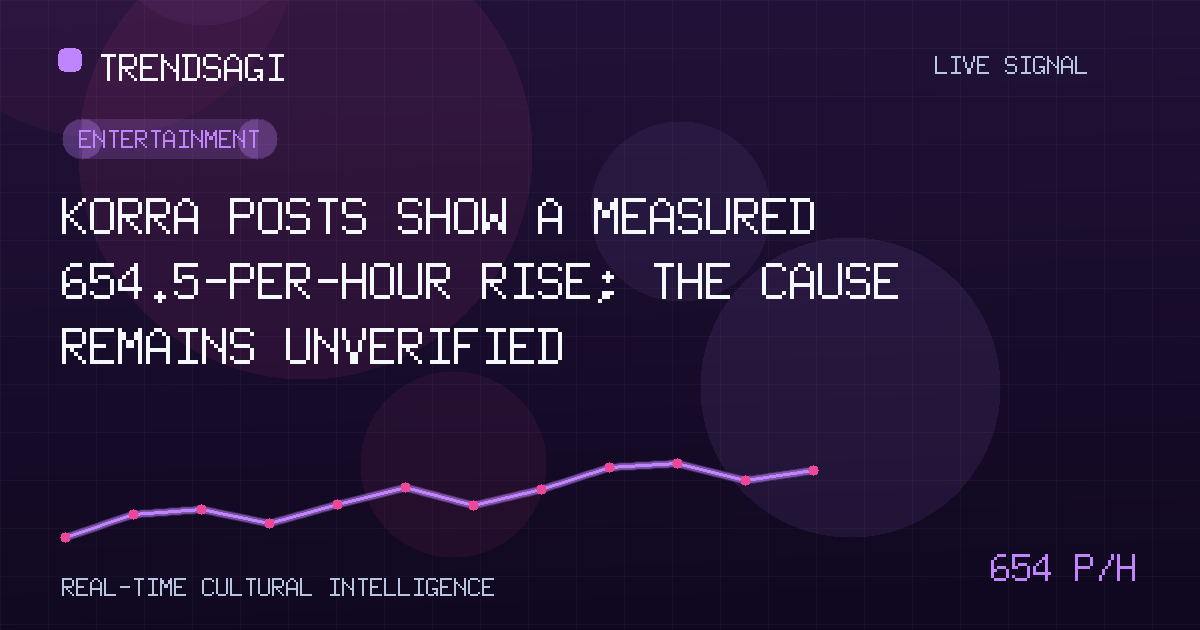
Korra posts show a measured 654.5-per-hour rise; the cause remains unverified
Korra posts rose at a measured 654.5 posts/hour over 875 seconds; here is what is verified, what is not, and what to watch.
Automated briefing. Generated from stored signal measurements and source-backed research; it is not manually reviewed. Read the methodology and limitations.
Metrics in this briefing are a snapshot associated with its publication date and may not reflect current conditions.
What changed
The “Korra” signal records a clear short-window increase in posts, but the event driving it has not been verified. The one-word label and its entertainment classification are not enough to connect the activity to a particular person, franchise, release, controversy, or announcement.
At the latest observation on 10 October 2026 at 08:56:25 UTC, the snapshot contained 452 posts. Across an exact 875-second window, the measured change was 654.5 posts per hour, based on two stored observations. That figure is a measured snapshot rate for this interval, not a live or current rate, a forecast, an audience estimate, or a count of unique people.
| Observation time | Measured snapshot rate | Latest snapshot volume |
|---|---|---|
| 10 October 2026, 08:56:25 UTC | 654.5 posts per hour | 452 posts |
Why this topic may be moving
No verified public event can yet be tied to the increase. Several mechanisms could produce a burst under a broad label: a new work or episode, a circulating clip, a social post from a prominent participant, a controversy, a search-driven story, or coordinated reposting. These are monitoring hypotheses rather than established explanations.
The immediate analytical problem is entity resolution. “Korra” could refer to multiple subjects, and the stored entertainment category does not disambiguate them. Until co-occurring names, source accounts, titles, or other identifying terms consistently appear, it would be unsafe to assign the activity to a specific franchise or creator. A burst can also reflect changes in how a term is used, rather than genuine news about its most likely referent.
The defensible conclusion is not that a particular Korra-related event has occurred, but that activity under the monitored Korra label increased during the measured interval; the trigger still needs identification.
Absence of a verified trigger is not evidence that no event occurred. It means the available record cannot yet distinguish an external news event from a platform effect, repeated content, fandom activity, or measurement noise.
Why it matters
For entertainment editors, the rise is a prompt to investigate rather than a story in itself. A verified connection to a release, performance, controversy, or announcement could make the activity newsworthy. Without that connection, publishing a causal claim would risk confusing an unrelated term collision with a real cultural event.
For audience and platform teams, the signal illustrates why raw post volume needs context. A concentrated burst may reflect a small number of highly active accounts, repeated excerpts, automated sharing, or a wider community responding to one event. None of those possibilities can be resolved from volume alone.
Brand, communications, and rights-monitoring teams should also avoid equating post count with attention quality. The signal does not establish sentiment, engagement, reach, or purchase intent. Its practical value is as an early warning that the term became more active, allowing editors to check whether the burst has an identifiable source and persists.
What the signal can and cannot establish
The recorded evidence supports a limited set of conclusions:
- Activity associated with the monitored “Korra” label increased during the exact 875-second comparison window.
- The latest stored snapshot contained 452 posts.
- The positive change rate measured from the two observations was 654.5 posts per hour.
It does not establish:
- which entity or entity set the label represents;
- why activity increased;
- whether the change came from news, fandom discussion, repetition, or automated behavior;
- how many unique accounts participated;
- the sentiment, credibility, reach, or engagement of those posts;
- whether the increase continued after the snapshot; or
- whether the rate was unusually high compared with a meaningful historical baseline.
Who should care
Editors and reporters should care because a fast-rising entertainment label can precede a story, but only after its identity and trigger are confirmed. Social-listening teams should care because the measurement warrants follow-up across additional snapshots. Researchers should care because the case demonstrates the difference between detecting activity change and explaining it.
Readers should treat the number as a monitoring observation, not proof of a broader cultural event. If the label is later resolved to a specific subject, the same data may help show when discussion accelerated; it still will not show how many people were involved or how influential the discussion was.
What to watch next
- Resolve the label: inspect the names, titles, account handles, and phrases repeatedly co-occurring with “Korra.” Check whether they point consistently to one subject or several unrelated ones.
- Find the earliest substantive posts: distinguish original discussion from bulk reposting and note which sources appear to introduce the theme rather than merely repeat it.
- Seek event confirmation: look for a dated announcement, release, broadcast, interview, review, or documented controversy that predates the burst and matches the language used in the posts.
- Track persistence: compare later snapshots to determine whether activity remains elevated, slows, or reverses. A one-window increase may be a short-lived spike rather than sustained momentum.
- Examine composition: separate original posts, quotations, reactions, clips, and promotional material. Repetition can inflate volume without representing equivalent participation.
- Watch for semantic drift: monitor whether “Korra” becomes associated with a stable set of secondary terms. That shift would provide stronger evidence about what the monitored signal actually represents.
Methodology and limitations
The reported rate comes from two stored observations separated by an exact 875-second window and was measured at 10 October 2026 at 08:56:25 UTC. The latest snapshot volume of 452 posts is a count at that observation, not a rate. The calculation describes the recorded change between those points; it does not describe activity before or after the window.
Two observations are insufficient to establish a trend curve, duration, peak, or normal baseline. The record also cannot independently remove duplicate posts, coordinated behavior, or ambiguity in the topic label. No causal claim should be made until public context resolves what “Korra” denotes and demonstrates a credible connection to the timing of the increase.
Track This Topic for New Signals
Set alerts for future velocity or sentiment changes around this topic.
Explore Tracking PlansAbout TrendsAGI research
TrendsAGI's automated research pipeline publishes dated signal snapshots, methodology notes, and practical workflows for teams evaluating cultural momentum. Read how signals are scoped, scored, and limited in our research methodology.