1719-second window · 3 observations · Measured Sep 26, 2026, 3:40 PM UTC · Provider: go_recent_snapshot_v2
Knoxville topic recorded 2475.1 posts/hour in the latest stored window; cause unverified
The Knoxville topic label recorded 2475.1 posts/hour in the latest stored window; cause, reach, and broader significance remain unverified.
Automated briefing. Generated from stored signal measurements and source-backed research; it is not manually reviewed. Read the methodology and limitations.
Metrics in this briefing are a snapshot associated with its publication date and may not reflect current conditions.
What changed
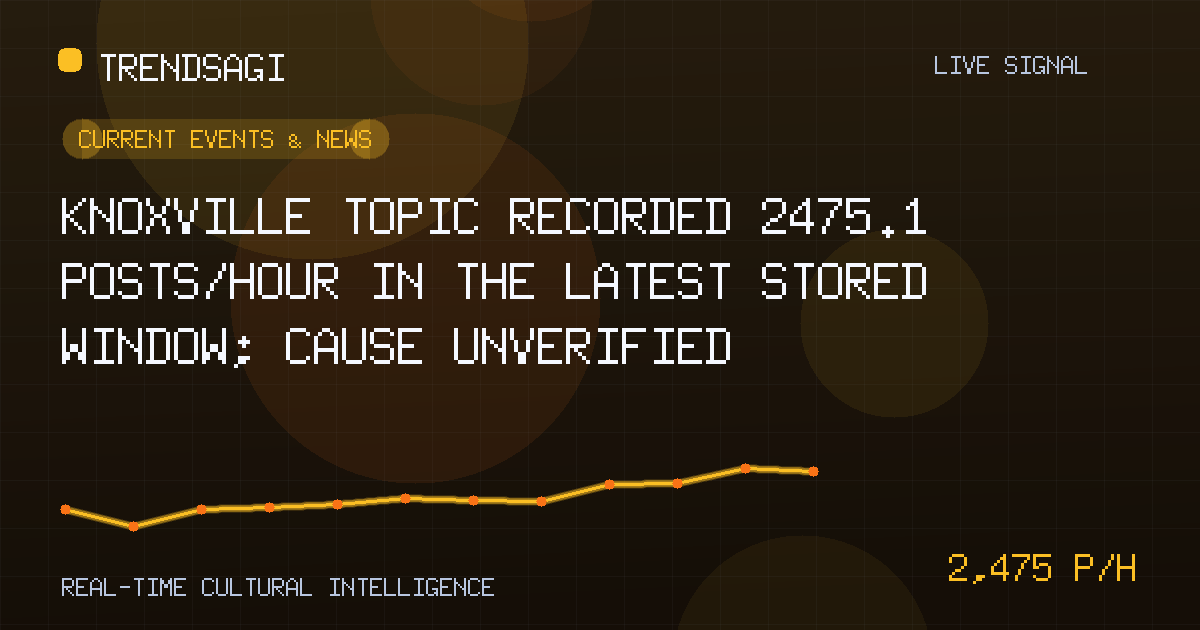
The monitored Knoxville topic recorded a rapid rise in the stored sample, with a measured snapshot rate of 2475.1 posts/hour. The direct conclusion is deliberately limited: post activity accelerated under that label, but no specific news event or other catalyst was verified as the cause.
| Measure | Stored value |
|---|---|
| Observation time | 2026-09-26T15:40:41Z |
| Measured snapshot rate | 2475.1 posts/hour |
| Snapshot volume | 1358 posts |
The 2475.1 posts/hour figure was measured over an exact 1719-second window using 3 stored observations. The latest snapshot held 1358 posts at 2026-09-26T15:40:41Z. These are stored measurements: 2475.1 is a measured snapshot rate, while 1358 is snapshot volume. It is not a live/current rate, forecast, reach, engagement, or unique-person count.
Why this topic may be moving
The stored record establishes a pace of change within the monitored sample, not the subject of the conversation. Its signal description is empty, and the available material contains no post text, links, named event, or official response. Even the boundary of the label remains uncertain: without examples, the record cannot show whether every post refers to the city, an organization, a person, or another Knoxville-related subject.
Possible explanations should therefore be treated as checks, not findings:
- A time-sensitive local incident, announcement, or public-safety issue could be generating new posts.
- A scheduled civic, sports, cultural, or commercial event could be increasing discussion.
- A broader story could be repeatedly connecting new content to the Knoxville label.
- Reposts, duplicated text, coordinated posting, or automated accounts could be inflating apparent activity.
- A change in collection settings, keyword matching, or the mix of observed sources could affect the measurement.
None of those possibilities is confirmed by the stored signal. No specific public catalyst was verified for this snapshot, so the reason for the increase remains unclear.
A measured spike is an investigative lead, not proof of an event. The relevant next step is to identify what the posts discuss and whether the increase reflects independent, locally relevant activity.
Why it matters
A fast-moving topic can prompt quick coverage, public communication, and online discussion, but speed alone does not establish importance or accuracy. The spike creates a reason to inspect the conversation; it does not supply a defensible explanation for what happened.
- Local newsrooms should examine representative posts and verify the apparent catalyst before presenting the increase as reaction to a named event.
- Public agencies and local organizations should check whether the discussion concerns their responsibilities before issuing a response. A monitoring alert is not, by itself, a reason to communicate.
- Residents should treat the volume as a signal to seek confirmed information, not as confirmation that a story is accurate or broadly supported.
- Businesses and community groups can use the alert to review whether the label captures operational information, public concerns, or unrelated noise.
- Researchers and analysts need post-level evidence before drawing conclusions about sentiment, public opinion, or local impact.
The most important distinction is between activity and significance. Posts can accumulate rapidly because of genuine attention, repetition, confusion, or measurement artifacts. Those possibilities require different responses.
What to watch next
The most useful follow-up checks would combine another stored measurement with direct inspection of the posts that produced the signal.
- Rate persistence: Compare the next available exact-window measurement with 2475.1 posts/hour. A further increase would indicate continued acceleration in the stored sample; a lower rate would indicate that the measured surge was easing.
- Content clusters: Identify repeated claims, named places, times, people, and organizations. A dominant factual cluster would help determine what readers appear to be discussing.
- Source composition: Separate original posts from reposts and syndicated material, and check whether activity is broadly distributed or concentrated in a small set of accounts.
- Geographic scope: Review location references and context to test whether the posts actually concern Knoxville rather than merely containing the label.
- Authoritative confirmation: Look for a direct statement or reliable reporting tied to the same subject. Repetition without corroboration would not establish the cause.
- Measurement integrity: Check for duplicate text, automated behavior, and any change in collection or keyword rules that could distort comparability.
A concrete escalation signal would be a sustained sequence of elevated measured rates alongside a coherent, independently verifiable story. A sharp reversal, heavy duplication, or concentration in unrelated posts would instead point toward a short-lived or mechanical explanation.
Methodology and limitations
The briefing uses the stored observation at 2026-09-26T15:40:41Z. The reported 2475.1 posts/hour rate comes from an exact 1719-second window and 3 stored observations. The separate figure of 1358 represents posts in the latest snapshot, not posting speed.
- The signal measures recorded post volume under a topic label; it does not measure unique authors, people reached, engagement, sentiment, or influence.
- The empty signal description prevents verification of the discussion's subject or scope.
- The available series is too limited to establish a persistent trend beyond the measured window.
- No specific public catalyst was verified, so assigning the increase to an event would go beyond the evidence.
The defensible takeaway is therefore narrow but useful: the Knoxville label showed substantial acceleration in the latest stored sample, and the next priority is verification through post-level review, follow-up measurement, and authoritative context.
Track This Topic for New Signals
Set alerts for future velocity or sentiment changes around this topic.
Explore Tracking PlansAbout TrendsAGI research
TrendsAGI's automated research pipeline publishes dated signal snapshots, methodology notes, and practical workflows for teams evaluating cultural momentum. Read how signals are scoped, scored, and limited in our research methodology.


