1144-second window · 3 observations · Measured Sep 26, 2026, 3:55 PM UTC · Provider: go_recent_snapshot_v2
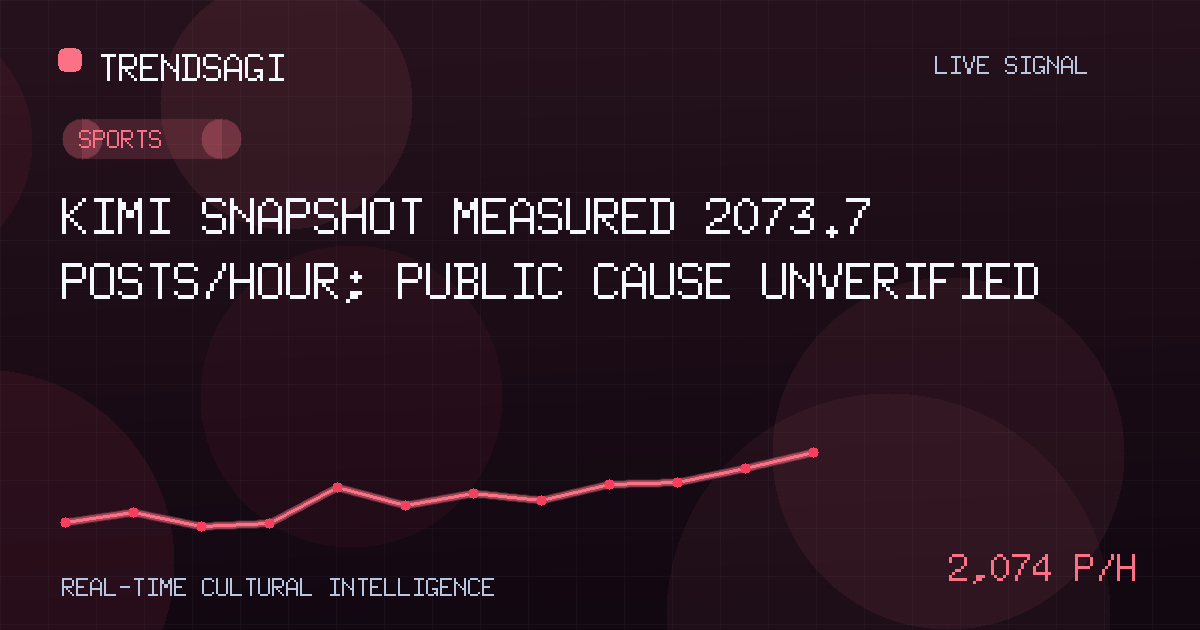
Kimi snapshot measured 2073.7 posts/hour; public cause unverified
Kimi activity measured 2073.7 posts/hour in the latest snapshot; the cause is unverified, with practical checks for interpreting the signal.
Automated briefing. Generated from stored signal measurements and source-backed research; it is not manually reviewed. Read the methodology and limitations.
Metrics in this briefing are a snapshot associated with its publication date and may not reflect current conditions.
What changed
The monitored topic labeled Kimi registered 2073.7 posts/hour in the latest stored observation. That is the defensible headline: the label showed rapid posting within the measured window, but the reason for the movement is not established. The record has no supporting description, and no publisher-attributable public context was verified, so this is not confirmation of a particular news event.
The rate was measured over an exact 1144-second window using 3 stored observations. The snapshot was observed at 2026-09-26T15:55:52Z, and latest snapshot volume was 3789 posts. Posts/hour here is the measured snapshot rate, not a live or current rate, forecast, reach, engagement, or unique-person count. The 3789 figure is total snapshot volume, not another rate.
| Metric | Stored value |
|---|---|
| Observation time | 2026-09-26T15:55:52Z |
| Measured snapshot rate | 2073.7 posts/hour |
| Latest snapshot volume | 3789 posts |
For readers, the finding is narrow: Kimi merits investigation, but it does not yet support a causal headline. A fast count identifies where to look, not what happened.
Why this topic may be moving
No verified trigger is available. Kimi appears only as a topic label, which does not identify the person, organization, product, team, event, or other referent involved. Without post examples, connecting the count to a specific Kimi risks conflating unrelated subjects.
The Sports category adds context but not an explanation. It does not show that a match, athlete, club, competition, or sports issue generated the posts. The signal also does not reveal whether activity consisted of original reporting, live reaction, routine references, repeated text, promotion, or unrelated uses of the name.
The cause is therefore unclear. Connecting the rate to a release, controversy, game, or announcement based on the label alone would be unsupported. The 3 observations support the supplied rate calculation, but do not establish persistence, a normal baseline, or whether the posts share a subject.
A fast count can locate where to investigate, but it cannot establish what happened, who generated the posts, or whether the label is meaningful.
What the signal can and cannot establish
The signal establishes a monitoring result: Kimi was associated with 3789 posts at the stated snapshot time, and the supplied calculation reports 2073.7 posts/hour for the specified window. This is enough to prioritize investigation and establish a comparison point.
- It does not establish who posted or how many distinct people were involved.
- It does not measure sentiment, engagement, reach, location, source credibility, or organic activity.
- It does not show whether the name was used consistently across posts.
- It does not prove that the label and Sports category accurately describe the underlying conversation.
Those limits matter because a large count can combine distinct conversations, duplicate material, or unrelated meanings. Volume can make a label look important, but reader relevance still depends on resolving the subject and checking evidence.
Why it matters
Sports editors should resolve the entity before using the signal to prompt a story; a valid rate attached to the wrong Kimi could misdirect coverage. Communications teams can use the timestamp and window as an audit anchor, then test whether discussion reflects an actual event rather than a category mismatch or repetition.
Researchers gain a temporal marker. The result says when to investigate and what count was observed while preserving the difference between rate and volume, avoiding any presentation of 3789 posts as current activity, audience size, or impact.
For teams considering a response, verification should precede amplification. Publishing a cause before resolving the referent could spread ambiguity; ignoring the alert is unnecessary because it still identifies an area of activity.
What to watch next
Useful follow-up should turn the label-level alert into an evidence-backed account. Prioritize checks that can confirm, weaken, or explain the movement:
- Entity resolution: inspect representative posts and variants of Kimi to determine whether they point to the same subject. This is the most urgent check.
- Event convergence: look for an earliest attributable source and independent reporting about the same occurrence. That would be stronger evidence than repeated wording without a verified event.
- Persistence: compare later complete windows with this snapshot. A similar rate would support a sustained conversation; a sharp drop would be more consistent with a brief burst.
- Content concentration: determine whether posts are original, copied, repetitive, promotional, or coordinated. Repetition can inflate volume, but duplication must be demonstrated rather than assumed.
- Audience and geography: collect account-level and location evidence if available. The existing count cannot distinguish a broad public conversation from a concentrated cluster.
- Category quality: review why the topic was classified as Sports and whether that classification remains stable. A mismatch may indicate an entity-resolution or routing problem.
The strongest escalation signal would be persistence plus a verified shared referent, supported by attributable reporting. The strongest warning signal would be inconsistent identity, repeated content, and no verified event. Either outcome would change how the 2073.7 posts/hour measurement should be interpreted.
Methodology and limitations
The 2073.7 posts/hour figure is reproduced as the supplied measured change rate, calculated over an exact 1144-second window from 3 stored observations. It was not recalculated or converted into another metric. The timestamp identifies the snapshot, not necessarily the start of the underlying event.
Latest snapshot volume is 3789 posts. The record does not establish that all 3789 posts accumulated during the 1144-second measurement window, so volume and rate must remain separate. No post text, account data, historical baseline, sentiment, engagement, geography, or source list is supplied, and the observations are not identified as independent.
No external factual explanation is included because no public context could be verified and attributed to a publisher. This briefing therefore reports the observed movement without assigning a cause. Additional snapshots, representative content, and attributable reporting are needed for a reliable explanation.
Track This Topic for New Signals
Set alerts for future velocity or sentiment changes around this topic.
Explore Tracking PlansAbout TrendsAGI research
TrendsAGI's automated research pipeline publishes dated signal snapshots, methodology notes, and practical workflows for teams evaluating cultural momentum. Read how signals are scoped, scored, and limited in our research methodology.