896-second window · 3 observations · Measured Sep 29, 2026, 9:36 PM UTC · Provider: go_recent_snapshot_v2
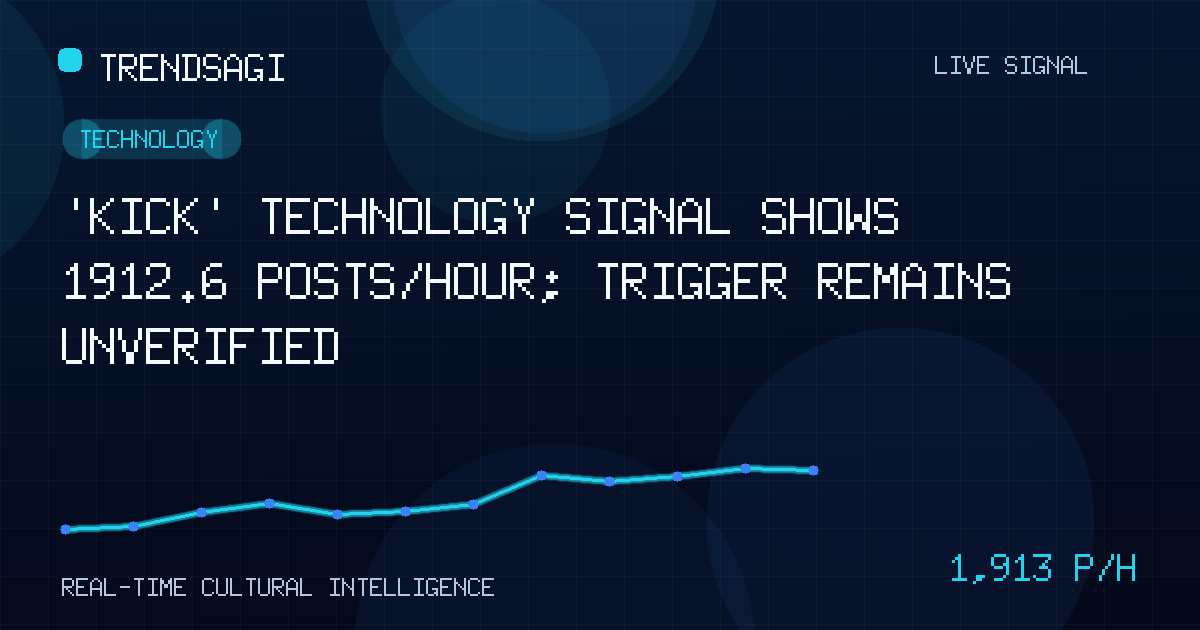
‘Kick’ technology signal shows 1912.6 posts/hour; trigger remains unverified
A stored signal shows Kick at a measured 1912.6 posts/hour snapshot rate over 896 seconds, while verified context does not identify the trigger.
Automated briefing. Generated from stored signal measurements and source-backed research; it is not manually reviewed. Read the methodology and limitations.
Metrics in this briefing are a snapshot associated with its publication date and may not reflect current conditions.
What changed
A stored Technology-category signal for the label “Kick” shows a measured snapshot rate of 1912.6 posts/hour at 2026-09-29T21:36:43Z. That establishes a short-window burst in recorded posting activity, but not its cause. No verified public context in the available record connects the burst to a launch, announcement, controversy, or other specific event, so any such explanation would be speculation.
The figure was measured over an exact 896-second window using 3 stored observations, with the measurement recorded at 2026-09-29T21:36:43Z. The latest snapshot contained 1411 posts. These are different measures: posts/hour characterizes change during the short window, while 1411 posts is the volume in the latest stored snapshot. Neither should be read as a live or current rate, forecast, reach, engagement, or unique-person count.
| Observation time | Measured posts/hour | Snapshot volume |
|---|---|---|
| 2026-09-29T21:36:43Z | 1912.6 posts/hour | 1411 posts |
Why this topic may be moving
The first unresolved issue is what “Kick” denotes. The stored Technology category gives broad orientation, not entity-level identification, and no descriptive text accompanies the signal. Without representative post text, account names, or destinations, the label cannot be reliably tied to a particular product, project, company, feature, or phrase.
Several mechanisms could produce a short-window burst. A breaking update could prompt immediate responses; a scheduled release could concentrate activity; criticism could drive repeated discussion; or duplicate, automated, or previously inactive accounts could affect the count. These are hypotheses, not verified explanations. A change in collection or query behavior could also alter what is captured. The available record does not show which mechanism, if any, is operating.
A defensible working interpretation is therefore “attention around an ambiguous label,” not “a confirmed technology event.” The next editorial task is entity resolution and chronology, not amplification of the largest number.
The evidence supports a change in recorded posting activity around the label “Kick.” It does not yet support a claim about what happened, who generated the activity, whether people were unique, or why the rate changed.
Why it matters
For communications and product teams, the immediate risk is misclassification. A response drafted from volume alone could address the wrong entity or amplify a conversation that is not about the product being monitored. The measured snapshot rate is a prompt to inspect the underlying posts, not a basis for a public statement.
For editors, the signal is useful because it marks where attention may be developing, but its ambiguity lowers confidence in causal attribution. The supported conclusion is that posting activity changed around “Kick,” not that a specific organization or technology achieved something. This distinction prevents a measurement from becoming an unsupported event narrative.
For platform, trust-and-safety, and research teams, the burst raises different questions: Is the activity substantive, duplicated, automated, or concentrated? Those questions cannot be answered from volume. The snapshot may be useful for triage, but it does not show harmful content, coordination, sentiment, or the number of people involved.
What to watch next
- Resolve the entity. Review a representative cross-section of the posts. Look for exact names, quoted phrases, linked destinations, hashtags, and account descriptions. The aim is to determine whether the posts point to one subject or several unrelated uses of “Kick.”
- Establish chronology. Compare the earliest substantive posts with the publication time of any candidate event. A cause is more credible when an independently verified public event precedes the acceleration and the discussion language matches that event.
- Inspect composition. Separate original posts from replies, reposts, duplicates, and templated text. Check whether activity is concentrated in a small set of accounts or broadly distributed, while avoiding any conversion of post counts into unique-person estimates.
- Check the baseline and persistence. Compare the exact measurement definition and window with adjacent windows and the same label’s recent history. Determine whether the burst persists, reverses, or shifts to a clearly identified subject.
- Verify externally before interpreting. Use Google Search only to test a proposed explanation: search the exact label with the observation date and distinctive post phrases, then look for a public page from the named subject. Search results alone do not prove that an event caused the measured change.
Concrete watch signals
The next useful evidence would be observable rather than rhetorical:
- Posts converging on one entity and one event description, making the label’s referent stable.
- A verified publication or announcement timestamp that aligns with the observed acceleration.
- New, non-duplicate posts across a broader account mix rather than repeated wording or destinations.
- A subsequent decline in the measured snapshot rate, which would weaken an event-driven explanation without proving it.
- Continued use of “Kick” for multiple subjects, which would keep causal attribution uncertain even if volume persists.
Methodology and limitations
The reported rate comes from the stored measurement taken at 2026-09-29T21:36:43Z. It uses an exact 896-second window and 3 stored observations. The 1411-post figure describes only the latest snapshot. Posts may include repeated expressions or activity from the same accounts; without account-level review, they cannot be treated as audience size.
The record supplies no platform coverage, collection method, historical baseline, geography, sentiment, engagement profile, or verified event link. A short window and 3 observations can be sensitive to timing and clustering, so the measured snapshot rate should not be extrapolated. No public cause is asserted because none can be verified from the available context.
Track This Topic for New Signals
Set alerts for future velocity or sentiment changes around this topic.
Explore Tracking PlansAbout TrendsAGI research
TrendsAGI's automated research pipeline publishes dated signal snapshots, methodology notes, and practical workflows for teams evaluating cultural momentum. Read how signals are scoped, scored, and limited in our research methodology.