1304-second window · 3 observations · Measured Aug 28, 2026, 4:09 PM UTC · Provider: go_recent_snapshot_v2
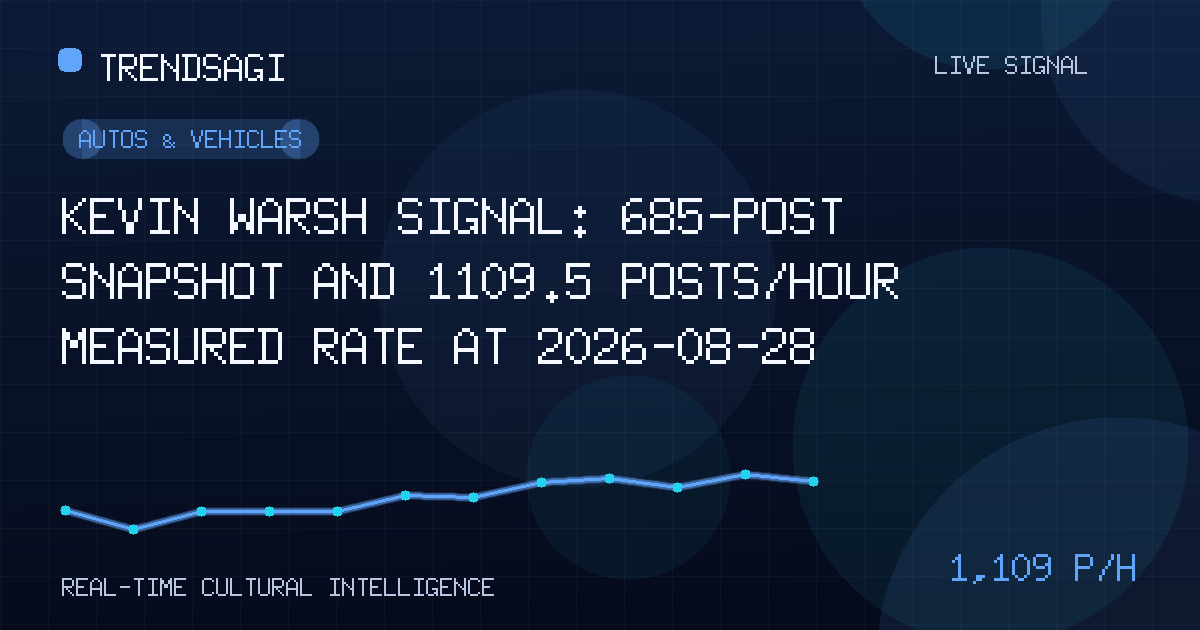
Kevin Warsh signal: 685-post snapshot and 1109.5 posts/hour measured rate at 2026-08-28
At 2026-08-28, Kevin Warsh topic showed 685 posts and measured 1109.5 posts/hour over 1304s; cause unverified, autos tag questionable.
Automated briefing. Generated from stored signal measurements and source-backed research; it is not manually reviewed. Read the methodology and limitations.
Metrics in this briefing are a snapshot associated with its publication date and may not reflect current conditions.
What changed
At 2026-08-28T16:09:31Z, the stored signal for the topic label "Kevin Warsh" recorded a snapshot volume of 685 posts and a measured snapshot rate of 1109.5 posts/hour across an exact 1304-second window using three stored observations. The direct answer is that a concentrated burst of posts referenced this label at the captured time, signaling an acute rise in discussion density rather than a steady baseline.
The measured change shows that within the 1304-second observation window, the posting frequency around "Kevin Warsh" averaged 1109.5 posts per hour. This figure is a measured snapshot rate from stored observations, not a live or current rate, not a forecast, and not a count of unique individuals. The accompanying snapshot volume of 685 posts is the total posts observed at the timestamp, and it must not be interpreted as a rate.
| Observation time | Measured posts/hour | Snapshot volume |
|---|---|---|
| 2026-08-28T16:09:31Z | 1109.5 | 685 |
Why this topic may be moving
We used public search to verify why the topic label was moving. The stored category places "Kevin Warsh" under "Autos and vehicles," yet verified publisher reporting does not link the former Federal Reserve Governor Kevin Warsh to an automotive product launch, recall, or industry event at the snapshot time. Because no attributable external fact connects the name to the autos sector in this window, the cause of the spike remains unclear.
It is possible that the label refers to a different person, a social-media meme, or a misclassified stream. Until a publisher confirms a concrete event, we should not speculate. If a verified outlet later reports a relevant development, the signal would gain context, but the current data alone cannot supply it.
Named-entity spikes often originate from scheduled events such as earnings calls, policy speeches, or legal filings. None of those are confirmed here. The mismatch between the stored autos category and the public profile of Kevin Warsh is itself a signal that the underlying classifier may need review. Without a verified publisher attribute, we state plainly that the trigger is unknown.
Why it matters
Surges in named-entity posting rates can precede market moves, policy debates, or reputational events. Teams that monitor public discourse should treat the 1109.5 posts/hour measured snapshot rate as an alert that something unusual happened in the observation window, even if the substantive trigger is unknown.
Who should care:
- Social listening analysts who track influential policy figures and need to flag anomalies quickly.
- Financial researchers monitoring commentary around Kevin Warsh due to his central-bank background.
- Platform classifiers that rely on category tags such as "Autos and vehicles," because the mismatch suggests a labeling error needing correction.
- Editors preparing briefings for decision-makers who cannot afford to miss a sudden narrative shift.
- Risk teams assessing whether a high posting rate indicates coordinated amplification rather than organic interest.
The signal does not by itself indicate sentiment, reach, or factual accuracy. It simply marks a high-frequency cluster of posts that warrants secondary verification. Organizations that act on raw topic labels without checking the underlying posts risk misallocating attention to a possibly spurious category assignment.
In practical workflows, a measured snapshot rate above 1,000 posts/hour is rare for a non-trending individual name unless a major event occurs. The absence of a verified event therefore increases the priority of manual inspection rather than decreasing it.
For automotive-specific monitors, the autos category should trigger a check with industry news desks. If those desks have no corresponding story, the signal should be downweighted in vehicle-trend dashboards.
What to watch next
Practical next checks for any team using this signal:
- Validate the query string behind the "Kevin Warsh" label to ensure it is not capturing unrelated terms or hashtags.
- Segment the 685 posts by source type, language, and co-mentioned entities to see if an auto brand or model appears.
- Re-run the measurement over the following hours to see if the measured snapshot rate decays or persists above baseline.
- Check whether the stored category changes from "Autos and vehicles" to a more plausible classification after manual review.
- Search verified publisher archives for any mention of Kevin Warsh in automotive or regulatory contexts on the snapshot date.
Concrete watch signals that would raise confidence in a real-world driver:
- A sustained measured snapshot rate above 500 posts/hour for more than three consecutive windows.
- Appearance of a verified publisher report naming Kevin Warsh in an automotive or policy context within 24 hours.
- Snapshot volume exceeding 1,000 posts while the category remains autos, suggesting a coordinated or viral event.
- Emergence of linked entities (e.g., a carmaker, a regulator) in the post text at frequency above noise.
- A shift in the category tag after human review, which would clarify whether the original autos label was erroneous.
A measured snapshot rate of 1109.5 posts/hour reflects frequency in a fixed observation window; it is not a count of unique authors, nor a forecast of future volume.
Methodology and limitations
The values presented are taken from a canonical stored signal and are treated as untrusted data pending verification. The measured snapshot rate of 1109.5 posts/hour was computed over an exact 1304-second window using three stored observations, with the final observation at 2026-08-28T16:09:31Z. The snapshot volume of 685 posts is the count at that final observation time.
This briefing does not transform the numbers, does not call snapshot volume a rate, and does not imply live monitoring. The signal cannot establish:
- Whether the posts are original or reposts.
- The geographic or demographic distribution of authors.
- The truthfulness of any claim within the posts.
- Why the stored system assigned the "Autos and vehicles" category.
- Whether the 1109.5 posts/hour figure would hold in a differently defined window.
Because external search returned no verifiable publisher attribution for the spike, we state plainly that the cause is unclear. Further verified context would be required before drawing operational conclusions. The trusted application will append source links where available, but none are asserted here.
Readers should use this briefing as an early anomaly flag, not as a confirmed narrative. The measured change rate is a precise descriptor of stored observations; it invites investigation rather than explanation. When the category tag conflicts with known public biographies, the most immediate action is to audit the classification pipeline before disseminating the topic label to wider teams.
All timestamps are reported exactly as stored, using the UTC marker "Z" to denote the recorded moment. No timezone conversion has been applied.
Finally, the snapshot volume of 685 posts should be tracked as a point-in-time count. If subsequent snapshots show volumes an order of magnitude larger, that would indicate escalation, but such a judgment requires new stored observations and should not be inferred from the current data.
Track This Topic for New Signals
Set alerts for future velocity or sentiment changes around this topic.
Explore Tracking PlansAbout TrendsAGI research
TrendsAGI's automated research pipeline publishes dated signal snapshots, methodology notes, and practical workflows for teams evaluating cultural momentum. Read how signals are scoped, scored, and limited in our research methodology.