903-second window · 3 observations · Measured Oct 5, 2026, 7:56 PM UTC · Provider: go_recent_snapshot_v2
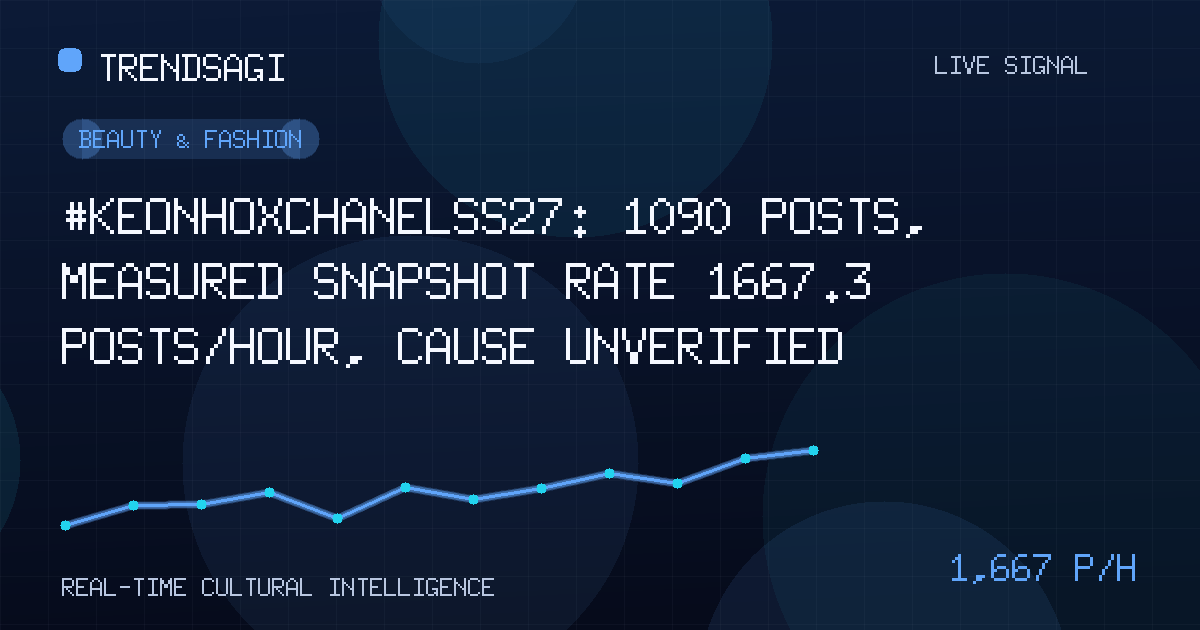
#KEONHOxCHANELSS27: 1090 posts, measured snapshot rate 1667.3 posts/hour, cause unverified
A 1090-post snapshot and measured 1667.3 posts/hour show a rapid historical burst; these checks identify the still-unverified catalyst.
Automated briefing. Generated from stored signal measurements and source-backed research; it is not manually reviewed. Read the methodology and limitations.
Metrics in this briefing are a snapshot associated with its publication date and may not reflect current conditions.
What changed
#KEONHOxCHANELSS27 showed 1090 posts in the latest Beauty & Fashion snapshot, but no specific public catalyst has been verified. The defensible conclusion is that the label moved quickly enough to merit monitoring, not that a confirmed collection launch, public appearance, or organic audience surge is taking place.
The series records a measured snapshot rate of 1667.3 posts/hour over an exact 903-second window using 3 stored observations, with the latest observation at 2026-10-05T19:56:11Z. That figure captures observed activity within that historical window. It is not a live rate, forecast, reach estimate, engagement measure, or count of unique people.
| Observation time | 2026-10-05T19:56:11Z |
|---|---|
| Measured snapshot rate | 1667.3 posts/hour |
| Snapshot volume | 1090 posts |
Why this topic may be moving
The label itself appears to concatenate “KEONHO,” “CHANEL,” and “SS27.” SS27 may be seasonal shorthand, while KEONHO may be a proper name, fandom tag, or another identifier. The signal does not confirm those readings or show that the label’s components belong to the same event. Its Beauty & Fashion classification is metadata, not proof of a substantive fashion connection.
Potential movement mechanisms are hypotheses, not findings:
- First-party release: A campaign, collection, editorial, event, or creator post could produce a burst of reaction. No such trigger is confirmed here.
- Fan or community discovery: A newly found image, rumor, interview, or discussion could turn an existing label into a temporary gathering place.
- Repetition or coordination: Repeated, near-identical, or reposted material can increase post counts without representing equally broad participation.
- Ambiguity or misclassification: A combined label may collect separate conversations, making unrelated activity appear to be one trend.
No verified public catalyst is established in the material available for this briefing. The cause is therefore unclear. It would be premature to describe the label as an official Chanel signal or a verified Keonho-related event.
The label is a measurable burst, not yet an explained event: it shows that posts accumulated rapidly in the measured window, but not who initiated the activity, whether participation was broad, or what caused it.
Why it matters
Fast label movement can act as an early warning to investigate a story, a naming collision, or a possible information cascade. It is not, by itself, evidence of cultural importance, official brand activity, or commercial impact.
- Editors and reporters should verify the originating post and subject before connecting the tag to a person, collection, or campaign.
- Brand, creator, and community teams can use the alert to locate active conversations and possible confusion, but not to infer sentiment, demand, or intent without reviewing the posts.
- Trend and social analysts have a candidate event for validation. Its speed makes it worth checking, while the limited observation window makes it weak evidence for a durable trend.
- Readers and shoppers should treat the label as a discovery lead, not authentication that an official announcement, product detail, or event exists.
What to watch next
Run the following checks before assigning a narrative to the movement:
- Persistence: Take later snapshots using the same query and tag rules. Record whether activity remains elevated, reverses, or becomes intermittent; the existing rate should not be treated as expected future activity.
- Breadth and originality: Count distinct original posts and unique accounts, separating exact duplicates, reposts, and quote posts. This shows whether the volume reflects broad participation or repeated content.
- Provenance: Identify the earliest non-duplicate posts and the accounts that supplied the original material. Establish whether an identifiable source prompted the first cluster or whether the label appeared without a clear origin.
- Content relevance: Review what participants are actually sharing. A genuine collection discussion should contain topic-specific media, names, product details, or reactions; spam and unrelated uses should be classified separately.
- Independent corroboration: Look for verification from an accountable first party or multiple credible publishers that independently connect the exact label to the same subject. Similar wording alone is not independent confirmation.
- Corrections and commercial evidence: Watch for clarifications, disavowals, or factual corrections. Do not translate the post burst into sales, demand, or brand impact without separate verified evidence.
Stronger evidence would be later persistence, broader participation among distinct original authors, independent timestamps converging on the same trigger, and confirmation from an accountable first party. Weaker evidence would be a rapid cooldown, substantial duplication, unrelated content under the same label, or no corroboration. Those checks have not been supplied with the signal, so the catalyst remains unverified.
Methodology and limitations
The available reading is a snapshot observed at 2026-10-05T19:56:11Z. It contains 1090 posts and reports a measured snapshot rate of 1667.3 posts/hour across an exact 903-second window based on 3 stored observations. Because the interval is short and the sample contains only 3 observations, the result may be sensitive to timing. It should not be annualized or compared with another label unless collection windows and counting methods match.
The snapshot does not establish unique participants, impressions, engagement, sentiment, geography, account authenticity, or whether activity was organic, automated, or coordinated. It also does not show what happened before or after the measured window. No verified public explanation establishes the cause, and the category assignment does not prove that the posts contained meaningful fashion content. The safest characterization is therefore a historically measured burst requiring provenance and persistence checks before broader interpretation.
Track This Topic for New Signals
Set alerts for future velocity or sentiment changes around this topic.
Explore Tracking PlansAbout TrendsAGI research
TrendsAGI's automated research pipeline publishes dated signal snapshots, methodology notes, and practical workflows for teams evaluating cultural momentum. Read how signals are scoped, scored, and limited in our research methodology.