1688-second window · 3 observations · Measured Oct 1, 2026, 10:38 PM UTC · Provider: go_recent_snapshot_v2
Keng Namping in Paris FW27: 833.8 posts/hour measured, cause unverified
Keng Namping in Paris FW27 registered 833.8 posts/hour; the cause is unverified, and these checks separate a spike from real influence.
Automated briefing. Generated from stored signal measurements and source-backed research; it is not manually reviewed. Read the methodology and limitations.
Metrics in this briefing are a snapshot associated with its publication date and may not reflect current conditions.
What changed
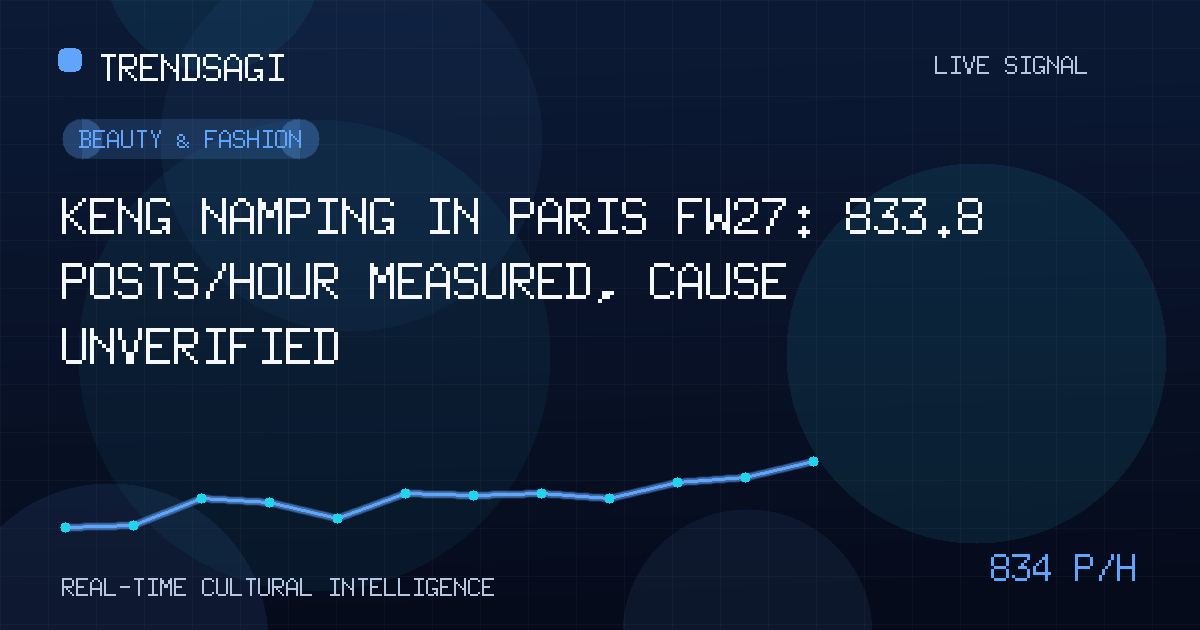
The tracked topic “Keng Namping in Paris FW27” registered a measured change rate of 833.8 posts/hour across an exact 1688-second window using 3 stored observations, measured at 2026-10-01T22:38:58Z. This is a measured snapshot rate, not a live count, forecast, reach figure, engagement total, or unique-person count.
The latest snapshot contained 1125 posts. A public explanation for the burst could not be independently verified, so the activity should be reported as a recorded spike of uncertain cause—not as confirmation of a particular Paris event, designer statement, or fashion development. The next task is to identify the trigger and test whether the activity reflects broad discussion or repeated circulation.
| Measure | Stored value |
|---|---|
| Observation time | 2026-10-01T22:38:58Z |
| Measured snapshot rate | 833.8 posts/hour |
| Exact measurement window | 1688 seconds |
| Stored observations | 3 |
| Latest snapshot volume | 1125 posts |
What the signal establishes
Three things are supported: the topic label was monitored, the rate describes the stated window, and the latest snapshot held 1125 posts. The record does not provide a prior baseline, geography, author count, sentiment, engagement, post originality, or verified context. The stored Beauty & Fashion category offers a classification, while the empty signal description adds no explanatory evidence.
- Momentum: The 833.8 posts/hour figure shows how quickly the measured feed accumulated posts during the window; it does not show how long attention will last.
- Scale: The 1125-post snapshot gives stored volume at the observation time. It is not another rate and cannot be converted into one without additional observations.
- Coverage: The label places the signal in fashion monitoring, but it does not verify that “Keng Namping,” “Paris,” and “FW27” refer to the same established subject.
The measured burst establishes concentrated activity in the tracked feed, not its cause, authenticity, audience size, or commercial effect.
The practical conclusion is narrow: something accumulated quickly enough to merit monitoring, but the record cannot yet establish whether that something was a news event, coordinated attention, a naming problem, or measurement noise.
Why this topic may be moving
No verified public item in the record establishes a trigger. Several explanations remain hypotheses that can be checked, rather than facts to publish:
- Event or announcement: A verified appearance, release, cancellation, or schedule change could have prompted posting, but no such item is confirmed here.
- Amplified circulation: One widely copied item could produce many posts that look like broad discussion while adding little independent information.
- Label ambiguity: A spelling question, unclear identity, or mixed use of “FW27” could have drawn clarification requests and reposts.
- Monitoring artifact: Duplicates, a collection change, or cross-topic contamination could inflate the tracked volume without representing a coherent trend.
These possibilities matter because they imply different responses. Editorial coverage requires a primary or publisher-verified trigger; audience analysis requires post-level inspection; taxonomy work requires checking the label and category against the actual language used online.
Why it matters
The spike creates a verification task because a fast-moving label can be mistaken for a confirmed development. The number is useful for triage, but not enough to support a story about who showed in Paris, what was announced, or whether the subject is gaining cultural or commercial influence.
- Fashion editors and reporters should confirm the event, spelling, participants, and date before treating the label as a news peg.
- Brand and communications teams should determine whether the movement is organic, creator-led, repost-heavy, or caused by content they can correct or substantiate.
- Audience and trend analysts should compare subsequent observations, inspect originality, and separate concentration in the feed from evidence of wider public reach.
- Community managers and creators should watch for misleading summaries, unsupported identity claims, and coordinated copying before amplifying the phrase.
The value of the signal is therefore operational: it flags where verification effort is needed. It does not, by itself, establish prestige, demand, sales, attendance, or influence.
What to watch next
A useful follow-up should move from quantity to corroboration:
- Resolve the label. Search the exact phrase and close variants, then confirm the spelling and identity of “Keng Namping” and what “FW27” means in this specific use. Do not silently normalize either term.
- Find a primary source. Look for a dated post, page, invitation, collection page, or statement from an identifiable organizer, designer, brand, or institution that directly connects the phrase to Paris.
- Require attribution for reporting. A named publisher should explain what happened and when. Repetition among social posts is not independent confirmation of the publisher’s claim.
- Inspect the post sample. Separate original posts from copies, reactions, quotations, and automated or spam-like material. Check whether multiple accounts are adding information or merely repeating one source.
- Compare later stored observations. Use 833.8 posts/hour as the measured reference for this snapshot, and keep 1125 posts as volume only. Check whether later activity persists, recedes, shifts to adjacent labels, or disappears.
- Watch corrective signals. Changes in spelling, a clarification, deletion, account correction, or taxonomy revision would materially change the interpretation even if post volume remained high.
The strongest confirming signal would be a primary item plus attributable reporting that explains the timing. The strongest warning signal would be continued volume with no verifiable source, heavy duplication, or evidence that the label combines unrelated subjects.
Methodology and limitations
The reported rate was supplied from an exact 1688-second window using 3 stored observations, with the change measured at 2026-10-01T22:38:58Z. The latest snapshot volume was 1125 posts. These measures are kept separate because a rate describes accumulation during a defined interval, while volume describes the stored snapshot. The record does not state whether observations overlap, whether the measures cover the same scope, or whether posts and authors were deduplicated.
The signal can establish that the monitored topic accumulated posts rapidly within the stated window and was large enough at the snapshot to warrant checking. It cannot establish a live rate, unique participants, sentiment, location, causation, authenticity, or business effect. Because no verified public context establishes why the topic moved, this briefing identifies plausible checks without presenting any of them as the cause.
Track This Topic for New Signals
Set alerts for future velocity or sentiment changes around this topic.
Explore Tracking PlansAbout TrendsAGI research
TrendsAGI's automated research pipeline publishes dated signal snapshots, methodology notes, and practical workflows for teams evaluating cultural momentum. Read how signals are scoped, scored, and limited in our research methodology.