903-second window · 3 observations · Measured Oct 5, 2026, 12:56 AM UTC · Provider: go_recent_snapshot_v2
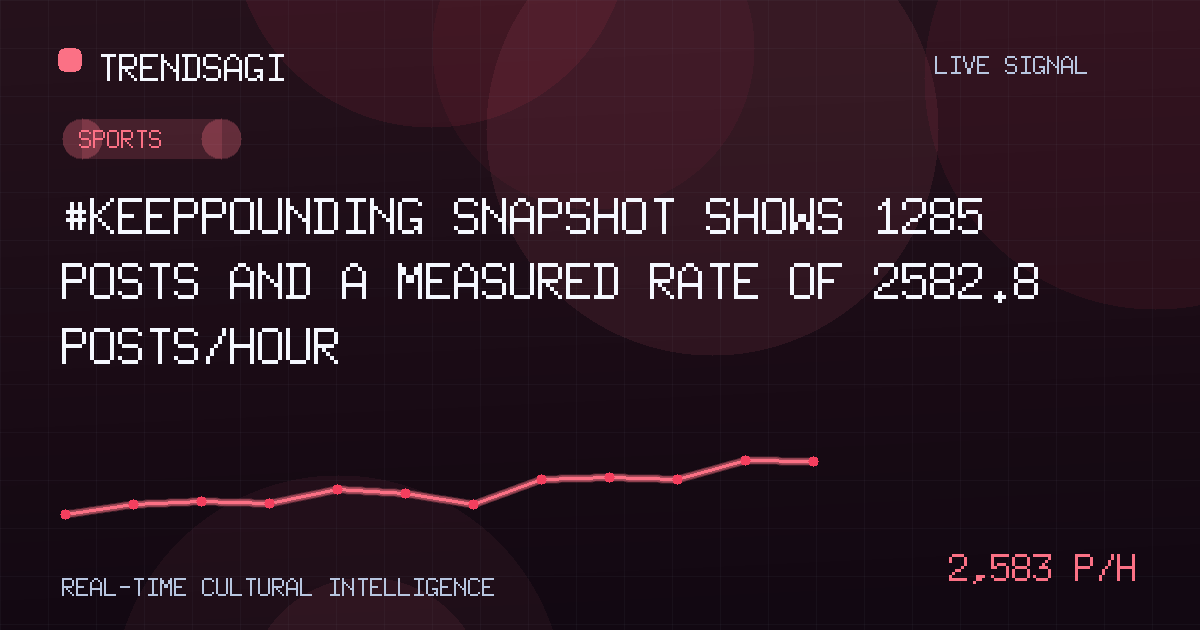
#KeepPounding snapshot shows 1285 posts and a measured rate of 2582.8 posts/hour
A stored #KeepPounding snapshot shows 1285 posts and a measured 2582.8 posts/hour rate; no public catalyst has been verified.
Automated briefing. Generated from stored signal measurements and source-backed research; it is not manually reviewed. Read the methodology and limitations.
Metrics in this briefing are a snapshot associated with its publication date and may not reflect current conditions.
What changed
The stored record shows a concentrated #KeepPounding posting burst: the latest snapshot contained 1285 posts at 2026-10-05T00:56:03Z. No verified game result, team announcement, player development, promotional effort, or other public catalyst can be tied to the increase from the available evidence, so the reason for the movement remains unclear.
The measured change was 2582.8 posts/hour across an exact 903-second window using 3 stored observations. This is a measured snapshot rate for that narrow interval—not a live/current rate, forecast, reach figure, engagement count, or unique-person total. It describes how the tracked count changed within the collection method; it does not identify who posted, whether activity was organic, or why it occurred.
| Observation time | Measured posts/hour | Snapshot volume |
|---|---|---|
| 2026-10-05T00:56:03Z | 2582.8 posts/hour | 1285 posts |
Why this topic may be moving
No verified public context accompanies the signal. A game result, team or player announcement, promotional effort, controversy, or platform event therefore remains a candidate, not an explanation. The Sports category routes the signal toward sports coverage, but it does not prove that a particular club, league, athlete, or competition produced the burst.
The phrase could be an organic fan response, a reused slogan, part of promotional or coordinated activity, or a repetitive or automated posting pattern. These possibilities are not mutually exclusive, and the supplied evidence does not favor one. A short, slogan-like hashtag may also collect uses that differ from the context a reader assumes.
For now, the defensible conclusion is a measured posting burst without a verified catalyst. A causal explanation needs time-aligned public evidence, not a plausible story.
The posting burst is measurable; its cause is not. Until an external event can be connected to the first observed activity by timing and provenance, the responsible description is volume without attribution.
What the signal can and cannot establish
The signal supports a narrow set of claims:
- Observed activity: The collection contained 1285 #KeepPounding posts at the stated observation time.
- Measured movement: The stored observations produced a rate of 2582.8 posts/hour over 903 seconds.
- Verification need: The movement warrants a causal check, but it does not support attribution.
It does not establish the platform, query scope, geography, language, sentiment, account types, or original versus reposted content. It also cannot show how many people participated, how many saw the posts, or whether accounts were independent. Those omissions prevent claims about organic reach, fan intent, or authenticity.
The snapshot count and rate answer different questions. The 1285 figure is the volume observed at a moment; 2582.8 posts/hour characterizes change within the supplied window. A falling count does not necessarily match a falling rate, and neither should be substituted for the other.
Why it matters
For a sports newsroom or social desk, this is a verification-priority signal rather than a ready-made story. Editors can use the timestamp, volume, and measured rate to direct a quick check, but should not attach a game, player, or campaign until a source establishes that link. The distinction helps prevent a high-volume hashtag from becoming an unsupported causal headline.
Teams, athletes, sponsors, and audience researchers may also care because apparent activity can prompt monitoring. Sponsors should not treat posts as impressions, and teams should not treat posts as supporters. Researchers need account-level and collection details before drawing conclusions about sentiment, origin, or coordination.
What to watch next
The next useful checks are concrete and ordered by evidential value:
- Origin: Retrieve the earliest available posts, note whether they are originals, replies, or reposts, and preserve timestamps and account names. An earlier first post is more useful than a later popular one for identifying onset.
- Catalyst: Check official competition, team, athlete, organizer, and reputable news accounts for time-stamped information that predates or closely overlaps the first observed burst. A matching subject alone is insufficient.
- Verified participation: Note whether official or credible accounts join during the window. Their timing matters: post-burst participation may be a response rather than the cause.
- Authenticity: Inspect repeated wording, synchronized intervals, account overlap, and profile patterns. These are warning signals for coordination or automation, not proof on their own.
- Continuation: Collect another observation using the same hashtag scope and a 903-second window design. Compare snapshot volume and measured rate separately; persistence shows continued posting activity, while a lower rate indicates slower measured growth, not necessarily contraction.
- Adjacent activity: See whether the same accounts or wording move into related sports tags. Expansion would suggest a broader conversation, while isolation would leave the event link unproven.
A verified public fact aligned with the onset would justify an explanatory update. Until then, the absence of a matching catalyst is itself the key reporting caveat.
Methodology and limitations
The metrics come from the canonical stored signal, not a complete census of public conversation. Only 3 observations underpin the change calculation, and no longer-run historical baseline is supplied. The 903-second interval is useful for immediate monitoring but cannot establish a normal level, persistence, or statistically unusual status.
The measured rate is reported as supplied and has not been recalculated from the latest count. Dividing the 1285-post snapshot by the window would not reproduce the same metric because a point-in-time stock and change across observations are different quantities. Collection and deduplication rules are also unspecified.
No external catalyst has been verified, so this briefing attributes none. Any future causal update should name the new supporting fact, show that its timing fits the onset, and distinguish evidence of posting from evidence about people, reach, or intent.
Track This Topic for New Signals
Set alerts for future velocity or sentiment changes around this topic.
Explore Tracking PlansAbout TrendsAGI research
TrendsAGI's automated research pipeline publishes dated signal snapshots, methodology notes, and practical workflows for teams evaluating cultural momentum. Read how signals are scoped, scored, and limited in our research methodology.


