902-second window · 3 observations · Measured Sep 26, 2026, 11:26 PM UTC · Provider: go_recent_snapshot_v2
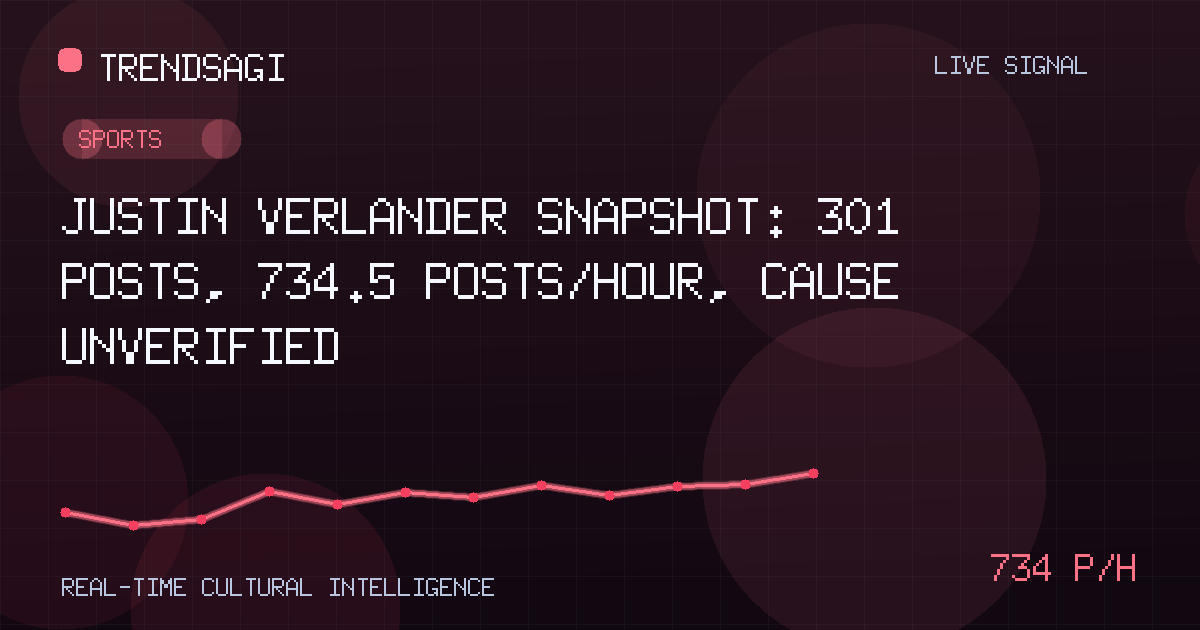
Justin Verlander snapshot: 301 posts, 734.5 posts/hour, cause unverified
Justin Verlander’s latest snapshot contains 301 posts and a measured 734.5 posts/hour; the trigger is unverified, and the next checks are outlined.
Automated briefing. Generated from stored signal measurements and source-backed research; it is not manually reviewed. Read the methodology and limitations.
Metrics in this briefing are a snapshot associated with its publication date and may not reflect current conditions.
What changed
The Justin Verlander signal records 301 posts in the latest stored snapshot and a measured change rate of 734.5 posts/hour over an exact 902-second window using 3 stored observations. That is clear evidence of concentrated topic-level posting during the measured window, but the available record contains no verified public context establishing a trigger, so the reason for the movement remains unclear.
The observation is timestamped 2026-09-26T23:26:42Z. The posts/hour figure is a measured snapshot rate, not a live or current rate, forecast, audience reach, engagement level, or count of unique people. The record also lacks a baseline for judging how unusual the rate is relative to normal activity.
| Observation time | Measured snapshot rate | Snapshot volume |
|---|---|---|
| 2026-09-26T23:26:42Z | 734.5 posts/hour | 301 posts |
Why this topic may be moving
The available record does not support a defensible event attribution. A topic can accumulate posts for very different reasons, and its label alone does not show which explanation applies here. Without reviewing the underlying post text or a verified report, it would be speculation to attribute the increase to a game, performance, injury, roster move, milestone, controversy, retrospective, or scheduled event. Those are hypotheses to test, not established causes.
The central distinction is between correlation and cause. The measurement shows that posts associated with Justin Verlander were arriving rapidly during the observed window. It does not show that a particular claim was true, that the posts were independent, or that they were driven by organic reader interest rather than repeated copying, automated posting, or activity from a small number of accounts.
High posting volume can locate attention, but it cannot explain itself. A trigger becomes established only when the underlying posts and verified public reporting point to the same event.
The responsible briefing therefore describes attention around the name, not an unverified assertion about what happened. The immediate research task is to determine whether the posts share a factual subject or are being aggregated under a broad label.
- Timing: Determine when the posting began and whether an earlier post introduced a claim that others copied.
- Content: Identify the specific subject being repeated and separate original comments from quotations and reposts.
- Provenance: Trace substantive claims to an official announcement, direct reporting, or an unattributed assertion.
- Authorship: Assess how much activity comes from distinct original contributors rather than repeated or automated publication.
Those checks would turn a fast-moving label into an explainable event—or show that the apparent surge is mostly duplication, incidental mentions, or a data-collection artifact.
Why it matters
The immediate value is triage. A short-window rate can tell an editor, reporter, team monitor, or communications team where to look first. It can also prevent a premature headline: strong volume may justify investigation before it supports a causal statement.
- Media and baseball desks can use the timestamp to check breaking developments and find the first credible report.
- Team, player, and brand teams can determine whether discussion reflects a real event, a misinformation episode, or repeated historical content.
- Audience and community teams can distinguish meaningful participation from a quote-post cascade and decide whether clarification may be necessary.
- Researchers and analysts should wait for a stable window and comparable baseline before treating the movement as a durable trend.
The stored Sports category helps route the signal for review, but it does not verify what happened. Likewise, the name can connect otherwise separate conversations. That makes post-level inspection more valuable than assuming the category itself supplies the explanation.
What to watch next
The next useful evidence should be concrete and testable. Watch for:
- A shared explanation across the earliest substantive posts. If independent posts converge on the same event, that explanation becomes more plausible. If they concern unrelated uses of the name, the aggregate may be blending separate conversations.
- A verifiable public origin. Look for confirmation from an official public statement or credible reporting that directly supports the claim repeated in the posts. Reposts do not independently verify a claim.
- Original contributions after repetition. A transition from copied text to distinct reporting, quotations, or analysis would suggest broader information-seeking rather than simple duplication.
- Persistence in later stored snapshots. Check whether the measured snapshot rate remains comparably high under the same collection method. A return toward the established baseline would weaken the case for a continuing event.
- Corrections, denials, or added context. A verified clarification can change the story more quickly than the initial volume does. Monitor whether reputable reports update or qualify the central claim.
A stronger conclusion would require both a named, verified trigger and post-level evidence that the activity centers on that trigger. Until then, describe the observation as concentrated short-window posting rather than a confirmed news event.
Methodology and limitations
The quantitative record consists of 301 posts in the latest snapshot and a measured change rate of 734.5 posts/hour, measured over an exact 902-second window from 3 stored observations and timestamped 2026-09-26T23:26:42Z. These are stored measurements, not live counts.
The posts/hour value must not be read as reach, engagement, sentiment, posting by unique people, or a forecast. Snapshot volume and the measured rate are separate measures; the record does not provide enough collection detail to reconcile them or determine what share of the 301 posts belongs to the 902-second window. No mathematical conversion is warranted.
Important missing context includes the source platform, query and matching rules, collection boundaries, sampling method, geographic and language distribution, account information, post text, and duplicate-handling procedure. There is also no prior baseline. The topic label can capture direct discussion, incidental mentions, or mixed content, while the signal does not measure sentiment or credibility.
Finally, 3 observations across the short window document the supplied change measurement but do not establish a durable trend or its cause. The appropriate next step is verification against the underlying posts and public reporting, followed by comparison with additional snapshots collected on the same basis.
Track This Topic for New Signals
Set alerts for future velocity or sentiment changes around this topic.
Explore Tracking PlansAbout TrendsAGI research
TrendsAGI's automated research pipeline publishes dated signal snapshots, methodology notes, and practical workflows for teams evaluating cultural momentum. Read how signals are scoped, scored, and limited in our research methodology.