907-second window · 3 observations · Measured Oct 6, 2026, 11:56 AM UTC · Provider: go_recent_snapshot_v2
Jupiter snapshot measured 515.9 posts/hour; catalyst remains unverified
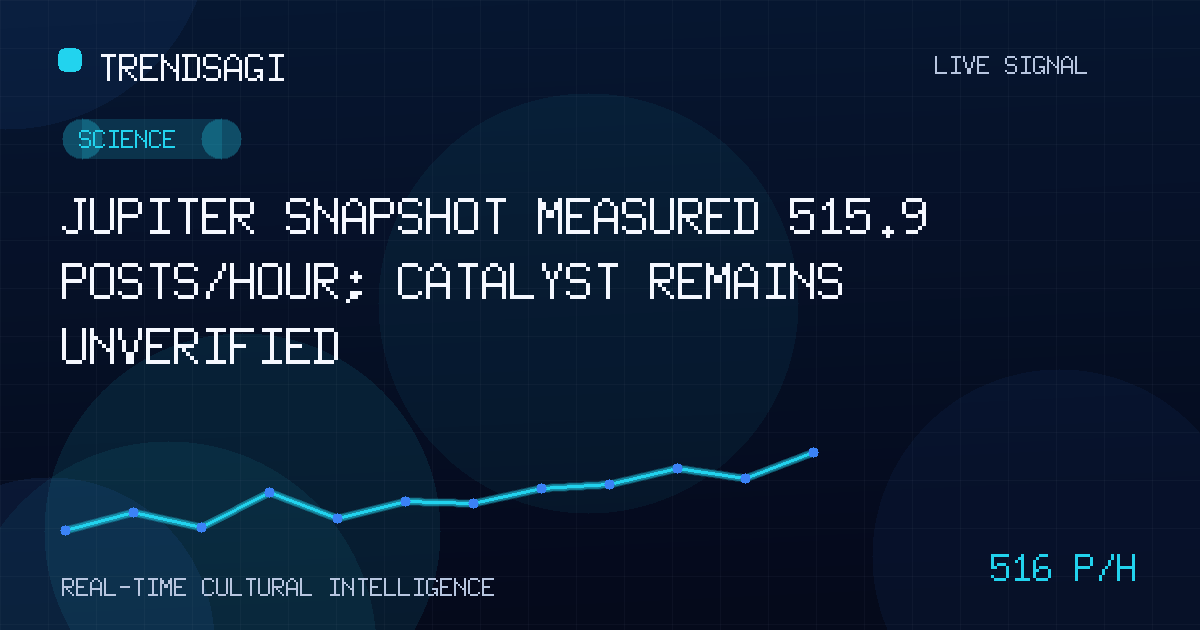
Jupiter’s latest stored snapshot had 269 posts and a measured 515.9 posts/hour; use it as a monitoring lead, not proof of a cause.
Automated briefing. Generated from stored signal measurements and source-backed research; it is not manually reviewed. Read the methodology and limitations.
Metrics in this briefing are a snapshot associated with its publication date and may not reflect current conditions.
What changed
Jupiter shows concentrated posting activity in the monitored stream, but the stored evidence does not establish why. The measured change is a snapshot posting rate of 515.9 posts/hour. That is enough to trigger verification work, not enough to call it a confirmed scientific event.
The rate was measured over an exact 907-second window using 3 stored observations. The latest snapshot contained 269 posts at 2026-10-06T11:56:25Z. These values describe the monitored collection at that moment; they are not a live rate, forecast, reach estimate, engagement measure, or count of unique people.
| Observation time | Measured snapshot rate | Latest snapshot volume |
|---|---|---|
| 2026-10-06T11:56:25Z | 515.9 posts/hour | 269 posts |
Why this topic may be moving
No verified public catalyst is available for this briefing, so the cause remains unclear. A central unresolved issue is what “Jupiter” denotes in this cluster. The stored Science category provides context, but it does not prove that every post concerns the planet or any particular astronomy development.
- Possible news trigger: A scientific or institutional announcement may have started the burst, but no matching announcement has been verified.
- Possible amplification: A creator, publication, or community may have repackaged an older item and driven repeated posting.
- Possible ambiguity: The label may refer to different entities that share the name, producing a combined count without one shared cause.
- Possible measurement effect: Duplicate content, automated reposting, or collection timing could shape the observed velocity; none is established here.
These are hypotheses, not findings. Until one is corroborated, the accurate editorial description is a sharp monitored burst with an unknown driver.
A measured rise in posting velocity shows that attention changed; it does not identify the event, fact, or behavior that caused it.
The signal establishes that posting activity accelerated within the observed stream and supplies a basis for follow-up. It cannot establish the catalyst, whether claims are true, whether posters agree, whether posts are original, who saw them, or whether the activity is organic rather than coordinated. It also cannot show that discussion reflects expert consensus.
Posting volume is not a proxy for importance. A rapid cluster can consist largely of repeated material, while a smaller exchange may contain original evidence and expert response. Neither the snapshot count nor the rate can adjudicate quality. The raw sample should therefore be preserved and compared over time, with uncertainty stated until the referent and catalyst are clear.
Why it matters
The immediate value is triage: deciding what deserves verification before the conversation moves further out of view.
- Science editors and astronomy communicators need to avoid turning a volume spike into an unsupported discovery or announcement.
- Researchers and educators need the underlying claim and its primary evidence before treating discussion as meaningful scientific activity.
- News and monitoring teams need to separate a real event from name ambiguity, repetition, or coordinated behavior.
- General readers benefit from knowing that attention is measurable while its meaning remains unconfirmed.
What to watch next
Useful follow-up should test what the cluster is about, whether it persists, and whether independent evidence supports the apparent trigger.
- Referent convergence: Inspect a representative sample for the dominant meaning of “Jupiter.” Watch whether posts consistently point to one subject or mix unrelated senses.
- Primary-source confirmation: Look for an original scientific, institutional, or creator publication that predates the burst and directly explains it.
- Timing alignment: Compare publication times with the observed window. Sequence supports context, but timing alone still does not prove causation.
- Persistence: Check later stored observations for continued elevation, a quick return to the prior pattern, or migration to a different subtopic.
- Distribution quality: Determine whether the posts add distinct information or repeat the same wording, media, claim, or link. Repetition can inflate apparent momentum.
- Independent corroboration: Watch for separate reputable publishers or subject experts confirming the same fact, rather than merely echoing the initiating post.
The strongest upgrade would be persistence plus independent corroboration tied to a clearly identified source. If the burst fades and the posts do not converge on one claim, it should remain a transient monitoring signal. For now, unexplained Jupiter posting burst is the most useful working label because it records both the observed behavior and the missing causal evidence.
Methodology and limitations
This briefing reports the supplied snapshot as observed. The 269 posts are the latest snapshot volume. The separate 515.9 posts/hour figure is the measured snapshot rate over the exact 907-second window from 3 observations. It is not extrapolated here.
A short window and a small set of stored observations limit confidence about what came before or after the burst. The topic label and category may be imperfect, the stored signal has no descriptive text, and no external causal context was verified. Volume can also be concentrated in repeated posts, and the measured rate may not persist. Without account-level, media-level, or engagement evidence, no inference about coordination, public reach, or scientific significance is warranted.
The evidence supports one firm conclusion: the monitored stream showed elevated posting velocity for Jupiter at the stated time. Any stronger claim about why—or what—needs source-level confirmation.
Track This Topic for New Signals
Set alerts for future velocity or sentiment changes around this topic.
Explore Tracking PlansAbout TrendsAGI research
TrendsAGI's automated research pipeline publishes dated signal snapshots, methodology notes, and practical workflows for teams evaluating cultural momentum. Read how signals are scoped, scored, and limited in our research methodology.


