898-second window · 3 observations · Measured Oct 7, 2026, 10:56 PM UTC · Provider: go_recent_snapshot_v2
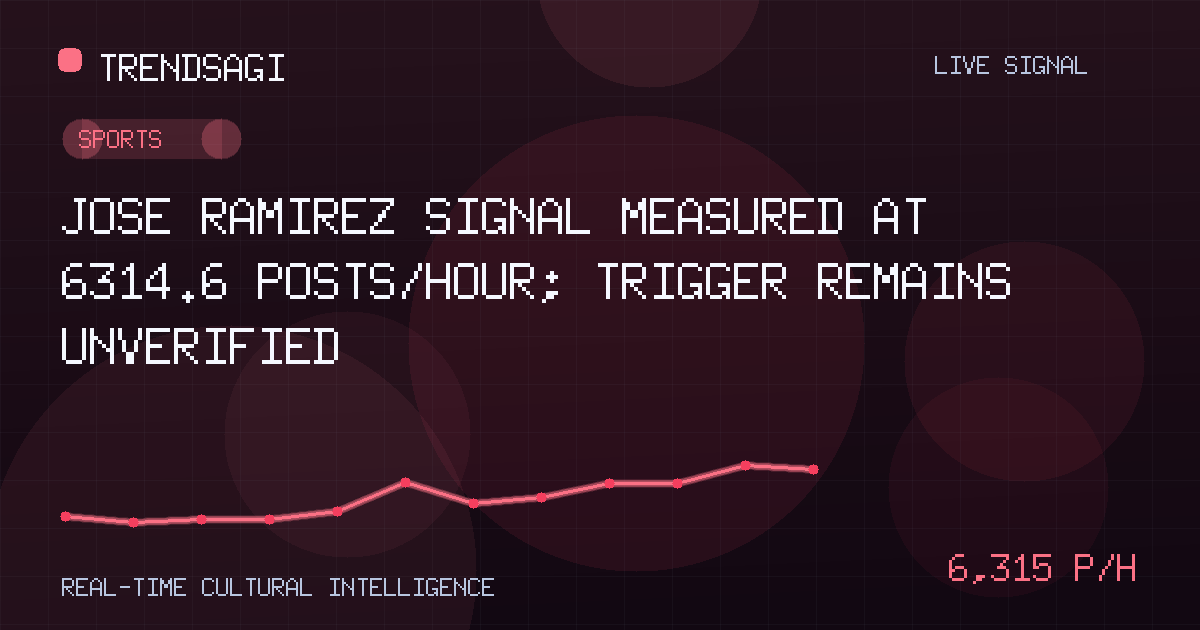
Jose Ramirez signal measured at 6314.6 posts/hour; trigger remains unverified
The Jose Ramirez signal measured 6314.6 posts/hour over 898 seconds; the trigger remains unverified and needs source checks.
Automated briefing. Generated from stored signal measurements and source-backed research; it is not manually reviewed. Read the methodology and limitations.
Metrics in this briefing are a snapshot associated with its publication date and may not reflect current conditions.
What changed
The stored Jose Ramirez signal recorded a concentrated increase in monitored posting activity at the latest observation. The snapshot contained 1714 posts, and the supplied measured change rate was 6314.6 posts/hour across an exact 898-second window. This establishes a short-window change in activity, but not its cause. No verified public context connects the increase to a particular sports event, so the trigger remains unclear.
The rate was calculated from 3 stored observations. It is a measured snapshot rate, not a live or current rate, forecast, reach, engagement figure, or unique-person count. Likewise, 1714 is the volume observed at one timestamp, not a posts-per-hour value. The stored category is Sports, but the record does not establish which Jose Ramirez the label denotes. A name collision, alternate spelling, or mixed set of public figures therefore remains possible.
| Observation time | Measured snapshot rate | Snapshot volume |
|---|---|---|
| 2026-10-07T22:56:37Z | 6314.6 posts/hour | 1714 posts |
What the signal can establish
The defensible conclusion is narrow: within the monitored dataset, posts attributed to this label changed quickly during the sampled interval. That makes the topic worthy of a verification pass. It does not establish that the activity is organic, broad, positive, or important to the person named. Posts can include reactions, quotations, duplicate mentions, automated activity, or discussion of an unrelated event sharing the same name.
The signal also cannot show who started the burst or whether discussion continued after the observation. A measurement based on 3 observations across 898 seconds can reveal a short-window change, but it cannot establish a durable trend, seasonality, or a normal baseline for this topic. Reach and impact would require account-level or audience data that is not present here.
Posting acceleration is evidence that the monitored conversation changed, not evidence of what prompted it. A verified event, not the rate alone, should supply the headline.
Why this topic may be moving
No verified cause can be named from the available evidence. Several explanations remain testable rather than proven:
- A sports event: A game result, selection, injury, roster move, award result, or other development may have prompted reaction. None is attached to this signal.
- A public statement or controversy: Commentary may have accelerated after remarks, reporting, or an exchange.
- Media amplification: A widely shared item may have generated many secondary posts without equivalent original discussion.
- Mechanical activity: Quoting, reposting, automated responses, or duplicate content may account for part of the measured increase.
- Entity mixing: Posts about multiple people named Jose Ramirez may be combined under one label.
Why it matters
For sports editors, the immediate value is triage. A rapid measured snapshot rate can justify checking whether a report, result, or announcement deserves coverage, but the rate alone should not determine the news angle. Editors need a verified event and a clear identity before treating the label as a story.
For fan communities and audiences, the distinction prevents overreaction: a large posting count does not prove a milestone or consensus. For athlete, team, or communications teams, it can still be an early warning to inspect the conversation before responding. For researchers, the record is a prompt to examine origins, not a finished measure of public attention.
What to watch next
Verification should proceed in this order:
- Resolve the identity: Confirm which Jose Ramirez is represented by examining context around the observation time and consistent aliases. Do not assume a sport, team, league, or country from the label alone.
- Find the trigger: Inspect the earliest substantial posts and replies for a shared object, such as an event, claim, result, or official update.
- Test authenticity: Compare account-level samples for original comments, quote posts, duplicates, coordinated repetition, and automated responses.
- Seek corroboration: Look for a credible report, official record, or direct statement that independently supports the proposed explanation.
- Measure persistence: Collect later windows and a longer baseline to determine whether activity remains elevated or quickly subsides.
Concrete warning signs would be a burst dominated by a copied item, rapid repetition of identical text, an unresolved identity split, or no identifiable initiating discussion. Positive confirmation would be diverse original posts converging on the same verified event, followed by credible reporting or an official update.
Methodology and limitations
The supplied evidence consists of a stored topic label, Sports category, latest snapshot volume of 1714, observation time, and the reported rate of 6314.6 posts/hour over 898 seconds using 3 observations. The figure is treated exactly as a measured snapshot rate. No platform-wide denominator, geography, language scope, historical baseline, sentiment distribution, account-level activity, or engagement data is provided, so cross-topic comparisons would be unsafe.
Only 3 stored observations are available. That is enough to calculate the stated short-window change, but not enough to diagnose its composition or persistence. Endpoint placement, a single viral item, duplicate distribution, or automated activity could materially shape the result. The category does not resolve the named person, and no external fact is used to invent a trigger.
Accordingly, this briefing identifies a measured change in the monitored signal while withholding causal interpretation. The next editorial decision should depend on entity resolution, representative post inspection, independent corroboration, and a subsequent measurement—not on the headline rate by itself.
Track This Topic for New Signals
Set alerts for future velocity or sentiment changes around this topic.
Explore Tracking PlansAbout TrendsAGI research
TrendsAGI's automated research pipeline publishes dated signal snapshots, methodology notes, and practical workflows for teams evaluating cultural momentum. Read how signals are scoped, scored, and limited in our research methodology.