916-second window · 3 observations · Measured Sep 24, 2026, 2:11 AM UTC · Provider: go_recent_snapshot_v2
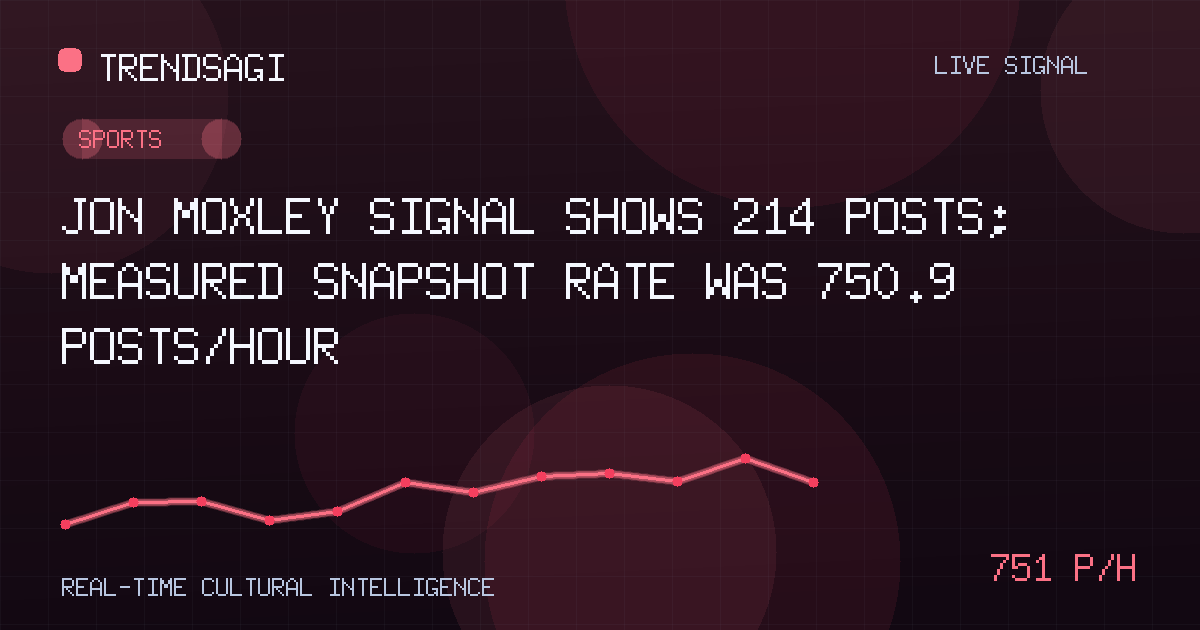
Jon Moxley signal shows 214 posts; measured snapshot rate was 750.9 posts/hour
A recorded Jon Moxley signal shows 214 posts at a 750.9 posts/hour measured rate; readers should verify the cause before treating it as news.
Automated briefing. Generated from stored signal measurements and source-backed research; it is not manually reviewed. Read the methodology and limitations.
Metrics in this briefing are a snapshot associated with its publication date and may not reflect current conditions.
What changed
The latest supplied snapshot, observed at 2026-09-24T02:11:44Z, contains 214 posts associated with Jon Moxley. That establishes a measured change in posting, not a verified news event. The reason for the movement remains unverified: no independently verified public catalyst accompanies the record.
Across an exact 916-second window, 3 stored observations produced a measured change rate of 750.9 posts/hour at the recorded snapshot. This is a measured snapshot rate, not a live or current rate, forecast, reach estimate, engagement measure, or count of unique people. The 214 posts are a separate snapshot volume, not the rate.
| Observation time | Measured snapshot rate | Snapshot volume |
|---|---|---|
| 2026-09-24T02:11:44Z | 750.9 posts/hour | 214 posts |
The rate describes the change between stored observations; it is not a tally for a completed hour. The table preserves the signal's time and counting context rather than presenting the activity as ongoing.
A fast measured rate should accelerate verification, not certainty. Report the observed activity and its limits; do not attach a news explanation until a primary source or attributable report supports one.
Why this topic may be moving
The record classifies the topic as Sports, but its description does not identify a particular event. A category is not evidence that a competition, announcement, result, or controversy caused the activity. The signal also does not establish whether the associated discussion is positive, negative, or mixed.
Several mechanisms could produce a name-centered burst: a new public statement, a scheduled event, resurfaced material, or widespread sharing of one item. Those are hypotheses only. Repetition or tightly synchronized posting could also raise the count without equivalent growth in distinct participants.
To distinguish these possibilities, inspect the posts available around the recorded interval, identify what they reference, and separate original material from quotation and repetition. The snapshot alone does not identify the originating item or show whether independent sources joined the discussion.
Why it matters
Speed changes the order of research, not the standard of proof. The 750.9 posts/hour measured snapshot rate is a reason to investigate promptly; 214 posts by themselves do not establish significance, authenticity, or audience size. A high count of posts is not a high count of people.
This signal is most useful to social-listening teams triaging verification work, media editors seeking a primary source, and readers who follow Jon Moxley and want to distinguish a concrete development from a repetitive burst. It is less useful as evidence of broader public interest because reach, geography, and source diversity are not supplied.
Any coverage should separate what is observed from what is inferred. If public reporting later identifies a catalyst, attribute that explanation to its publisher. Until then, the accurate description is a short-window increase in posting with an unverified cause.
What to watch next
- Trace the origin. Examine posts available near the recorded interval and identify the specific item they reference. Separate the earliest accessible post from later quotations, reactions, and reposts; an early-looking post can still be repeating something older.
- Repeat the measurement. Use a non-overlapping 916-second window with the same coverage and counting rules. Compare the resulting measured rate with 750.9 posts/hour and the new snapshot volume with 214 as reference points, not targets or predictions.
- Check source diversity. Look for distinct originating sources, repeated wording, shared media, and tight posting clusters. Ask whether many posts represent independent discussion or the circulation of one item. The supplied data cannot answer that.
- Test the proposed explanation. Seek a dated primary item or an attributable public report that connects the activity to a defined event. Keep the explanation out of the headline and summary if that connection cannot be verified.
Concrete follow-up signals are a rate that remains elevated in a comparable window, greater spread across distinct sources, and a verified event tied to the timing. A lower comparable rate would show that the initial burst was not maintained; none of these checks, by itself, measures public reach.
Methodology and limitations
The reported 750.9 posts/hour figure comes from 3 stored observations over exactly 916 seconds, measured at 2026-09-24T02:11:44Z. Posts per hour is the unit of the observed change, not a count of what occurred during a full hour. The 214-post figure is the latest snapshot's volume and should not be converted into a different rate.
The record has no independent baseline, longer time series, verified public-context explanation, or measurements of sentiment, location, platform, source credibility, or organic reach. It therefore cannot establish that the activity is historically exceptional, how long it will last, or whether it is organic. Nor can it establish unique-person counts. Record the timestamp, exact window, observation count, and counting definition in any update; do not extrapolate the snapshot into a live trend claim.
With the available evidence, the most accurate conclusion is narrow: 214 posts, a 750.9 posts/hour measured snapshot rate over 916 seconds, and no verified explanation for the change.
Track This Topic for New Signals
Set alerts for future velocity or sentiment changes around this topic.
Explore Tracking PlansAbout TrendsAGI research
TrendsAGI's automated research pipeline publishes dated signal snapshots, methodology notes, and practical workflows for teams evaluating cultural momentum. Read how signals are scoped, scored, and limited in our research methodology.